Standard
How pallets are inspected
A grade only means something if the standard behind it is written down. This is a general description of the checks a recycled pallet should pass, and what to ask any supplier.
Start a quote
Tell us the footprint, grade and volume. A partner supplier follows up with a quote.
Short answer
A well-run recycled pallet inspection covers stringer integrity, deck board condition, fastener condition, dimensional accuracy, moisture, marking legibility and contamination. The inspection determines structural acceptance; grade is then assigned on appearance criteria on top of a pass. Pallets failing a structural check should go to repair, teardown or rejection — never to a lower grade.
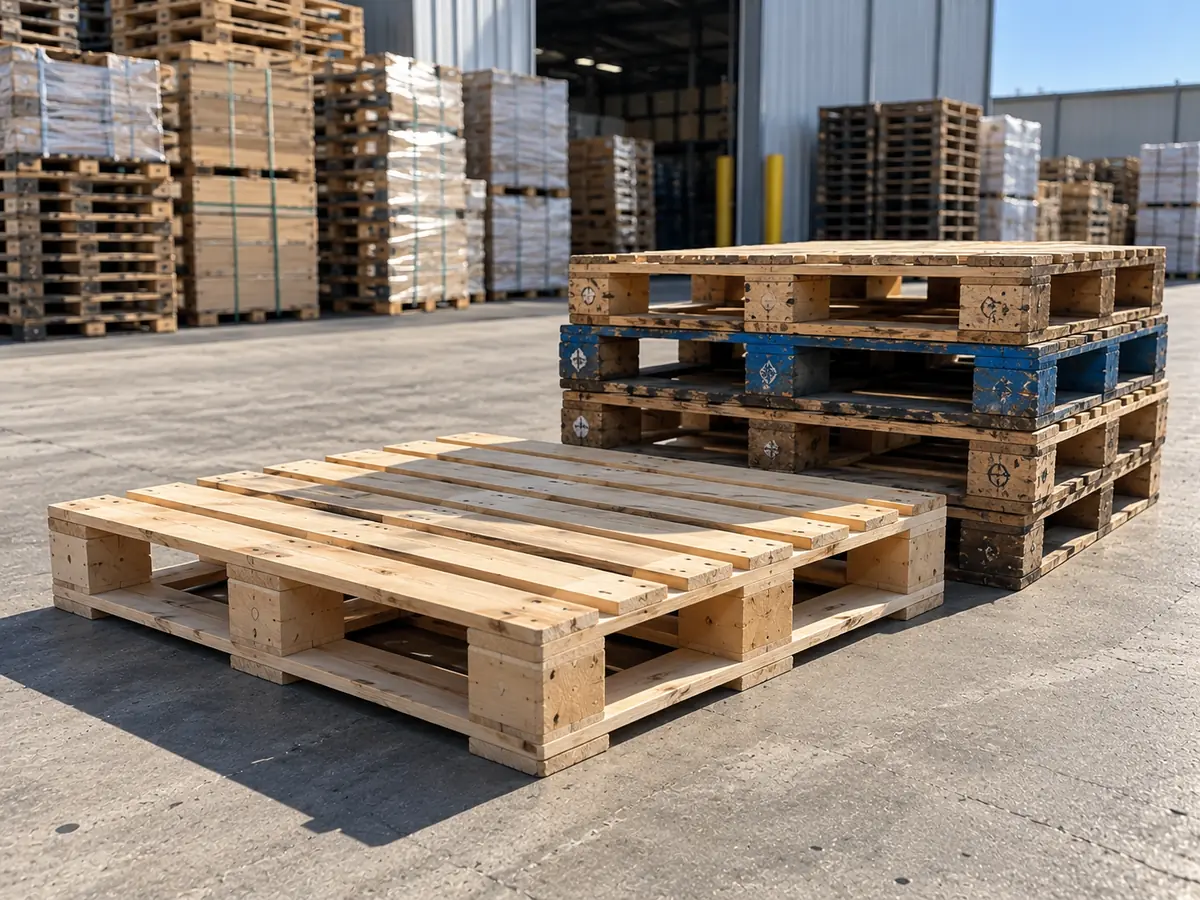
Structure first, grade second
A structural failure never becomes a cheaper pallet. It becomes a repair or a teardown.
Consistency matters
One written standard applied the same way at every position is the entire point.
Ask for it
If you want to hold a supplier to a standard, you should be able to read it.
Stringers or blocks
Through-cracks. Any crack passing fully through a stringer is a structural failure. Repair with a full-length companion stringer, or teardown.
Notch splits. Splitting radiating from a notch corner is the most common stringer failure and the most commonly missed. Inspect by sighting along the stringer face, not by looking at it head-on.
Nail-line splits. Splitting along the line of the deck board nails, usually from drying. Shallow splits pass; splits that have opened enough to reduce fastener holding do not.
Block integrity (block pallets). Crushing, splitting or separation at the block-to-board joint. Blocks are individually replaceable, so this is usually a repair rather than a rejection.
Deck
Board count. Full complement top and bottom. A missing board in the load path is a failure regardless of where it is.
Lead board condition. The outer boards take fork impact. Cracked or missing lead boards should be replaced, because that is where the next failure would be.
Splits and cupping. Boards with through-splits or cupping beyond roughly a quarter inch across the width are replaced.
Board thickness consistency. Mixed thicknesses cause uneven load bearing and height variance. Acceptable within a grade band, not across one.
Fasteners
Protrusion. Any nail standing proud of a deck surface should be driven or replaced. Protruding nails tear product, shred stretch film and cut hands.
Withdrawal. Nails that have backed out reduce joint stiffness long before they look like a problem. Check by flexing the pallet on the bench and listening.
Dimensional
Square. Measured across diagonals. Within 1/4 inch for Grade A, 1/2 inch for Grade B. A racked pallet does not seat properly in a rack bay and will jam automation.
Height and twist. Overall height within 1/4 inch of nominal for Grade A. Twist — the pallet not sitting flat on all four corners — is a rejection at any grade.
Condition
Moisture and biological. Spot-metered. Visibly wet pallets are stacked to dry rather than graded. Any visible mould growth is an immediate rejection, not a repair.
Contamination and marking. Chemical staining, oil, adhesive residue and odour are rejections. The IPPC/ISPM 15 stamp is checked for legibility; illegible stamps on export-destined pallets require re-treatment and re-stamping. A pallet marked MB (methyl bromide) should be kept out of reuse streams.
What happens after the check
A pallet passing the structural checks is graded on appearance: uniform and repair-free is Grade A; sound with visible repairs is Grade B. A pallet failing a structural point or two goes to repair. A pallet failing more than that, or failing on contamination, goes to teardown for component salvage or to recycling.
Nothing should ever be downgraded to cover a structural failure. That distinction is the reason a written standard is worth having.
At a glance
- Areas checkedStringers or blocks, deck, fasteners, dimensions, condition
- Applied toEvery incoming and every repaired pallet
- OutcomeGrade A, Grade B, repair, teardown, or reject
- Ask the supplierFor their inspection criteria in writing
- Partner suppliersEach follows its own inspection process
Next steps
Reference
Reference table
| Check | How it is found | Fails if |
|---|---|---|
| Stringer through-cracks | Sight along the face with light across it | Any crack passing fully through |
| Notch splits | Sight down the stringer from the end | Split radiating from a notch corner |
| Nail-line splits | Visual, both faces | Opened enough to reduce fastener holding |
| Block integrity (block pallets) | Lift and inspect block-to-board joints | Crushing, splitting or separation |
| Deck board count | Count, top and bottom | Any board missing in the load path |
| Lead board condition | Visual and tap | Cracked or missing — should be replaced |
| Splits and cupping | Visual and straight edge | Through-split, or cup beyond ~1/4 in |
| Board thickness consistency | Gauge | Mixed thickness across one deck |
| Fastener protrusion | Gloved hand across both faces | Any nail standing proud |
| Fastener withdrawal | Flex the pallet and listen | Clicking or creaking joints |
| Square | Measure across diagonals | >1/4 in (A) or >1/2 in (B) |
| Height and twist | On a flat bench, press one corner | Opposite corner lifts, or height out of band |
| Moisture and biological | Spot meter, visual | Visible mould — immediate rejection |
| Contamination and marking | Visual and smell | Staining, oil, odour, MB stamp, illegible IPPC |
Applications
Where this gets used
Supplier auditing
Bring this list to any pallet supplier and ask them to produce theirs. The answer tells you a great deal in two minutes.
Internal receiving checks
A short subset — cracks, protruding nails, twist, contamination — takes seconds and catches most of what matters.
Training
A written standard is a training document. New sorters learn from it, qualify against it and are assessed against it.
Dispute resolution
When a load is queried, both sides look at the same checks. Either the pallet meets them or it does not.
Why it is written down
A grade only means something if the standard behind it is written down
There is no enforced national grading standard for recycled pallets in the United States. That single fact underlies everything on this page. 'Grade A' is whatever the supplier selling it decides it is.
What that does to a market
It pushes competition onto price for an undefined product, which is the worst shape a market can take. A buyer comparing quotes cannot tell whether the cheaper supplier is more efficient or simply grades looser — and the loose grader wins the order.
It also makes quality disputes hard to resolve. Without a written standard there is nothing to appeal to; it becomes two opinions and whoever has more leverage wins.
Why suppliers resist writing it down
Publishing removes flexibility: a written standard is one you have to meet on the Friday when supply is short and a load is marginal. It helps competitors, who can copy it. And it invites customers to audit against it.
Why you should ask anyway
Losing the flexibility to grade loosely is not a cost for the buyer — it is the entire value. A standard a supplier can bend is not a standard, it is a preference.
What changes in practice
Quotes get easier — the conversation moves from price to specification. Disputes get shorter. Training gets better. And a supplier says no more often, which is the whole point.
Structure first, grade second
Structural checks decide acceptance. Grade is then assigned on appearance and consistency on top of a pass.
A pallet failing a structural point should never become a cheaper pallet. It goes to a repair bench, to teardown, or to rejection. That distinction is the reason a written standard is worth having.
Process
How it runs, step by step
Ask your supplier for their standard in writing
One question. If the answer is a paragraph of adjectives, you are buying somebody's mood.
Check a sample against it on arrival
Pull a sample from every load and check a few points on each. Cracks, protruding nails, twist, contamination.
Photograph anything that fails
Evidence turns a dispute into a conversation. Report problems promptly.
Ask what the supplier's process looks like
How pallets are sorted, who checks them and what records exist.
Review the standard periodically
A standard that never changes is a standard nobody is using.
Decision rules
If this, then that
- If a supplier cannot produce a written standardThen treat their grade labels as marketing rather than specification.
- If a load fails on structureThen reject it. Structural failures are never a grade question.
- If a load fails on appearance onlyThen decide whether the application actually needs the grade you ordered.
- If you receive pallets from multiple suppliersThen apply one receiving standard to all of them, or the comparison is meaningless.
Avoid
Common mistakes
Grading a wet pallet
Moisture masks defects — a damp stringer sounds different and a wet board looks sound when it is not. Dry it first.
Inspecting the deck and not the stringer face
Notch splits are the dominant structural failure and they are invisible head-on. Sight along the face.
Missing backed-out fasteners
A sixteenth of an inch proud is nearly invisible and means the joint has lost meaningful stiffness. Flex and listen.
Treating a structural failure as a lower grade
It is not a cheaper pallet. It is a repair, a teardown or a rejection.
Terms
Vocabulary for this page
- Bench check
- The per-unit inspection carried out at a sorting position. Every pallet, incoming and repaired.
- Notch split
- A crack radiating from a notch corner. The dominant stringer failure and the most commonly missed.
- Twist
- A pallet that will not sit flat on all four corners. Rejection at every grade.
- Racking (of a pallet)
- Going out of square in plan. Measured across the diagonals.
- Spot metering
- Sampling moisture content with a handheld meter rather than measuring every unit.
- Qualification
- Supervised grading before a sorter works unsupervised. Consistency, not speed, is what is being built.
The wider reference is in the pallet glossary.
Questions
Before you order
Can I audit a supplier's inspection process?
That is between you and the supplier. Partner suppliers in our network run their own processes, so ask about their criteria and what they will allow before you order.
Should inspection be per unit or per load?
Per unit is the stronger approach — every pallet passes a bench. Some suppliers record per-load summaries instead. Ask what records are available.
What proportion of incoming pallets are rejected?
It varies by source. Rejections are usually dominated by contamination rather than damage. Damage is repairable; a chemical spill is not.
How often should a standard change?
Reviewed periodically, with input from customers. A standard that never changes may not be in use.
What proportion of incoming pallets fail outright?
It varies by source. Rejections are usually dominated by contamination rather than damage. Damage is repairable; a chemical spill is not.
Ready to put a number on it?
Send the footprint, the grade and the volume. We'll come back with price per unit and the first window we can hold.