Grade
Remanufactured pallets
Built entirely from parts of other pallets. Typically the lowest-priced structurally sound wooden pallet, a strong reuse story, and honestly not pretty.
Start a quote
Tell us the footprint, grade and volume. A partner supplier follows up with a quote.
Short answer
A remanufactured pallet is assembled from salvaged components — reclaimed deck boards and stringers taken from pallets beyond repair — rather than repaired from a single original pallet. It should be structurally inspected to the same standard as any other grade, typically costs less than Grade B, uses no new lumber, and is visibly mixed in colour and component age.
No new lumber
Reusing components avoids building a new pallet. Used vs new pallets →
Honest about looks
It looks like what it is. If that matters for your application, buy Grade B.
Made from salvage
Availability depends on the salvage a partner supplier has on hand, so ask early.
How a remanufactured pallet is built
Pallets that cannot be repaired go to a dismantler, which shears deck boards off stringers. Sound components are sorted by dimension and condition. A remanufactured pallet is then assembled from that pool: three sound stringers of matching length, top and bottom boards of matching thickness, nailed to a standard pattern on a jig.
The result is a structurally new pallet made entirely of used parts. When components are inspected individually before assembly, that is arguably a more rigorous process than inspecting a whole pallet — you cannot hide a soft stringer inside an assembled pallet when the stringer was handled on its own first.
Where it sits on cost and impact
It is typically the lowest-priced structurally sound wooden pallet, usually below Grade B. It also avoids new lumber, milling and kiln drying. What remains is the transport to collect the source pallets and the energy of the dismantling and nailing lines.
What it looks like
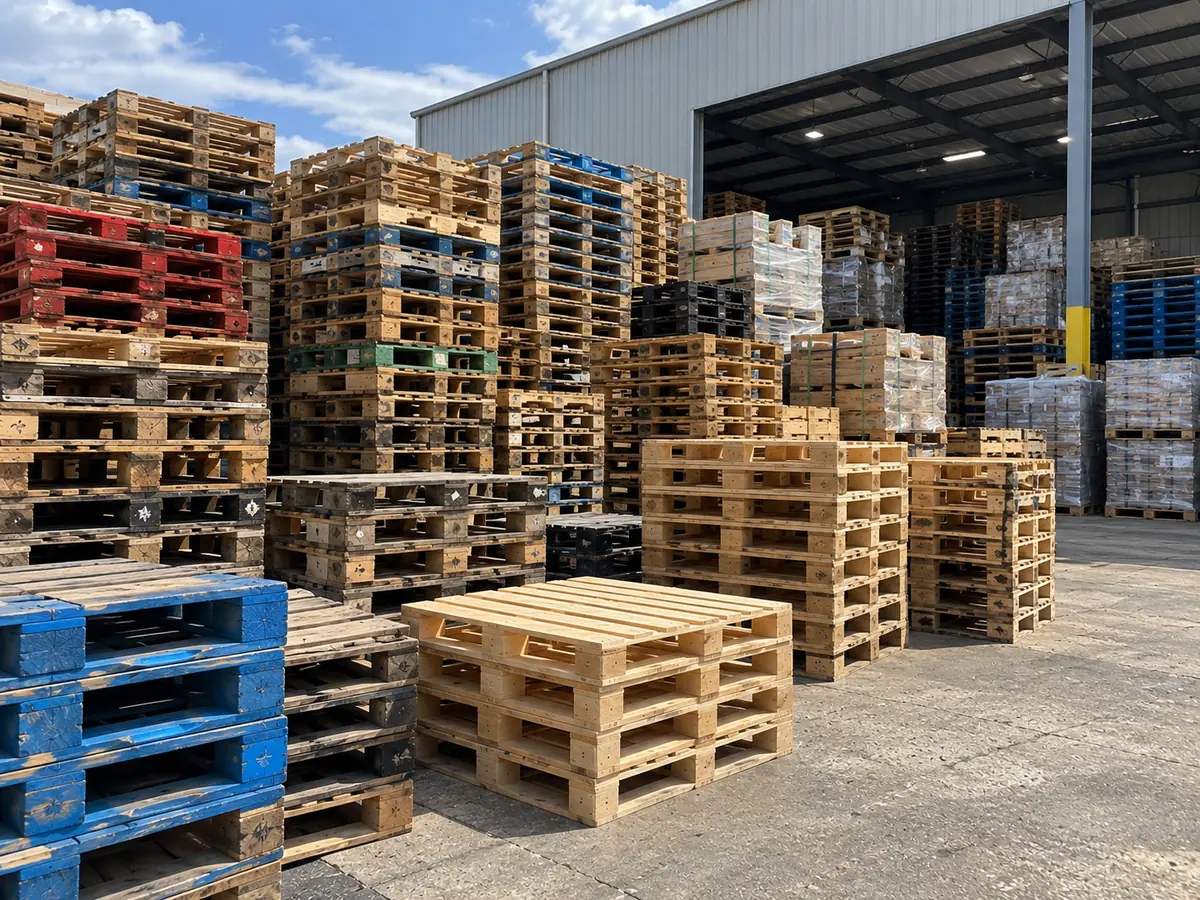
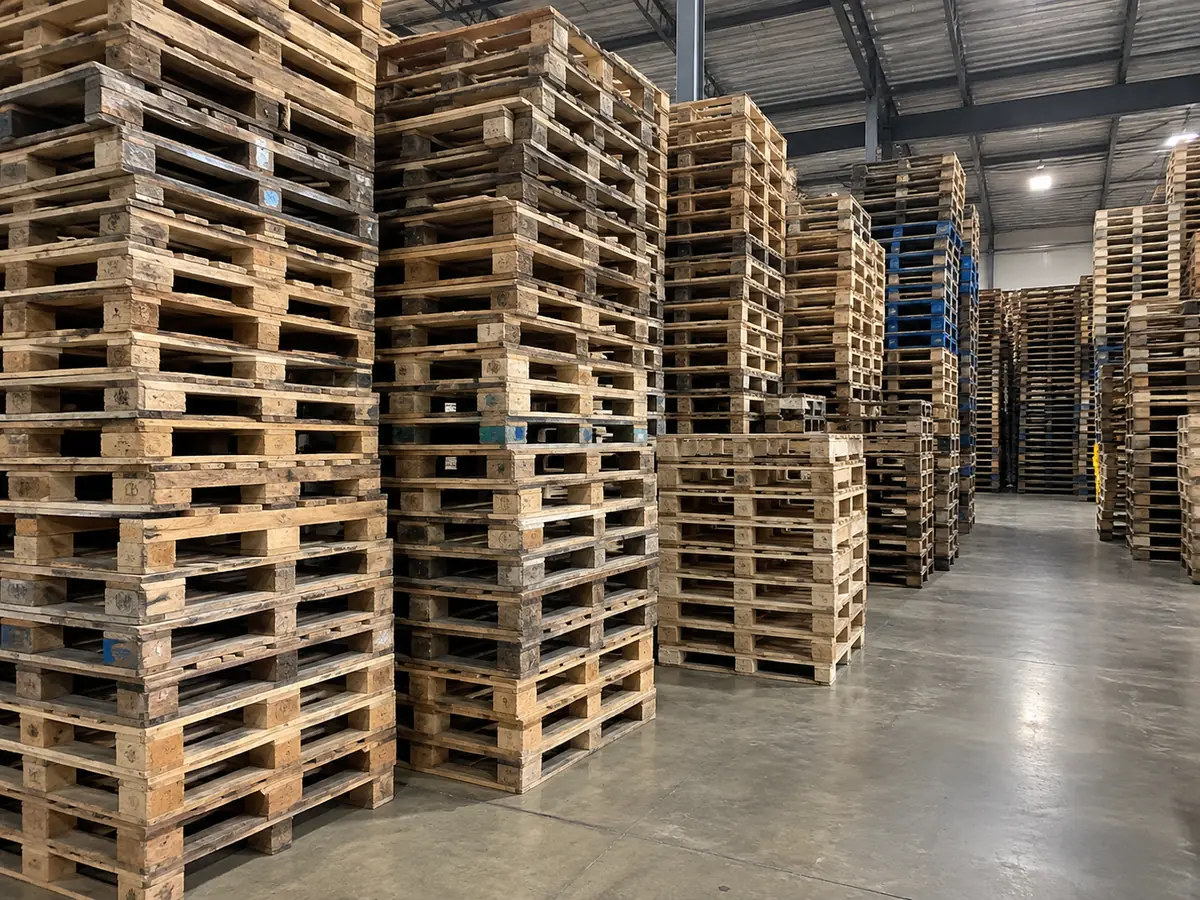
Mixed. Boards from several pallets of different ages, some grey and weathered, some still pink. Stamps that do not match each other. It is honest and it is not attractive, and it is better to say that than have a pallet arrive as a surprise.
If any part of your operation puts pallets in front of a customer, an auditor or a camera, buy Grade B instead. The saving is not worth the conversation.
Performance
A remanufactured 48x40 built to standard pattern can carry standard 48x40 ratings — commonly quoted at roughly 2,500 lb dynamic, 3,000 lb static, 2,000 lb racked unsupported. The same jig, the same nailing pattern and the same inspection standard should apply as for anything else.
The honest caveat is component age. Every board in a remanufactured pallet has already served, so the pallet as a whole has less remaining service life than a new one. For internal loops with predictable handling, that is fine. For a pallet expected to make many long round trips, it is not.
Requesting it
Remanufactured pallets are built from whatever salvage a partner supplier has generated, so supply is not constant. Mention the footprint and quantity in your quote request. Custom footprints are sometimes possible from salvage stock too — see custom pallets.
At a glance
- ConstructionAssembled from salvaged boards and stringers
- AppearanceVisibly mixed colour and component age
- Structural checkSame standard as other grades
- Load ratingRated to construction; typically standard 48x40 figures
- PriceTypically the lowest of the wooden grades
- MaterialNo new lumber
- AvailabilityDepends on partner supplier salvage stock
Next steps
Reference
Reference table
| Option | Relative price | Appearance | Best for |
|---|---|---|---|
| New wooden pallet | Highest | Uniform | Regulated, export one-way, critical automation |
| Grade A recycled | High | Uniform, no repairs | Customer-facing, AS/RS, audited |
| Grade B recycled | Mid | Visible repairs | Internal movement, general freight |
| Remanufactured | Typically lowest wooden option | Visibly mixed | Internal loops, static storage, one-way |
| Reject / core | Raw material value | Broken | Raw material only |
Applications
Where this gets used
Internal transfer loops
Between buildings or between production and staging, where nobody outside sees the pallet.
Static storage
Floor-stacked stock that sits rather than travels. Static rating is the least demanding condition.
Empty-container movement
Totes, bins and returnable packaging going back. Low value load, low value pallet.
Reuse-led programmes
Built entirely from salvaged components, with no new lumber.
How it is built
A structurally new pallet made entirely of used parts
Remanufactured is the step in the cascade between repair and reclaim, and it is the one most buyers have never heard of.
The process
Pallets that cannot be repaired go to a dismantler, which shears deck boards off stringers. Sound components are sorted by dimension and condition into bins.
A remanufactured pallet is then assembled from that pool on a jig: three sound stringers of matching length, top and bottom boards of matching thickness, nailed to standard pattern with helical or screw-shank fasteners.
Why the inspection can be better
When every component is handled and assessed individually before assembly, you cannot hide a soft stringer inside an assembled pallet — the stringer was inspected on its own first.
The finished pallet should then pass the same structural inspection as anything else.
Performance
A remanufactured 48x40 built to standard pattern can carry standard ratings — commonly quoted at roughly 2,500 lb dynamic, 3,000 lb static, 2,000 lb racked unsupported. Same jig, same nailing pattern, same inspection.
The honest caveat is component age. Every board has already served, so the pallet as a whole has less remaining service life than a new one. For internal loops with predictable handling that is fine. For many long round trips it is not.
Impact
No new lumber, no milling, no kiln. What remains is the transport to collect the source pallets and the energy of the dismantling and nailing equipment. Reusing components avoids building a new pallet.
Appearance, stated plainly
Mixed. Boards from several pallets of different ages, some grey and weathered, some still pink. Stamps that do not match each other.
It is honest and it is not attractive. If any part of your operation puts pallets in front of a customer, an auditor or a camera, buy Grade B instead — the saving is not worth the conversation.
Export
Because it is newly assembled, a remanufactured pallet must be treated as a unit after assembly for ISPM 15 compliance. The individual components' treatment history does not carry over, and this catches people out.
Process
How it runs, step by step
Confirm nobody outside sees these pallets
This is the single qualifying question. If the answer is uncertain, buy Grade B.
Ask early
Remanufactured pallets are built from whatever salvage a partner supplier has on hand, so supply is not constant.
Specify footprint and quantity
Custom footprints are sometimes possible from salvage stock.
Say if it is export-bound
Treatment must be applied after assembly; component history does not carry over.
Ask what records are available
If you report on reuse, ask the supplier what documentation it can provide.
Decision rules
If this, then that
- If the load is internal and low valueThen remanufactured is typically the lowest-priced structurally sound wooden option.
- If appearance matters at allThen buy Grade B. The saving is not worth the conversation.
- If reuse is a priorityThen remanufactured uses no new lumber, which is a strong wooden story.
- If the pallet needs many long round tripsThen buy Grade A or new — component age is the real limitation here.
Avoid
Common mistakes
Confusing remanufactured with recycled
A recycled pallet is an original pallet inspected and possibly repaired. A remanufactured pallet is newly assembled from parts of several.
Assuming component treatment carries over
For ISPM 15, the assembled pallet must be treated as a unit. Component history is irrelevant.
Expecting constant availability
It is made from salvage. Supply depends on what the partner supplier has on hand.
Using it where appearance matters
It looks exactly like what it is. That is the trade you are making.
Terms
Vocabulary for this page
- Remanufactured
- A pallet newly assembled from components salvaged out of several other pallets.
- Dismantler
- The machine that shears deck boards off stringers, breaking nail joints rather than boards.
- Component sort
- Grading salvaged boards and stringers individually by dimension and condition before assembly.
- Salvage yield
- The proportion of a torn-down pallet that is sound enough to reuse. Varies with the source pallets and the method.
- Standard pattern
- The nailing and board layout for a given footprint, applied on a jig so every unit is identical.
- Component age
- The service history already carried by each salvaged part. The genuine limitation on remanufactured service life.
The wider reference is in the pallet glossary.
Questions
Before you order
Is remanufactured the same as recycled?
No. A recycled pallet is an original pallet that has been inspected and possibly repaired. A remanufactured pallet is newly assembled from components salvaged out of several different pallets.
How much cheaper is remanufactured?
It is typically priced below Grade B and is usually the lowest-priced structurally sound wooden option. Partner suppliers quote on request.
Can remanufactured pallets be heat treated?
Yes. Because they are newly assembled, they must be treated as a unit after assembly for ISPM 15 compliance — the individual components' treatment history does not carry over. More on ISPM 15 →
Can remanufactured pallets be racked?
Yes, to the same rating as any pallet of that construction — commonly around 2,000 lb unsupported on a 48x40. Fit wire decking for heavy loads regardless of grade.
Can custom footprints be remanufactured?
Sometimes, from salvage stock, subject to component availability in the required dimensions. Lead time is usually longer than for a standard footprint.
Is remanufactured the same as 'combo'?
No. A combo load is a blend of Grade A and Grade B pallets. Remanufactured is a construction method, not a mix.
Ready to put a number on it?
Send the footprint, the grade and the volume. We'll come back with price per unit and the first window we can hold.