Free quote request · No obligation
Those pallets are worth money
Used pallets often have a market value, yet many sites pay a waste hauler to take them away. Send a count and four photographs and a partner supplier in our network follows up with a quote.
Get a price for your pallets
Quantity, footprint and postcode is enough to start. Put the condition in the Message field.
Short answer
RePallet Market is a referral service. Send a count and photographs of the pallets you want to sell and we pass the request to partner suppliers; a supplier follows up with a quote, and any collection and payment terms are agreed with them. Availability depends on partner suppliers near you. Pooled pallets such as CHEP and PECO cannot be bought or sold.
What it is worth
What affects a quote
Sorting is the single biggest lever available to you, and it costs an hour of one person’s time. The full list of what raises and lowers a price is in the selling playbook.
Free quote request
Send a count and four photographs.
A partner supplier follows up with a quote and the terms for collection.
The process
Five steps, from request to payment
Send a count and four photographs
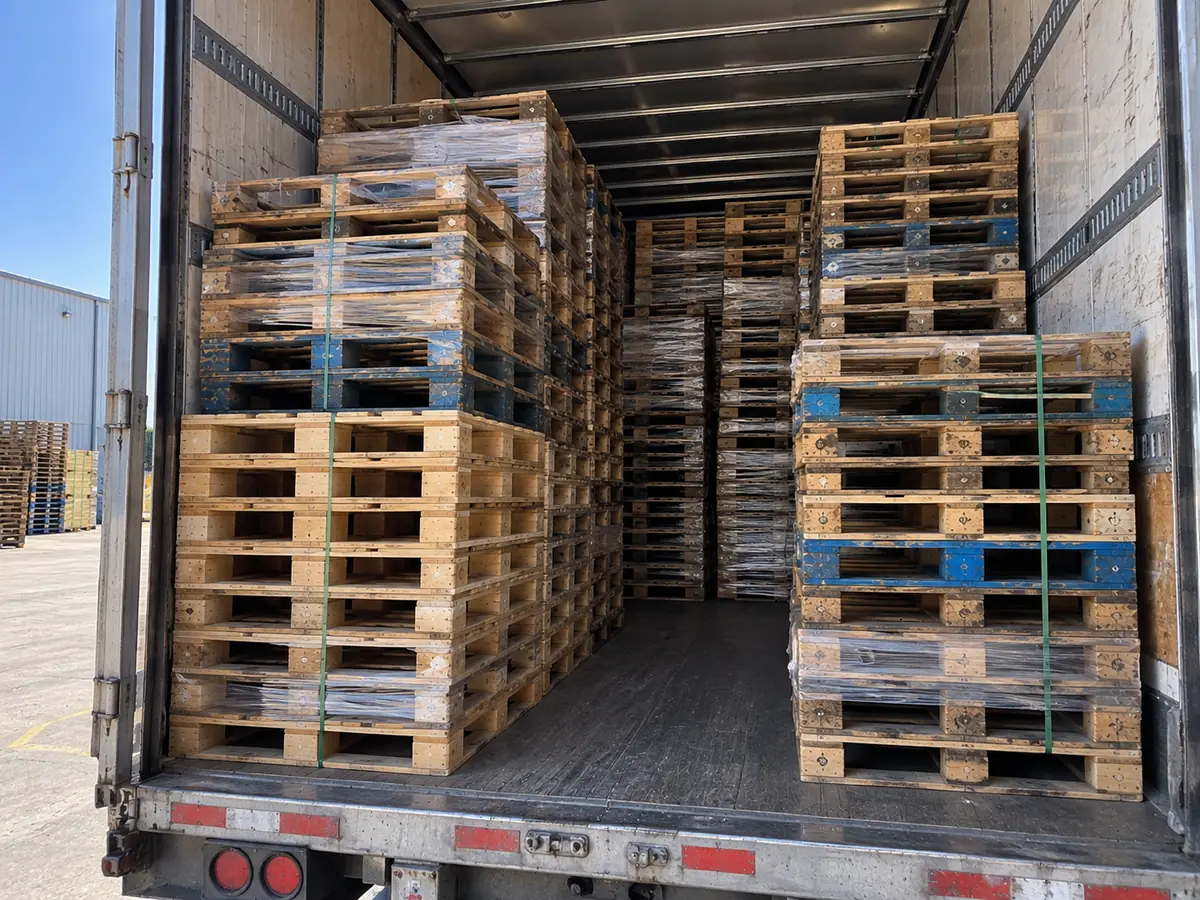
Stack from the front, stack from the side, one typical pallet close up, and the dock or gate the truck will use. That last one prevents most failed collections.
A partner supplier quotes — before anything moves
Typically a per-core price for sorted reusable stock, or a lot price for mixed loads. Ask for collection and payment terms in writing before agreeing.
You accept and schedule
Timing is agreed with the supplier and depends on where you are. Check your area →
The supplier collects and weighs
Collection is arranged by the supplier. Where loads are sold by weight, ask for a weigh ticket showing gross, tare and net.
Payment, as agreed with the supplier
Payment terms are agreed with the partner supplier. If you track waste for reporting, ask what records the supplier can provide. See pallet reuse for context.
What gets quoted
And what suppliers generally cannot take
Partner suppliers commonly buy
- 48x40 GMA in any condition — reusable cores command the most
- All standard footprints: 42x42, 48x48, 36x36, 40x48 and more
- Odd and custom footprints, quoted as a lot
- Broken and teardown-grade pallets
- Pallet collars, crates, boxes and solid wood dunnage
- Plastic pallets, including cracked and retired stock
- Clean untreated wood waste from manufacturing
Usually not accepted
- Pooled pallets — CHEP, PECO, iGPS and similar. They are not yours to sell.
- MB-stamped pallets (methyl bromide fumigated)
- Chemically contaminated, oil-saturated or spill-exposed pallets
- Pallets with visible mould growth
- Flood-exposed pallets that have stood in water
- Pressure-treated lumber (CCA, ACQ), particleboard, MDF, coated wood
Acceptance varies by supplier. If you are not sure which category something falls into, send a photograph with the request.
Recurring volume?
A standing route can price better than one-off collections and removes scheduling effort. If you generate pallets every week, say so in the request.
FAQ
Selling questions
How much will I be paid for my pallets?
It depends on footprint, condition, volume and location. Reusable 48x40 GMA cores generally command the most; other standard footprints less; mixed or damaged loads are usually quoted as a lot. Core values move with market supply, so pricing comes from the partner supplier’s quote rather than a published list that would be wrong within a month. Whether a load is paid for, collected for free or carries a fee is the supplier’s call.
Do I need a minimum quantity?
Minimums depend on the partner supplier and on how far the truck has to travel. A dedicated collection generally needs a meaningful load; smaller quantities may be handled differently. Put your count in the request and the supplier will say what works.
What if my pallets are broken?
Say so in the request. Broken pallets are raw material for reclaimed lumber, remanufacture and mulch. They are usually worth less than reusable cores, but there are better places for them than a dumpster.
Can I sell CHEP, PECO or other pooled pallets?
No. Pooled pallets remain the property of the pooling company and are not yours to sell. Set them aside and arrange collection with the pooler. Any legitimate buyer will refuse them — and a buyer who does not refuse them is telling you something about how they operate.
Will I be charged for removal?
That is set by the partner supplier and depends on the load. Sorted, reusable stock with easy access is the most likely to be collected on good terms. Loads that are mostly broken, wet or contaminated, or that need special equipment, are the most likely to carry a fee. Ask for the terms in writing before agreeing to a collection.
Valuation
How each thing on your dock tends to be valued
| Item | Condition | Relative value | What a supplier may do with it |
|---|---|---|---|
| 48x40 GMA | Reusable, sound | Highest | Graded and resold |
| 48x40 GMA | One or two repairs needed | High | Repair bench, resold as Grade B |
| 48x40 GMA | Broken beyond repair | Low | Teardown for components and reclaimed lumber |
| Other standard footprints | Reusable | Medium–high | Graded and resold; thinner market |
| Odd and custom footprints | Any | Quoted as a lot | Teardown or resale if a buyer exists |
| Block / EPAL pallets | Reusable | High | Graded; export market |
| Plastic pallets | Sound | Medium–high | Graded and resold |
| Plastic pallets | Cracked, retired | Scrap value | Granulated as regrind |
| Collars, crates, boxes | Sound | Medium | Repaired and resold |
| Solid wood dunnage & blocking | Any | Low–medium | Reclaim stream |
| Clean untreated wood waste | Any | Low | Grind to mulch and biomass |
| Pooled pallets (CHEP/PECO/iGPS) | Any | Not purchasable | Return to the pooling company |
Decision rules
What to do with what you have
- If you have 100 or more palletsThen request a quote for a dedicated collection. Sorted and dry loads price better.
- If you have a small number of palletsThen say so in the request; a supplier may suggest another option.
- If the load is genuinely mixedThen ask for a lot price rather than a per-unit rate. It is the honest way to quote it.
- If the pallets have been rained onThen say so. A wet load is still worth buying; a wet load quoted as dry damages a relationship.
- If you generate this volume every weekThen ask about a standing route — better pricing and scheduling disappears.
- If you find blue, red or black pooled palletsThen set them aside and contact the pooler. They are not yours to sell.
Avoid
Six ways to leave money on the dock
Mixing footprints
Lowers the offer because the sorting labour moves from your dock to the supplier. Sorting is an hour or two of work for a mid-sized load.
Storing outdoors
Wet pallets weigh noticeably more, are worth less, and some will have mould by the time they dry.
Banding the stacks
Banding has to be cut before loading, which costs time and risks damage. That time can come out of what you are offered.
Estimating the count
The most common cause of a disputed invoice in this industry, and ten minutes of counting avoids it entirely.
Photographing your best pallet
The quote is issued against it and may be revised on inspection, which is a worse conversation than an accurate quote.
Waiting until the pile is a problem
A planned collection generally prices better than an urgent one.
Terms
Words you will hear on a sale
- Core
- A used pallet bought for reprocessing. Reusable 48x40 cores command the highest price.
- Lot price
- A single price for a mixed load rather than a per-unit rate.
- Per-core price
- A unit rate paid for reusable pallets, quoted from photographs and a count.
- Weigh ticket
- The weighbridge record for a load — gross, tare and net weight.
- Standing route
- A recurring scheduled collection. Often prices better than one-off trips.
- Trailer swap
- A 53-foot trailer left on site, loaded by your crew, exchanged when full.
- Pooled pallet
- A rental pallet belonging to CHEP, PECO, iGPS or similar. Never yours to sell.
Keep reading
Before you send a request
Send a count and four photos.
Free and with no obligation. A partner supplier follows up with a quote.