Reference
The pallet size chart
Over forty footprints in inches and millimetres, with construction, entry type and what each one is typically used for. Filter by region below.
Need a size that is not listed?
Send the dimensions and the load in a free, no-obligation quote request. A partner supplier in our network follows up.
Short answer
The standard North American pallet is 48 x 40 inches (1219 x 1016 mm), known as the GMA pallet. The standard European pallet is 1200 x 800 mm (47.2 x 31.5 inches), known as the EUR or EPAL pallet. ISO 6780 recognises six footprints in total, none of which is globally dominant. Pallet dimensions are always written length first, and on a stringer pallet the length is the direction the stringers run.
The chart
Over forty footprints, four groups
| Name | Inches | Millimetres | Entry | Construction | Typical use |
|---|---|---|---|---|---|
| 48 x 40 GMA | 48" x 40" | 1219 x 1016 | 4-way notched | Stringer | Grocery, general freight — the North American default |
| 42 x 42 | 42" x 42" | 1067 x 1067 | 4-way | Stringer / block | Telecom, paint, beverage |
| 48 x 48 | 48" x 48" | 1219 x 1219 | 4-way | Stringer, heavy | 55-gallon drums, four per pallet |
| 40 x 48 | 40" x 48" | 1016 x 1219 | 4-way notched | Stringer | GMA turned 90°, used for rack-depth loading |
| 48 x 42 | 48" x 42" | 1219 x 1067 | 4-way | Stringer | Chemical, packaged paper |
| 40 x 40 | 40" x 40" | 1016 x 1016 | 4-way | Stringer | Dairy, beverage crates |
| 48 x 45 | 48" x 45" | 1219 x 1143 | 4-way | Stringer | Automotive components |
| 44 x 44 | 44" x 44" | 1118 x 1118 | 4-way | Stringer | Drums, chemical intermediate |
| 36 x 36 | 36" x 36" | 914 x 914 | 4-way | Stringer | Beverage, small-format retail |
| 48 x 36 | 48" x 36" | 1219 x 914 | 4-way | Stringer | Beverage, shingles, packaged paper |
| 40 x 32 | 40" x 32" | 1016 x 813 | 2-way | Stringer | Retail display base |
| 48 x 20 | 48" x 20" | 1219 x 508 | 2-way | Stringer | Half pallet, in-aisle retail display |
| 36 x 48 | 36" x 48" | 914 x 1219 | 4-way | Stringer | Distribution, sheet goods |
| 35 x 45.5 | 35" x 45.5" | 889 x 1156 | 4-way | Stringer | Half-size specialty footprint |
| 60 x 48 | 60" x 48" | 1524 x 1219 | 4-way | Block, heavy | Cable reels, oversized equipment |
| 66 x 42 | 66" x 42" | 1676 x 1067 | 2-way | Stringer, heavy | Long goods, pipe, extrusions |
| Name | Inches | Millimetres | Entry | Construction | Typical use |
|---|---|---|---|---|---|
| EUR / EPAL 1 | 47.2" x 31.5" | 1200 x 800 | 4-way | Block, 9 blocks | The European standard — stamped EUR/EPAL |
| EUR 2 / EPAL 2 | 47.2" x 39.4" | 1200 x 1000 | 4-way | Block | Industrial, chemical, wider loads |
| EUR 3 / EPAL 3 | 39.4" x 47.2" | 1000 x 1200 | 4-way | Block | Heavy industrial |
| EUR 6 / EPAL 6 | 31.5" x 23.6" | 800 x 600 | 4-way | Block | Half Euro — display and retail |
| Quarter Euro | 23.6" x 15.7" | 600 x 400 | 4-way | Block | Display and point-of-sale |
| CP1 | 39.4" x 47.2" | 1000 x 1200 | 4-way | Stringer, 3 runners | Chemical industry standard |
| CP2 | 31.5" x 47.2" | 800 x 1200 | 4-way | Stringer | Chemical industry |
| CP3 | 44.9" x 44.9" | 1140 x 1140 | 4-way | Stringer | Chemical, drum loads |
| CP4 | 43.3" x 51.2" | 1100 x 1300 | 4-way | Stringer | Chemical, tall loads |
| CP5 | 29.9" x 44.9" | 760 x 1140 | 4-way | Stringer | Chemical, narrow |
| CP6 | 47.2" x 39.4" | 1200 x 1000 | 4-way | Stringer | Chemical, general |
| CP7 | 51.2" x 43.3" | 1300 x 1100 | 4-way | Stringer | Chemical, heavy |
| CP8 | 44.9" x 44.9" | 1140 x 1140 | 4-way | Block | Chemical, drum loads |
| CP9 | 44.9" x 44.9" | 1140 x 1140 | 4-way | Block | Chemical, drum loads |
| Name | Inches | Millimetres | Entry | Construction | Typical use |
|---|---|---|---|---|---|
| ISO 1 — 1219 x 1016 | 48" x 40" | 1219 x 1016 | 4-way | Stringer | North America |
| ISO 2 — 1000 x 1200 | 39.4" x 47.2" | 1000 x 1200 | 4-way | Block | Europe, Asia |
| ISO 3 — 1165 x 1165 | 45.9" x 45.9" | 1165 x 1165 | 4-way | Block | Australia |
| ISO 4 — 1067 x 1067 | 42" x 42" | 1067 x 1067 | 4-way | Stringer / block | North America, Europe, Asia |
| ISO 5 — 1100 x 1100 | 43.3" x 43.3" | 1100 x 1100 | 4-way | Block | Asia |
| ISO 6 — 800 x 1200 | 31.5" x 47.2" | 800 x 1200 | 4-way | Block | Europe |
| Name | Inches | Millimetres | Entry | Construction | Typical use |
|---|---|---|---|---|---|
| Drum pallet 4-drum | 48" x 48" | 1219 x 1219 | 4-way | Block, reinforced | Four 55-gal drums per pallet |
| Display quarter | 20" x 16" | 508 x 406 | 4-way | Block | Point-of-sale display |
| Display half | 40" x 24" | 1016 x 610 | 4-way | Block | In-aisle retail display |
| Nestable plastic | 48" x 40" | 1219 x 1016 | 4-way | Moulded HDPE | One-way and return-nested transport |
| Rackable plastic | 48" x 40" | 1219 x 1016 | 4-way | HDPE with steel rod | Edge-racked closed loops |
| Machine skid | Made to order | Made to order | 2-way | 4x4 runners, no bottom deck | Machinery, castings, transformers |
| Pinwheel / slip sheet | 48" x 40" | 1219 x 1016 | Push-pull | Kraft or HDPE sheet | Container floor-loading without a pallet |
Construction
Stringer or block — the difference that decides everything
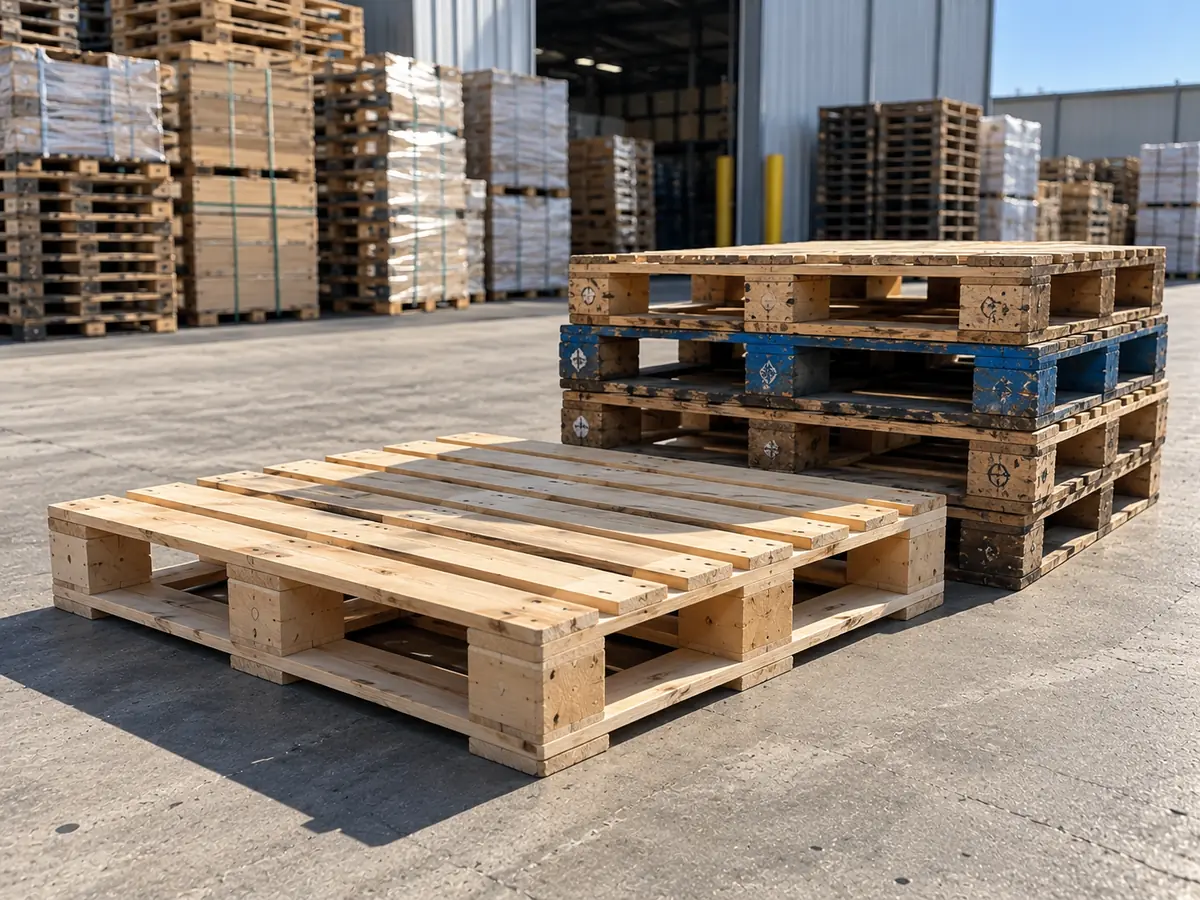
Footprint is only half a specification. Construction determines whether a pallet jack can enter from the side, how the pallet fails under load, and how cheaply it can be repaired.
Go deeper
Size guides
Reference pages covering the footprints and specifications people ask about most.
The 48x40 GMA pallet
Full specification for the 48x40 GMA pallet: dimensions, deck layout, stringer sizing, commonly quoted load ratings and weight, and how to request used ones.
Open →The Euro pallet (EPAL, 1200 x 800)
The EUR/EPAL 1200x800 pallet explained: dimensions, nine-block build, the marks, spotting a counterfeit, and how it compares to 48x40 GMA.
Open →Block vs stringer pallets
Block and stringer pallets compared: true four-way vs notched entry, load behaviour, cost, repairability and which suits your operation.
Open →Pallet load capacity guide
How pallet load ratings work: static vs dynamic vs racking capacity, why racking is lowest, how span matters and what recycled pallets carry.
Open →ISO standard pallet sizes
The six pallet footprints recognised by ISO 6780, where each is used, how they fit shipping containers and how to choose one for export.
Open →Custom & odd pallet sizes
How to specify a custom pallet size: the seven questions, overhang, rack and trailer fit, and what to send a supplier to get an accurate quote.
Open →Getting it right
Three common specification errors
Dimensions written the wrong way round
40x48 is not 48x40. On a stringer pallet the first number is the stringer direction, which determines which faces have true fork openings. Getting this wrong means forks cannot enter from the face your operators use.
“Four-way” assumed to mean pallet-jack access
A notched stringer pallet is four-way for forklifts and two-way for pallet jacks. If your operation runs manual jacks and needs side entry, you need block construction, not notches.
Load rating read as one number
Static, dynamic and racking capacities are three different figures, and racking is usually far below static. Racking a pallet at its static rating is how rack-level failures happen. Load capacity guide →
FAQ
Common size questions
What is the standard pallet size in the United States?
48 x 40 inches (1219 x 1016 mm) — the GMA pallet. It is the most widely used pallet in North America, and the dimension comes from trailer width: two 48-inch pallets side by side is 96 inches inside a trailer roughly 98–100 inches wide. Full specification →
How do you write pallet dimensions correctly?
Length first, then width. For a stringer pallet, length is the direction the stringers run. A 48x40 pallet has 48-inch stringers and 40-inch deck boards. Writing it as 40x48 specifies a different pallet with forks entering a different face — one of the most common and most expensive specification errors in the industry.
What is the standard pallet size in Europe?
1200 x 800 mm (47.2 x 31.5 inches) — the EUR/EPAL pallet. It is block-built on nine blocks with eleven boards and 78 nails in specified positions. Full specification →
How tall is a standard pallet?
A 48x40 GMA pallet is 5.5 inches nominal — 5/8 inch top deck, 3.5 inch stringer, 5/8 inch bottom deck, plus tolerance. A Euro pallet is 144 mm (5.67 inches). Height variance beyond about a quarter inch causes problems in automated storage and retrieval systems.
Send dimensions and a load.
Request a free, no-obligation quote. A partner supplier in our network follows up on whether a standard footprint solves it or a custom build is needed.