Product
Custom-built pallets
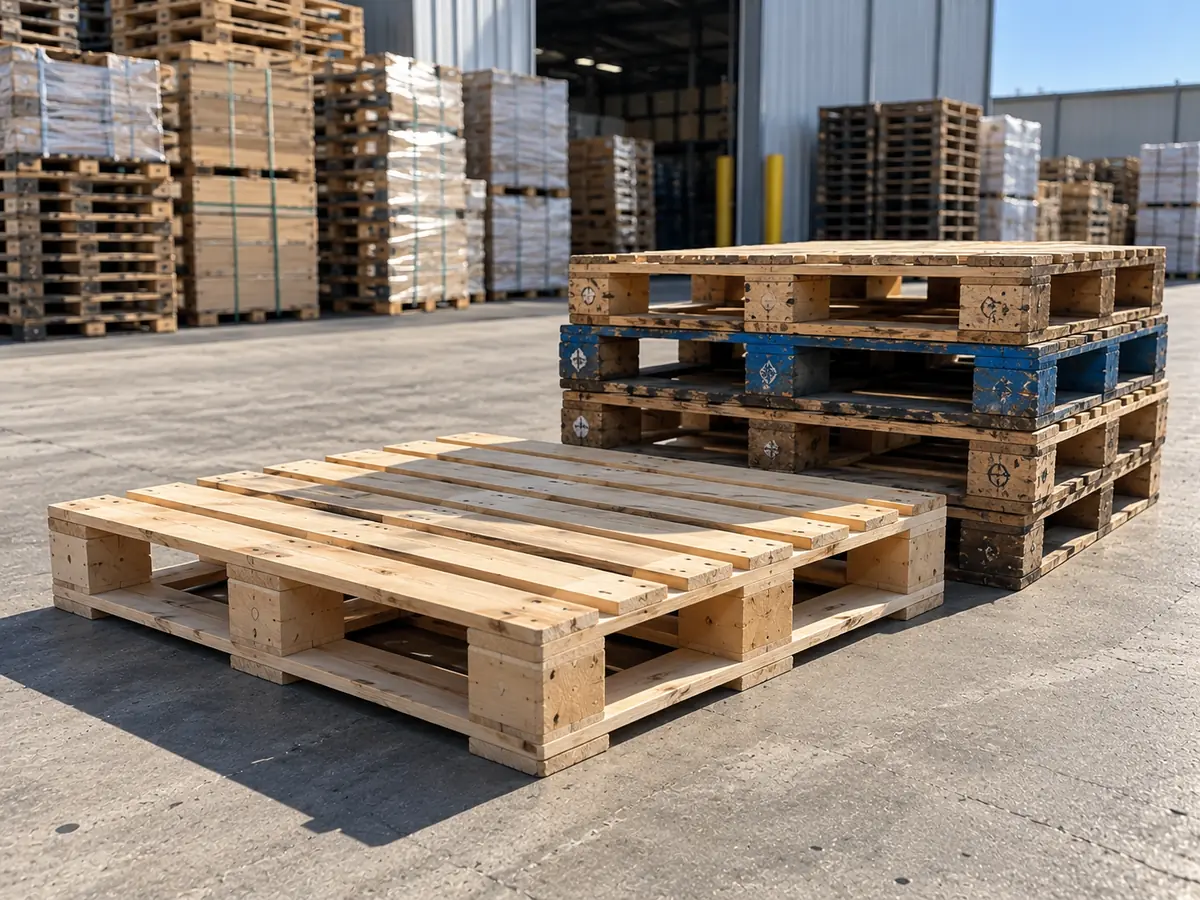
Most pallets are a compromise between what the load needs and what the market stocks. Custom removes the compromise — and, built from reclaimed deck boards and stringers, it can cost less than people expect.
Start a quote
Tell us the footprint, grade and volume. A partner supplier follows up with a quote.
Short answer
Custom pallets are built to a specific footprint, deck configuration and load rating rather than to a market standard. Partner suppliers can build them from reclaimed or new lumber for applications including machine bases, oversized equipment, non-standard rack profiles and export crating bases. Run sizes, lead times and pricing come from the supplier's quote.
First article
On any sizeable run, ask for one built unit to load-test before the full order is built.
Reclaimed where possible
Custom does not have to mean new lumber. Many custom runs can use reclaimed stock.
Drawing optional
A photo, a sketch, or a physical sample of the thing you are trying to ship is usually enough to start a quote.
The three reasons people go custom
The load is the wrong shape. A 96-inch motor housing on a 48-inch pallet overhangs by four feet on each side, and overhang is where damage happens. A purpose-built base costs less than one damaged unit.
The rack is the wrong shape. Older racking, drive-in systems and some AS/RS installations have clearances that standard pallets simply do not respect. Two inches of width can be the difference between a system that runs and a system that jams.
The load is heavier than the pallet. Standard 48x40 stringer construction is commonly quoted around 2,500 lb dynamic, though this varies. Machine tooling, castings, transformers and stone go well past that. Those loads call for doubled stringers, full-perimeter bases and, when it matters, engineered deck schedules.
How a custom job typically runs
- Brief — you send dimensions, weight, entry requirement and destination. Or you send the thing itself.
- Spec and price — the supplier comes back with a spec, a drawing and a price, often at two or three quantity breaks.
- First article — a single unit is built and shipped. You load it, rack it, and report what is wrong with it.
- Production — the full run is built, stamped, banded and dispatched.
Rush work is sometimes possible when the supplier already has the lumber. It usually costs more; ask before you commit.
Design choices that matter more than people think
Fastener selection. Helical and screw-shank nails hold substantially more withdrawal resistance than smooth-shank. On a pallet that will be handled many times, this is the single highest-leverage decision in the whole spec.
Deck board spacing. Wider gaps save lumber and weight, but every extra inch of unsupported span is a place a small carton falls through. For mixed-case loads, 3-inch maximum gaps are the practical limit.
Stringer notch depth. Deep notches make four-way entry easier and make the stringer weaker at exactly the point where it carries most. A 1-1/2 inch nominal notch is common unless the application forces otherwise.
Chamfered bottom boards. A little extra work per pallet that prevents years of pallet-jack damage. Worth asking for on anything that will see manual handling.
Export and oversize
Custom bases going overseas need ISPM 15 heat treatment like any other solid wood packaging; ask the partner supplier for treatment documentation. For oversized equipment, the base can sit under a full crate — see crates, boxes and skids.
At a glance
- Run sizeSet by the partner supplier; say your quantity on the request
- FootprintLarge and odd footprints possible; ask the supplier about maximum size
- Load ratingsEngineered builds possible on request
- Lead timeSet by the partner supplier
- SampleAsk whether a first-article sample before a full run is available
- MarkingStencil, branding iron, colour band, IPPC stamp
- Repeat ordersAsk whether a supplier keeps the jig for repeat orders
- Rush workSometimes possible when lumber and jig exist
- DrawingOptional — a physical sample is better
Next steps
Reference
Reference table
| Material | Run size | Relative unit cost | Typical application |
|---|---|---|---|
| Reclaimed lumber | Small | Highest of the reclaimed options | Odd footprints, low volume, internal use |
| Reclaimed lumber | Medium | Moderate premium | Standing requirement, repeat orders |
| Reclaimed lumber | Large | Smaller premium | Programme volume, held jig |
| New lumber | Medium | Higher | Regulated, export, dimensionally critical |
| New lumber, engineered | Any | Highest | Heavy point loads, documented calculation |
| Rush, any material | Any | Adds a premium | When the jig and the lumber already exist |
Applications
Where this gets used
Oversized equipment
A 96-inch housing on a 48-inch pallet overhangs four feet each side, and overhang is where damage happens. A purpose-built base costs less than one damaged unit.
Legacy racking
Older racking, drive-in systems and some AS/RS have clearances no standard pallet respects. Two inches of width decides whether a system runs or jams.
Heavy point loads
Machine tooling, castings, transformers and stone go well past commonly quoted standard ratings. Doubled stringers, full-perimeter bases, engineered deck schedules.
Branded assets
Stencilled and colour-banded pallets worth retrieving from third-party sites rather than replacing.
Display and retail
Half and quarter footprints built to a merchandising drawing, in matched appearance stock.
Export bases
Any footprint, heat treated and stamped by a supplier with a program, frequently as the base of a full crate.
Engineering
The design choices that decide whether it survives
Custom pallets are not difficult to build. They are easy to specify badly, and the failures are usually in the same four places.
Fastener selection
Helical and screw-shank nails hold substantially more withdrawal resistance than smooth-shank in softwood. Since pallets overwhelmingly fail at joints rather than in members, this is the highest-leverage line on the whole specification and it costs very little per pallet.
On anything expected to make more than a handful of trips, deformed shank is not optional.
Deck board spacing
Wider gaps save lumber and weight. Every extra inch of unsupported span is also somewhere a small carton falls through or sags into. Three inches maximum for mixed-case loads; for a single heavy item, gaps barely matter.
If you are unsure, send a photograph of the load on your current pallet. The sag pattern tells a builder the answer immediately.
Stringer notch depth
Deep notches make four-way entry easier and make the stringer weaker at exactly the point where bending stress peaks. A 1-1/2 inch nominal notch is common unless the application forces otherwise, and a good builder will tell you when a requested notch depth is going to cause cracking.
Chamfered bottom boards
A little extra work per pallet that prevents years of pallet-jack damage. Worth specifying on anything that will see manual handling; it is a common omission on drawings.
Racking is the constraint people forget
A pallet spanning two rack beams with nothing underneath is a beam in bending, and racking capacity is typically far below static. Concentrated loads sharply increase the bending moment of the same weight spread evenly.
Tell the supplier if the pallet will be racked, what it will carry, and what the beam span is. If the load is heavy, either fit wire decking or have the pallet engineered for it. Load capacity guide.
The first-article process
Ask for one unit to be built and shipped before the run. Load it, rack it, run it through whatever is going to break it.
A meaningful share of first articles come back with a change request, and each of those is a change that would otherwise have been repeated across the whole run. It is the cheapest part of the process and the part customers most often try to skip.
Send the object
The most reliable specification method is not a drawing. Offer an existing pallet as a sample so the builder can measure every dimension, count every fastener and build to it. No ambiguity survives a physical sample.
Process
How it runs, step by step
Brief — dimensions, weight and destination
Or describe the thing you are trying to ship. Photographs of the current failure mode help more than most drawings.
Spec, drawing and price
Ask for two or three quantity breaks, plus tooling if genuinely new geometry is involved.
First article
One unit, built and shipped. You load it and report what is wrong with it.
Production
Cut, notch, chamfer, nail, treat if required, stamp after treatment, band, stage.
Dispatch and jig retention
Ask whether the jig is kept for repeat orders. Tell the supplier if the job will repeat — it can change how it is built.
Decision rules
If this, then that
- If product overhangs the deck by more than two inchesThen go custom. Overhang reduces carton compression strength and the damage can exceed the pallet premium.
- If the run is very smallThen use a standard footprint with a plywood cap. Setup dominates the price at low quantities.
- If the job will repeatThen say so up front — the jig may be built differently and the first run is often cheaper.
- If the load is heavy or will be edge-rackedThen ask for an engineered build with a documented calculation basis.
Avoid
Common mistakes
Sending a drawing instead of a pallet
Drawings leave ambiguity that a physical sample does not. If you have a sample, offer it.
Skipping the first article
A first article often finds a problem. Skipping it means finding that problem across the whole run instead of once.
Specifying the footprint from the catalogue
Derive it from the loaded product, then check it against trailer and rack widths. Allow clearance around each pallet in the rack.
Forgetting the fastener line
Six of the seven spec questions usually arrive. The seventh is almost always the fastener, and it is the one that decides service life.
Terms
Vocabulary for this page
- First article
- A single production-representative unit built and shipped for approval before a run.
- Jig
- The fixture that holds components in position during assembly. New geometry needs one; some suppliers keep it for repeat orders.
- Overhang
- Load extending past the pallet footprint. Reduces carton compression strength and is a leading cause of transit damage.
- Perimeter base
- A bottom deck running the full perimeter rather than three boards. Used on heavy builds to spread load into the floor or the rack.
- Notch
- A cutout in a stringer face admitting forklift tines from the long sides. Deeper notches ease entry and weaken the stringer.
- Engineered build
- A pallet sized against published allowable spans for the species, with the calculation basis supplied.
The wider reference is in the pallet glossary.
Questions
Before you order
What is the smallest custom run?
That varies by partner supplier. Below a certain quantity the setup time dominates the price and a standard footprint with a plywood cap may serve you better. State your quantity on the request.
Can a custom pallet be built to an engineered load rating?
Often, yes. Suppliers size stringers and deck schedules against published allowable spans for the species and can usually provide the calculation basis on request. Ask for it in writing.
Do custom pallets cost much more?
Built from reclaimed lumber, a custom pallet can land fairly close to a comparable standard recycled pallet. Built from new lumber, expect a larger premium. The footprint being unusual matters far less than the material choice. Exact pricing comes from a quote.
Is there a tooling charge?
Possibly, for genuinely new geometry. Ask the partner supplier, and ask whether the jig is kept so repeat orders carry no further tooling charge.
Can a competitor's pallet be matched exactly?
Often, yes. Offer a sample so the builder can measure every dimension and count every fastener. This is routine work and it is far more reliable than matching from a drawing.
What is the largest pallet that can be built?
That depends on the supplier's equipment. Beyond a certain size it becomes a skid or a crate base, which is a different engineering conversation.
Ready to put a number on it?
Send the footprint, the grade and the volume. We'll come back with price per unit and the first window we can hold.