Service
Pallet repair & reconditioning
A damaged pallet is rarely a lost pallet. Most of what gets thrown away needs one board and a few nails.
Start a quote
Tell us the footprint, grade and volume. A partner supplier follows up with a quote.
Short answer
Pallet repair restores a damaged pallet to a rated, usable condition through companion stringers, deck board replacement, re-nailing and squaring. RePallet Market is a referral service: submit a free, no-obligation request, and a partner supplier in our network follows up on whether it can repair your pallets, including customer-owned pallets, and on what terms.
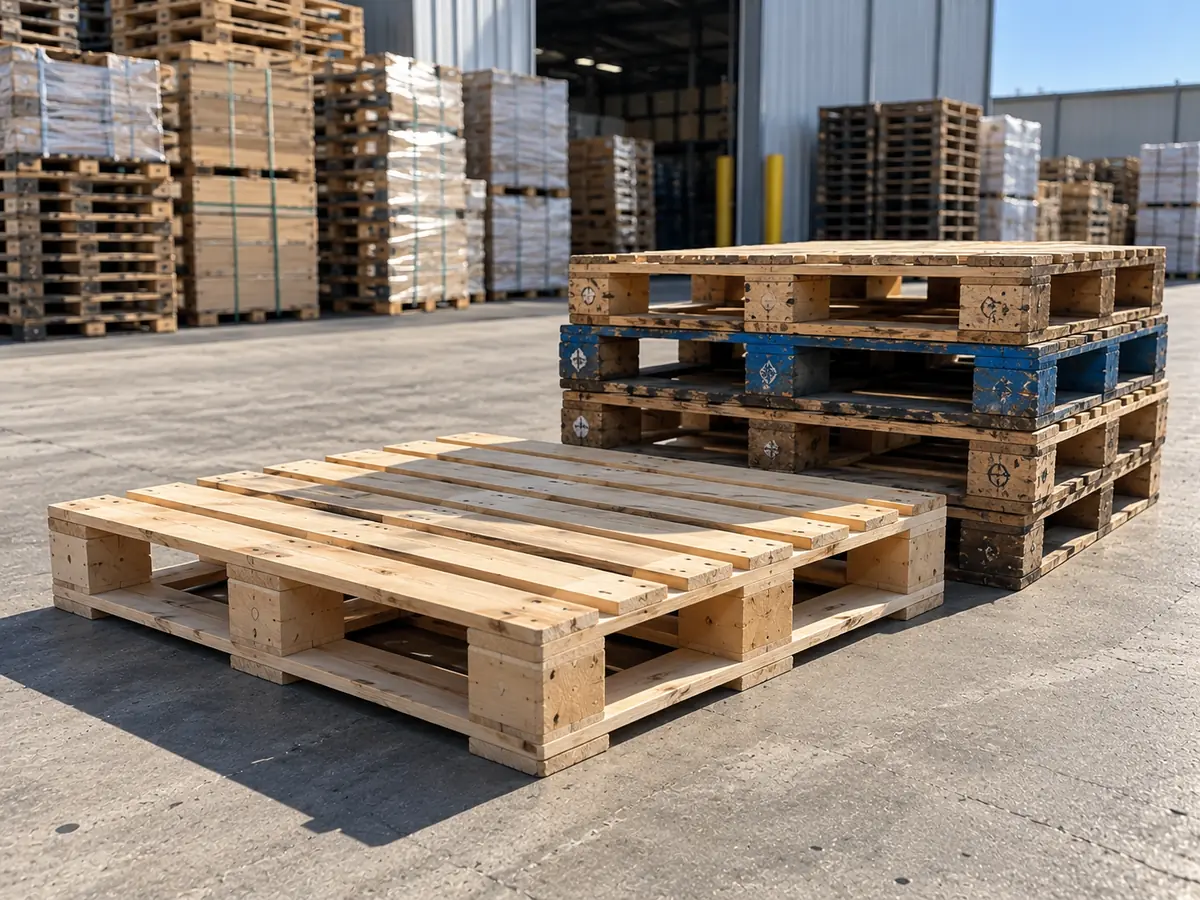
Toll repair
Where a partner supplier offers it, your own pallets are repaired and returned, which keeps branded or custom assets in your loop.
Re-graded honestly
A repaired pallet should be labelled as repaired. Ask suppliers how they grade, and compare against the grade definitions.
Component salvage
What cannot be repaired can feed remanufacture rather than the grinder.
The repairs, and what each one means
Companion stringer. A cracked or broken stringer gets a second stringer nailed alongside it, full length. This is the single most common repair in the industry and the reason many Grade B pallets are Grade B. It restores rated capacity; it is visible, which is why it costs a grade.
Deck board replacement. Missing, split or badly cupped boards come off and get replaced with salvaged or new stock of matching thickness. Lead boards, the outer ones that take fork impact, are best replaced with the strongest material available, because that is where the next failure will be.
Re-nailing. Nails back out over a pallet's life, particularly in green lumber that has since dried. Protruding nails tear product, shred stretch film and injure hands. Re-nailing is fast, cheap and hugely underrated.
Square-up. Pallets rack over time. A racked pallet does not sit properly in a rack bay and will not run through automation. Squaring is partly mechanical and partly re-fastening.
Plugging. Filling a notch or a hole in a stringer with a fitted block. Acceptable for many applications, unacceptable for others. Plugged pallets are generally graded B or below.
What a good inspection checks
Before a pallet is graded, a competent repairer works through the same set of checks every time. Stringers: through-cracks, splits at the notch, splits at the nail line. Deck boards: count, thickness, splits, cupping. Fasteners: protrusion, missing, backed out. Overall: square, twist, height variance. Plus moisture, stamp legibility, contamination and odour.
Consistency is what makes a grade mean something. Read how pallets are inspected →
Toll repair for customer-owned pallets
If you run branded, custom or pooled pallets, you want them back rather than replaced. Some suppliers will collect, repair, re-grade and return them, pricing per repair type. For higher volumes, a dedicated batch keeps your assets from mixing with general stock. Ask the partner supplier whether it offers this.
This is the most common use of repair for customers with custom-built pallets, since an expensive purpose-built base is worth repairing several times over.
When repair is the wrong answer
Three failures on one pallet, a broken lead board on both ends, or any sign of chemical contamination, and the pallet is better torn down than patched. A pallet that fails under load in a rack bay costs far more than the pallet.
At a glance
- Repair typesCompanion stringer, board replacement, re-nail, square-up, plug
- Handled byPartner suppliers in our network
- Toll repairRepairing your own pallets and returning them; ask the supplier
- PricingBy quote; usually well below replacement for simple repairs
- Output gradeRe-graded and labelled after repair
Next steps
Reference
Reference table
| Repair | Fixes | Restores rated load? | Resulting grade | Relative cost |
|---|---|---|---|---|
| Companion stringer | Cracked or split stringer | Yes, fully | B | Highest single repair |
| Deck board replacement | Missing, split or cupped board | Yes | A (one board) or B | Low |
| Lead board replacement | Fork-impact damage at the ends | Yes | A or B | Low |
| Re-nailing | Backed-out or protruding fasteners | Yes | Unchanged | Very low |
| Square-up | Racked or out-of-square pallet | Yes | Unchanged | Low |
| Plug | Damage in a stringer face or notch | Partially | B or lower | Low |
| Block replacement (block pallets) | Crushed or split block | Yes | A | Moderate |
| Full remanufacture | Three or more failures | Yes, as new build | Remanufactured | Moderate |
Applications
Where this gets used
Toll repair of your own assets
Branded, custom or pooled-adjacent pallets you want back rather than replaced. Where a supplier offers it, they are collected, repaired, re-graded and returned.
High-value custom pallets
An engineered base is worth repairing several times over. This is the commonest toll-repair use.
On-site repair benches
At very high volumes it can be cheaper to repair near the point of use than to move pallets twice. Whether a supplier offers it varies.
Export pallet re-treatment
A treated pallet repaired with untreated components is no longer compliant. It has to be re-treated and re-stamped.
Method
How a repair is actually done, and when to refuse
Repair is the step that changes the economics of pallet recycling. Without it, only what arrives sound is saleable. With it, a good share of every load goes back to work.
The companion stringer, properly
The dominant repair and the reason Grade B exists. A cracked stringer gets a second stringer nailed alongside it, full length. A short sister board spanning only the crack moves the failure point rather than removing it.
Nails go down through the top deck boards into the new stringer, so the deck does the clamping. Helical or screw-shank nails are the usual choice, because withdrawal resistance decides whether the repair lasts many trips or a few.
The result can carry the pallet's original rated load with margin: two boards where there was one, one of them intact and freshly fastened. It is genuinely stronger and it still costs a grade, because it is visible. The full explanation.
Why stringers crack where they do
Almost always at the notch. A notch removes material at exactly the point where bending stress peaks on a racked pallet. Add lumber with knots and grain runout, and a fork tine entering slightly off-line, and you have the industry's dominant failure mode.
The second origin is the nail line: splitting along the row of deck-board nails, usually from green lumber drying and shrinking after the pallet was built.
Lead boards get the best material
The outermost deck boards take fork impact, which means they are where the next failure will be. They are best replaced with the strongest stock available rather than with whatever is nearest.
Re-nailing is underrated
Nails back out over a pallet's life, particularly in green-built pallets that have since dried. A nail standing slightly proud is nearly invisible and means the joint has lost meaningful stiffness.
It is found by flexing the pallet on the bench and listening, since a sound pallet is quiet, and by running a gloved hand across the deck. Fast, cheap and effective.
When to refuse a repair
Three failures on one pallet. Both lead boards broken at the same end. Any contamination: oil, chemical staining, mould, an MB stamp. And accumulated repair history: a pallet already carrying two companion stringers and several replaced boards has very little original material left to fasten to.
At that point the honest move is teardown and a remanufactured build from the sound components rather than continuing to patch.
Repair always goes back through inspection
A repaired pallet should be graded again from scratch against the same inspection checks. A repair is never a route around a structural failure, and a pallet that fails a structural check should not go back into circulation regardless of how much work has gone into it.
Process
How it runs, step by step
Tell the supplier the volume and whether the pallets are yours
Toll repair returns your own assets; general repair feeds a supplier's graded stock. Different processes, different pricing.
Agree collection or drop-off
Ask how toll batches are kept segregated so your assets never mix with general stock.
Bench assessment
Every pallet is inspected. Repairable, remanufacture candidate, or reject, decided before any work starts.
Repair and re-grade
Companion stringers, board swaps, re-nailing, square-up. Then back through inspection and labelled honestly.
Re-treat if export-bound
Repairs with untreated components invalidate an ISPM 15 mark. Ask the supplier about re-treatment and re-stamping.
Decision rules
If this, then that
- If the pallet is branded, custom or expensiveThen ask about toll repair: get the asset back rather than replacing it.
- If the pallet has three or more failuresThen tear down and remanufacture from the sound components.
- If the repair cost approaches a graded replacementThen a good supplier will say so rather than doing the work.
- If you scrap a very large number of palletsThen ask whether repair could be done near the point of use, and measure how many are single-repair candidates first.
Avoid
Common mistakes
Assuming a repaired pallet is weaker
A full-length companion stringer restores original rated capacity. What changes is appearance and grade, not strength.
Scrapping single-repair candidates
Many scrapped pallets need only one repair. That is a disposal cost and a replacement purchase paid for the same pallet.
Repairing export pallets with untreated wood
It invalidates the IPPC mark. Re-treat and re-stamp, or the container is at risk.
Using smooth-shank nails on repairs
A repair that loosens is worse than no repair. Deformed shank, without exception.
Terms
Vocabulary for this page
- Companion stringer
- A second full-length stringer nailed alongside a cracked one. Restores rated capacity; costs a grade because it is visible.
- Toll repair
- Repairing a customer's own pallets and returning them, rather than exchanging them for stock.
- Plug
- A fitted block filling damage in a stringer face or notch. Acceptable for many applications; generally grades the pallet B or below.
- Square-up
- Correcting a pallet that has gone out of square in plan, measured across the diagonals.
- Withdrawal resistance
- The force required to pull a fastener out of wood. The property that decides how long a repair lasts.
- Twist
- A pallet that will not sit flat on all four corners. A rejection at any grade, since it rocks in a rack and jams automation.
The wider reference is in the pallet glossary.
Questions
Before you order
Does a repaired pallet carry the same load?
A properly repaired pallet with a full-length companion stringer and a complete deck can carry its original rated load. What changes is appearance and grade, not capacity. Load ratings explained →
Can pallets be repaired at my site?
Some suppliers will, for sustained volumes. For one-off batches it is usually cheaper to move the pallets than to move a repair crew. Mention your volume and whether on-site work matters when you request a quote.
How much does pallet repair cost?
It is by quote from the partner supplier and depends on repair type and volume. A single deck board swap is cheap; a companion stringer plus several boards plus a square-up starts to approach the cost of a graded replacement, and a good supplier will say when it does.
How are toll batches kept separate?
Ask the partner supplier. A typical approach is dedicated staging positions and a batch reference on the work order, and for high volumes a discrete line so your batch never mixes with general stock.
Will repaired pallets look consistent?
Within a grade band, broadly. Replacement boards are matched as closely as stock allows, but a repaired pallet is visibly repaired. That is what the grade is telling you.
Can block pallets and Euro pallets be repaired?
Block pallets, yes; block replacement usually keeps them Grade A. EPAL-marked Euro pallets can be repaired dimensionally, but only an EPAL-licensed repairer can keep the mark valid.
Ready to put a number on it?
Send the footprint, the grade and the volume. We'll come back with price per unit and the first window we can hold.