Size guide
Custom & odd pallet sizes
Standard footprints exist because trailers and racks exist. When your load does not respect either, a custom pallet is often cheaper than the damage a standard one causes.
Start a quote
Tell us the footprint, grade and volume. A partner supplier follows up with a quote.
Short answer
A custom pallet size is any footprint outside standard market dimensions, built to suit a specific load, rack profile or handling system. RePallet Market passes custom pallet requests to partner suppliers, who quote on footprint, material, quantity and load requirements.
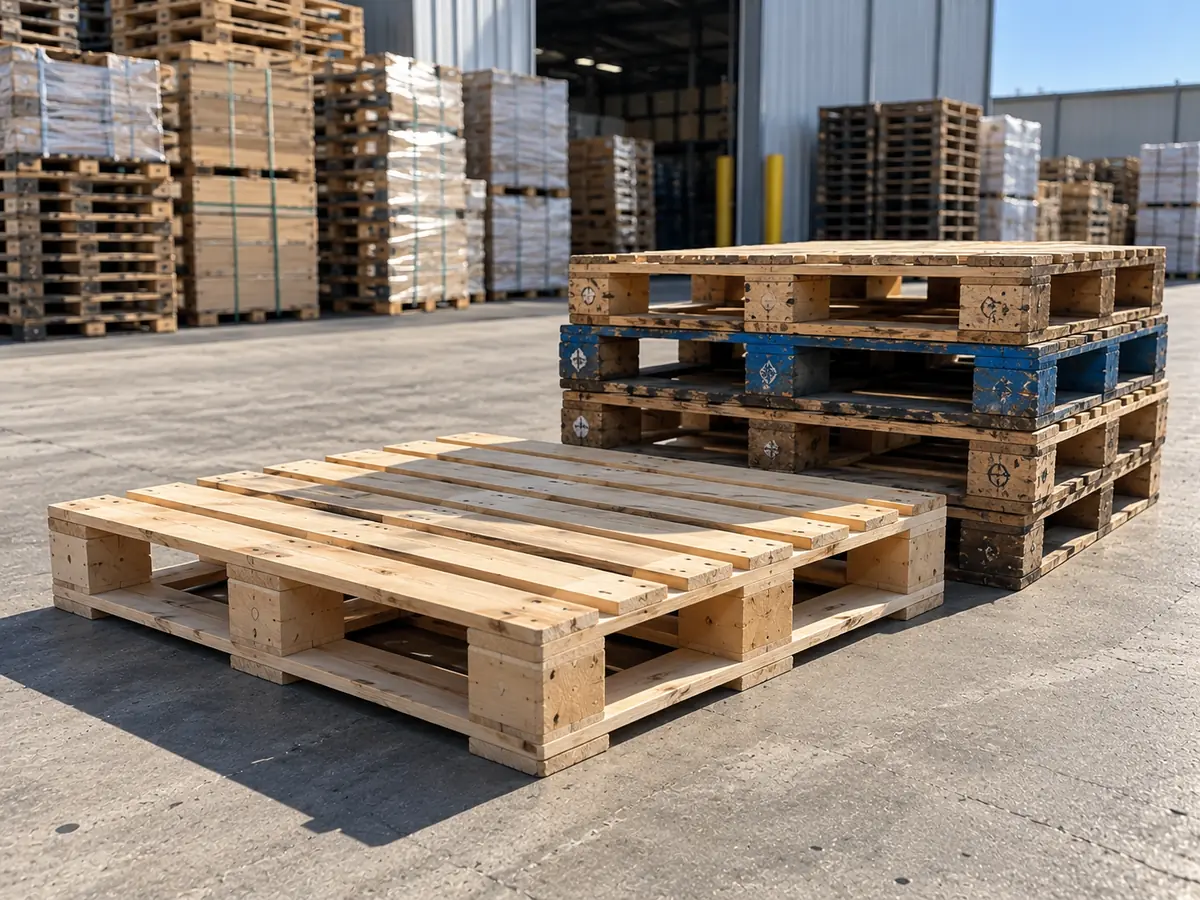
Overhang costs more than pallets
Product overhanging a pallet loses a meaningful share of its compression strength. A correctly sized base can pay for itself in damage avoided.
Send the object
A physical sample removes every ambiguity a drawing leaves in.
Say if it will repeat
Repeat orders can change how a supplier tools the job and how they price it.
The seven questions
A complete custom spec answers all of these. If you send six, the supplier will ask about the seventh — and it is usually the fastener pattern, which helps determine how many trips the pallet survives.
- Footprint — length x width in inches, length first (length is the stringer direction)
- Deck configuration — number and thickness of top and bottom boards, and gap spacing
- Structural members — stringer dimensions and count, or block layout
- Entry — two-way, partial four-way, full four-way
- Load — weight, distribution, and whether it will be racked
- Treatment — untreated, HT, or KD-HT
- Marking — IPPC position, customer stencil, colour band
Overhang, and why it matters more than people think
A carton overhanging the edge of a pallet loses a substantial share of its compression strength; published figures vary with overhang depth and stacking pattern. The bottom layer of a unit load carries everything above it, so overhang at the bottom compromises the entire stack.
This is a common reason to go custom. Somebody is shipping a 52-inch product on a 48-inch pallet, absorbing damage, and treating it as a cost of doing business. It is not; it is a four-inch specification error.
Fitting the rack and the trailer
Two external constraints usually bound a custom footprint. Trailer width: roughly 96 to 100 inches internal, so two pallets across means each must be under about 48 to 50 inches. Rack bay width: varies by system, so measure your own bay and subtract clearance.
Work out how many you want across in each, then subtract clearance — about three inches per pallet is a reasonable working figure. That usually narrows a custom footprint to a small range before you have considered the product at all.
What affects the price
Material matters more than the footprint. A custom footprint built from reclaimed lumber generally costs less than the same pallet built from new lumber. The unusual dimension itself adds little; setup and tooling are the main extra, and they are spread across the run. Pricing is by quote from partner suppliers.
Why a sample helps
Ask a supplier to build one, then load it, rack it and run it through whatever is going to break it. Then report what is wrong. A change caught on a sample is a change you do not have to make across a whole run.
At a glance
- QuotingBy partner suppliers, based on your specification
- What to sendFootprint, load, entry type, treatment and quantity
- SampleA physical pallet removes ambiguity
- MaterialReclaimed or new lumber, depending on the supplier
- TreatmentUntreated, HT or KD-HT as required
Next steps
Reference
Reference table
| Constraint | Typical dimension | Deduct | Resulting pallet limit |
|---|---|---|---|
| Trailer internal width | 98–100 in | 2–4 in clearance | Two across: 47–49 in each |
| Rack bay, 2 pallets | Varies by system | 3 in per pallet + uprights | Measure your own bay |
| Rack bay, 3 pallets | Varies by system | 3 in per pallet + uprights | Measure your own bay |
| Container width (40ft) | About 92.5 in | 1–2 in | Two across: ~45 in each |
| Dock door height | Varies | Load height + pallet | Governs stack height, not footprint |
| Product footprint | Measured | Add nothing | Pallet must be equal or larger |
Applications
Where this gets used
Oversized product
Anything overhanging a standard footprint by more than a couple of inches is costing you compression strength and damage.
Legacy racking
Older systems, drive-in racking and some AS/RS have clearances no market footprint respects.
Heavy or concentrated loads
For very heavy loads, engineered construction matters more than dimension.
Display and merchandising
Half, quarter and bespoke footprints built to a merchandising drawing.
Specification
Start from the load and the building, not from the catalogue
A custom footprint is not exotic. The unusual dimension itself adds little to the cost; setup and material choice matter more, and setup is spread across the run.
Derive the footprint
Measure the loaded product. Add nothing. That is the minimum pallet.
Then check it against two external constraints: trailer width, so you know how many fit across; and rack bay width, so you know it will seat. Three inches of clearance per pallet is a reasonable working figure.
Those two checks usually narrow the answer to a small range before you have considered anything else.
Overhang is the reason most people are here
A carton overhanging a pallet edge loses a meaningful share of its compression strength, depending on depth. Because the bottom layer carries the entire stack, overhang at the base compromises everything above it.
This is a common reason to build custom: somebody is shipping a 52-inch product on a 48-inch pallet, absorbing damage, and treating it as a cost of doing business. It is not. It is a four-inch specification error. The full write-up.
Underhang is not free either
Product that does not reach the pallet edge wastes deck area and cube, and in a trailer it means the pallets touch before the loads do — so the loads shift. Less damaging than overhang, not costless.
The seven-question spec
Footprint, deck configuration, structural members, entry type, load and racking, treatment, marking. Send six and the supplier will ask about the seventh, which is often the fastener pattern. The seven questions.
Tooling and repeats
Most custom footprints need a jig. For genuinely new geometry there may be a one-time setup cost, which a partner supplier will include in the quote.
Say if the job is likely to repeat. It can change how the jig is built and how the job is priced.
Build a sample first
Ask for one unit, then load it, rack it, and run it through whatever is going to break it. Changes found at that stage are cheap; changes found after a full run are not.
Process
How it runs, step by step
Measure the loaded product, all four sides
With a straight edge against the current pallet edge. Anything over a couple of inches of overhang is the reason to be here.
Check trailer and rack fit
Three inches of clearance per pallet. This usually narrows the footprint to a small range immediately.
Answer the seven spec questions
Footprint, deck, structure, entry, load, treatment, marking — plus the fastener line.
Ask about a sample
One unit, built and shipped. Load it before committing to a full run.
Say whether it will repeat
It can change the jig design and the pricing.
Decision rules
If this, then that
- If product overhangs by more than a couple of inchesThen consider custom. The damage can exceed the premium.
- If the quantity is very smallThen use a standard footprint with a plywood cap instead; setup dominates small runs.
- If the load is very heavy or edge-rackedThen ask for an engineered build with a documented calculation basis.
- If you have an existing pallet that nearly worksThen send or describe it. Reverse-engineering from a sample beats any drawing.
Avoid
Common mistakes
Sizing the pallet from the catalogue
Derive it from the loaded product and the building. The catalogue is where you check whether a standard already solves it.
Adding a margin 'to be safe'
A pallet larger than the load wastes cube and lets loads shift in a trailer. Match the footprint.
Ordering below the economic run
On small runs the setup dominates. A capped standard pallet can be the better answer.
Forgetting the rack bay
A footprint that fits the trailer beautifully and not the rack is a problem you discover on the second delivery.
Terms
Vocabulary for this page
- Overhang
- Load extending past the pallet edge. Costs carton compression strength and is a leading cause of transit damage.
- Underhang
- Load falling short of the pallet edge. Wastes cube and allows loads to shift in a trailer.
- Clearance
- The gap allowed between a pallet and rack uprights or trailer walls. Three inches per pallet is a working figure.
- Jig
- The assembly fixture for a given geometry. New shapes need one.
- First article
- A single unit built for approval before a production run.
- Cap
- A plywood or reclaimed-board sheet over a deck, spreading load and bridging gaps.
The wider reference is in the pallet glossary.
Questions
Before you order
What is the smallest custom order?
That depends on the partner supplier. Setup tends to dominate the price on small runs, so for very small quantities a standard pallet with a plywood cap may be a better fit. Request a quote and the supplier will tell you.
Do custom pallets cost much more than standard?
Material choice moves the price more than the dimension does. Pricing is by quote from partner suppliers.
Can a pallet I already use be reverse-engineered?
Usually, and it is the most reliable specification method. Measure every dimension and count every fastener, or send the pallet itself if the supplier agrees.
Is a custom footprint harder to replace later?
Recycled supply in a custom footprint generally does not exist — each order is a build, with the lead time that implies. Keep the specification on file so repeat orders are straightforward.
Can a custom pallet be built from recycled material?
Often, depending on the supplier and the dimensions needed. It is typically lower cost and lower impact than new lumber and performs well for many applications.
How small can a custom pallet be?
Display quarter pallets around 20x16 inches are a known size. Below that it becomes a base or a riser rather than a pallet.
Ready to put a number on it?
Send the footprint, the grade and the volume. We'll come back with price per unit and the first window we can hold.