Product
New wood pallets
Sometimes reuse genuinely is not the answer — a regulated environment, a one-way export, a load that has to be dimensionally perfect. When that is the case, a new pallet built from known lumber is the right call, and it costs more in both money and embodied carbon.
Start a quote
Tell us the footprint, grade and volume. A partner supplier follows up with a quote.
Short answer
New wood pallets are built to order from fresh-cut lumber. Partner suppliers build stringer and block pallets in southern yellow pine, mixed hardwood and oak, in a wide range of footprints, with ISPM 15 heat treatment available. They cost more than a recycled equivalent and carry more embodied carbon per trip, so they make sense where reuse is genuinely unsuitable.
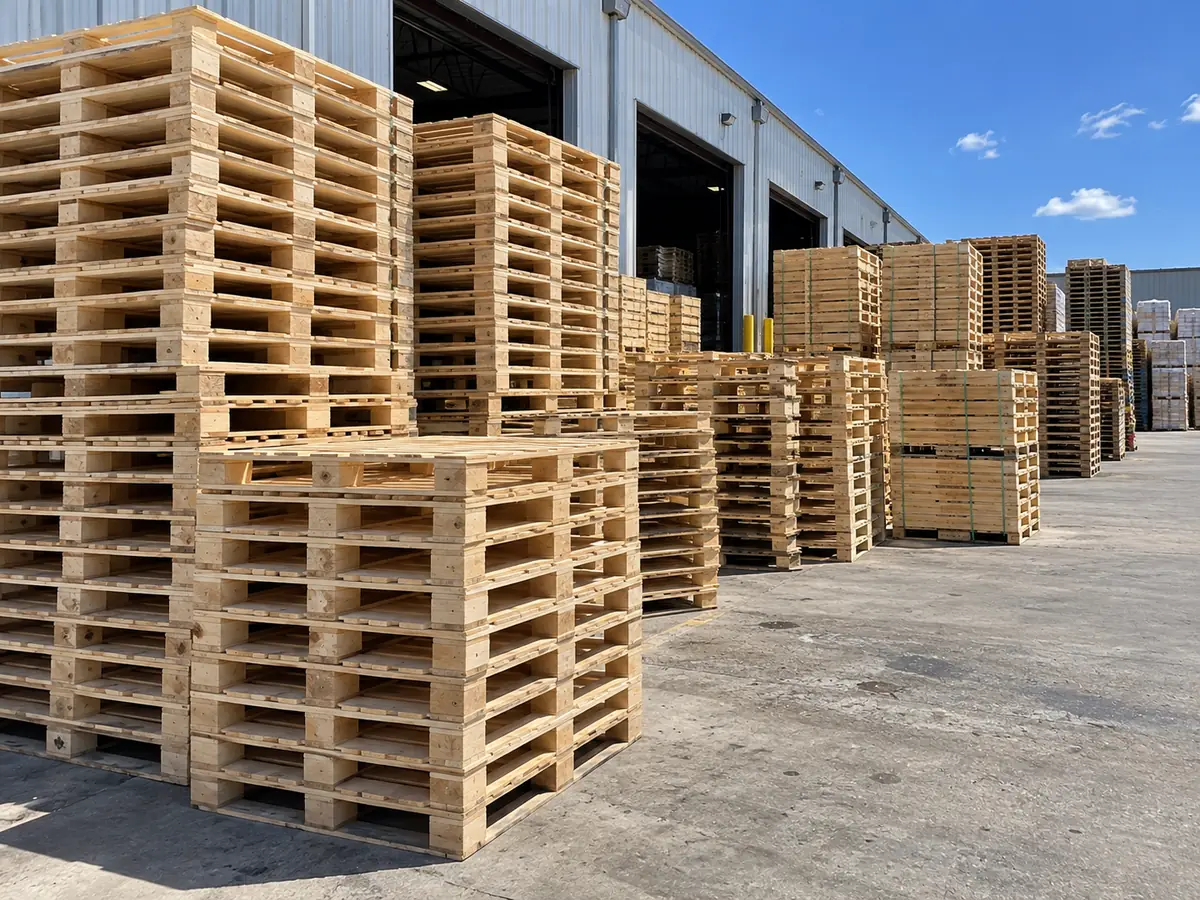
Known lumber
Ask the partner supplier where the lumber comes from and what documentation is available for it.
Any footprint
If it can be drawn, it can be quoted. Custom sizes →
Honest guidance
Our guides say when a recycled pallet would do the same job for less money.
When new is the right call
There are four situations where a new pallet is usually the right recommendation. First, regulated environments — pharmaceutical, medical device and some food-contact applications where an auditor wants unambiguous provenance. Second, one-way export where the pallet is not coming back and the receiving country has strict phytosanitary enforcement. Third, dimensionally critical automation, where a 3/8-inch deviation in overall height stops a conveyor. Fourth, heavy point loads above what a recovered stringer should be asked to carry.
Outside those four, a graded recycled pallet generally does the same work.
How new pallets are built
New stringer pallets come in three common configurations — two-way solid, partial four-way notched, and full four-way notched — and block pallets are built on a jig for anything requiring true four-way entry with a bottom perimeter deck. Nailing is pneumatic with helical or screw-shank fasteners, which hold substantially more withdrawal resistance than smooth-shank and matter far more to service life than most buyers realise.
Builders typically buy #2 and better lumber, and kiln-dry when moisture-sensitive product or long ocean transit is involved. Green lumber is cheaper and perfectly appropriate for domestic freight, but it will shrink, and shrinkage loosens nails.
Specifying a new pallet properly
A good spec answers seven questions: overall footprint, deck board count and thickness top and bottom, stringer dimension and count, entry type, fastener pattern, moisture requirement, and marking. If you send six of the seven, a supplier will ask about the seventh — usually it is the fastener pattern, and usually it is the one that decides whether the pallet survives many trips or few.
- Footprint — length x width, length first, in inches
- Deck configuration — e.g. 7 top boards / 3 bottom boards, 5/8" nominal
- Stringers — 1-3/8" x 3-1/2" x 48", three-count, notched
- Entry — four-way partial, four-way full, or two-way
- Treatment — untreated, HT, or KD-HT
- Marking — IPPC stamp position, customer stencil, colour band
The carbon conversation
A new pallet carries embodied impact from harvesting, milling, manufacture and haulage. Spread across a single one-way trip, that is the whole number. Spread across many trips, it shrinks per trip. This is the argument for reuse, and it is why our guides lead with recycled stock and treat new as the exception.
If you need new pallets but want the carbon story to hold up, ask the partner supplier whether they will take the pallets back at end of life.
At a glance
- ConstructionStringer (2-way, partial 4-way, 4-way notched) or block
- SpeciesSouthern yellow pine, mixed hardwood, red oak
- Lumber grade#2 and better is common; kiln-dried on request
- FasteningHelical or screw-shank nails, pneumatic
- Lead timeSet by the partner supplier
- QuantitiesRuns are set by each partner supplier
- TreatmentISPM 15 HT or KD-HT available
- Deck options5/8" or 3/4" nominal; butted deck available
- Stringer options3, 4 or 5 count; doubled for heavy loads
- MoistureGreen, air-dried or kiln-dried to ≤19%
Next steps
Reference
Reference table
| Option | Standard | Upgrade | When the upgrade is worth it |
|---|---|---|---|
| Deck thickness | 5/8" nominal | 3/4" nominal | Heavy point loads, repeat-use loops, forklift-heavy sites |
| Stringer count | 3 | 4 or 5 | Heavy loads, or wide unsupported spans in racking |
| Fastener | Helical | Screw-shank | Hardwood decks and any pallet expected to make many trips |
| Species | Southern yellow pine | Mixed hardwood / red oak | Abrasive loads, very heavy point loads, long service life |
| Moisture | Green | Kiln dried ≤19% | Sealed containers, long ocean transit, moisture-sensitive goods |
| Treatment | Untreated | HT or KD-HT | Any international shipment of solid wood packaging |
| Bottom boards | Square edge | Chamfered | Manual pallet-jack handling and conveyor transfers |
| Marking | None | IPPC + stencil + colour band | Pooled, branded or tracked assets |
Applications
Where this gets used
Regulated production
Pharmaceutical, medical device and some food-contact environments where an auditor wants unambiguous material provenance that a used pallet cannot provide.
One-way export
The pallet is not coming back and the destination enforces phytosanitary rules hard. You want the simplest possible documentation trail.
Dimensionally critical automation
AS/RS and conveyor systems where a 3/8-inch height deviation stops a lane. New pallets are consistent by construction.
Heavy point loads
Machine tooling, castings, transformers and stone. Usually this becomes an engineered custom build rather than a standard new pallet.
Specification
How to write a new-pallet spec that a builder can quote from
Most incomplete new-pallet enquiries are missing the same thing, and it is rarely the footprint. Here is what a complete specification contains and why each line exists.
The seven lines
- Footprint — length x width in inches, length first. Length is the stringer direction.
- Deck configuration — number and thickness of top and bottom boards, plus the gap between them.
- Structural members — stringer dimension and count, or block layout.
- Entry — two-way, partial four-way notched, or full four-way block.
- Load — weight, distribution, and whether it will be racked without deck support.
- Moisture and treatment — green, KD, HT, or KD-HT.
- Marking — IPPC position, customer stencil, colour band, asset code.
The eighth line most people forget
Fastener type. Helical and screw-shank nails hold substantially more withdrawal resistance than smooth-shank in softwood. Because pallets mostly fail at joints rather than in members, this is the highest-leverage decision on the whole sheet and it costs very little per pallet.
Write it in: *helical or screw-shank, minimum two per deck-to-stringer joint, three on lead boards.*
Deck gaps matter more than people expect
Wider spacing saves lumber and weight. Every extra inch of unsupported span is also somewhere a small carton can fall through or sag into. For mixed-case loads, three inches is the practical maximum. For a single heavy item, gaps barely matter at all.
Green versus kiln dried
Green lumber is cheaper and is perfectly appropriate for domestic freight in a dry warehouse. It will shrink, and shrinkage is what loosens nails — which is the main reason deformed-shank fasteners matter so much on green-built pallets.
Kiln drying to 19% or below buys dimensional stability, lower weight, better fastener retention and mould resistance. Specify it when the product is moisture-sensitive or when the pallet is going into a sealed container for a long transit. HT vs KD explained.
The carbon conversation, honestly
A new pallet carries embodied impact from harvesting, milling, manufacture and haulage. Across a single one-way trip that is the whole number; across many trips it shrinks per trip. This is the argument for reuse, and it is why our guides lead with recycled stock.
If you need new pallets but want the carbon story to hold up, ask the partner supplier whether they will take the pallets back at end of life.
Process
How it runs, step by step
Send the spec — or the object
A physical sample removes every ambiguity a drawing leaves in. Mention on the request whether you can supply one.
Ask for quantity breaks
Plus tooling if a genuinely new jig is required. Tell the supplier if the job will repeat; it can change how the jig is built.
Ask for a first article
One pallet, built and shipped, before a full run. Load it, rack it, break it if you can.
Production run
Cut, assemble, treat if required, stamp after treatment, band and stage. Timing comes from the supplier.
Dispatch
Delivery is arranged with the supplier. Ask whether a core collection can be combined if you generate used pallets.
Decision rules
If this, then that
- If an auditor needs documented material provenanceThen buy new — a used pallet's service history is by definition incompletely known.
- If the pallet is one-way into a strict phytosanitary jurisdictionThen buy new and heat treat, for the cleanest possible documentation trail.
- If a jam in your AS/RS costs a production shiftThen buy new, or buy Grade A against written tolerances.
- If none of the above appliesThen buy recycled. It carries a comparable rated load at a lower price and with much less embodied carbon.
Avoid
Common mistakes
Assuming kiln-dried lumber means a kiln-dried pallet
Lumber dried at the mill reabsorbs moisture if stored outdoors before it is ever nailed. Unless the finished pallet was dried, it is not a KD pallet.
Specifying new because 'used feels risky'
The risk with used pallets is ungraded supply, not used supply. Ask any supplier for their grading standard in writing and the risk shrinks.
Leaving the fastener off the spec
It is a major determinant of service life and it is the line most often omitted. Smooth-shank is only defensible on a genuine one-way pallet.
Ordering below an economic run size
Below a certain quantity, setup dominates the price. A standard recycled footprint with a plywood cap is often the better answer.
Terms
Vocabulary for this page
- Green lumber
- Freshly sawn, undried timber. Cheaper and heavier; it will shrink in service, and shrinkage is what backs nails out of joints.
- KD-HT
- Kiln dried and heat treated. Both processes performed — what a moisture-sensitive export shipment actually needs.
- Helical nail
- A nail with a spiral shank that rotates as it is driven. Substantially more withdrawal resistance than a smooth shank in softwood.
- Butted deck
- Deck boards placed edge to edge with no gap, producing a solid surface. Heavier, stronger, more expensive; used for small-item and bagged loads.
- First article
- A single production-representative unit built and shipped for approval before a run.
- Chamfer
- A bevelled edge on bottom deck boards so a pallet jack rolls on rather than catching. Little extra work that prevents long-term damage.
The wider reference is in the pallet glossary.
Questions
Before you order
How much more do new pallets cost?
New pallets generally cost meaningfully more than a recycled equivalent of the same footprint, depending on species, moisture spec and run size. The exact figure comes from a quote.
Can a supplier match an existing pallet exactly?
Often, yes. Matching from a physical sample removes ambiguity, though a drawing with dimensions works too. Describe what you have on the quote request and the partner supplier will say what they need.
Is the lumber certified?
That depends on the partner supplier. If you need chain-of-custody documentation for a particular forestry program, say so on the request and ask for it in writing; it may affect price and timing.
What lead time should I plan for new pallets?
Lead time depends on the partner supplier, the quantity, and whether material or tooling must be sourced. Say when you need the pallets on the quote request.
Can new pallets be built to an engineered load rating?
Often, yes, on the custom line. Suppliers size stringers and deck schedules against published allowable spans for the species and can usually provide the calculation basis on request.
Is a buy-back available on new pallets?
Some suppliers will arrange recovery of pallets at end of life. Ask for it in writing. It is what gives a new-pallet purchase a defensible carbon story.
Ready to put a number on it?
Send the footprint, the grade and the volume. We'll come back with price per unit and the first window we can hold.