Size guide
ISO standard pallet sizes
ISO 6780 recognises six pallet footprints. Not one of them is universal, and the gap between them is why international shipping wastes so much container space.
Start a quote
Tell us the footprint, grade and volume. A partner supplier follows up with a quote.
Short answer
ISO 6780 recognises six pallet footprints: 1219x1016 mm (48x40 in, North America), 1000x1200 mm (Europe and Asia), 1165x1165 mm (Australia), 1067x1067 mm (42x42 in, North America/Europe/Asia), 1100x1100 mm (Asia) and 800x1200 mm (Europe). No single size dominates globally, which is the root cause of much container cube inefficiency in international freight.
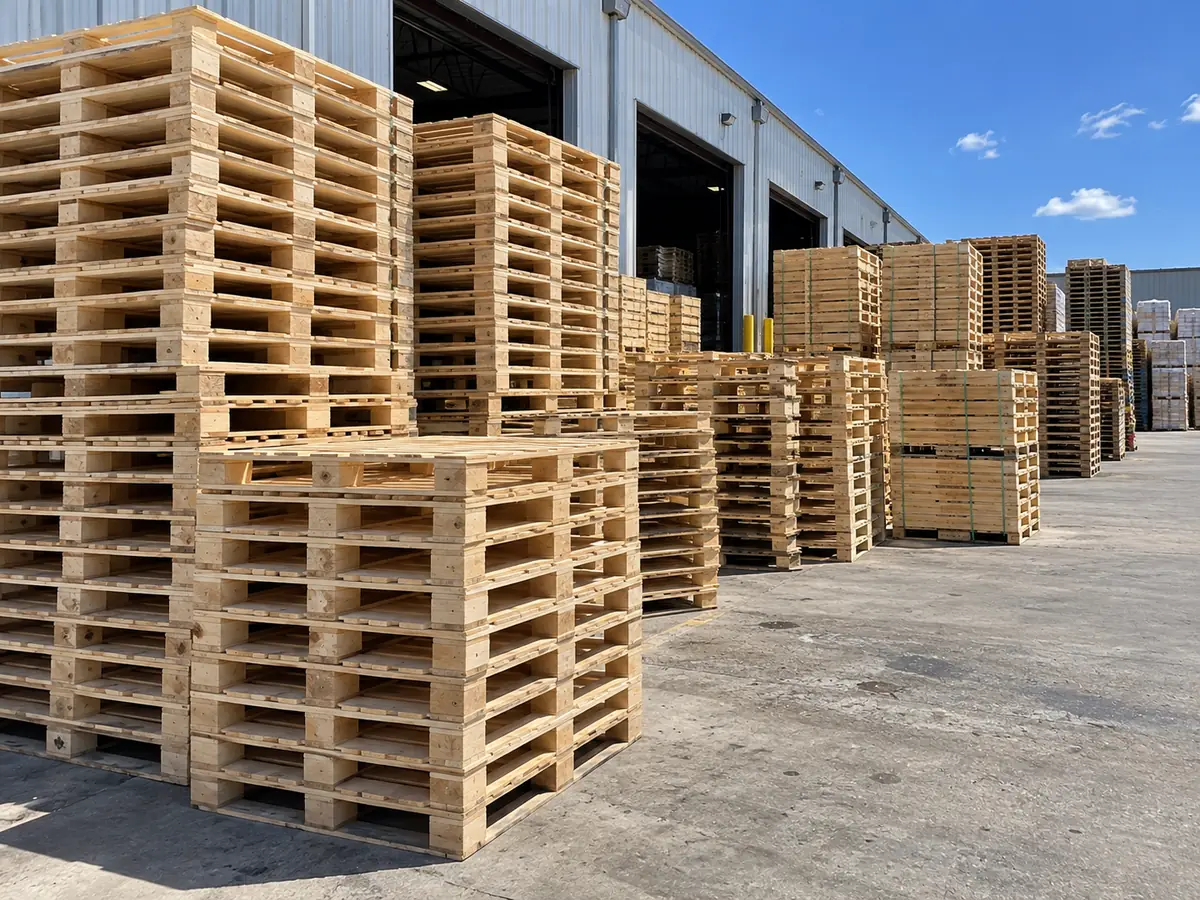
None is universal
ISO standardised six sizes because it could not standardise one. That is the whole story.
Container fit decides
The right footprint for an export lane is the one that fills the container, not the one you have on your dock.
Custom builds exist
Partner suppliers can quote custom builds in these footprints, with ISPM 15 treatment where needed.
The six, and where they actually run
1219 x 1016 (48 x 40 in). North America's default, the GMA footprint. Derived from trailer width. Dominant in the US, Canada and Mexico. Full spec →
1000 x 1200. Widely used across Europe and Asia for industrial and chemical goods. Also known as EUR 3 / EPAL 3 in block form, and as CP1 in the chemical industry standard.
1165 x 1165. The Australian standard, sized for Australian rail wagons. Rare elsewhere, and a persistent problem for exporters shipping into Australia.
1067 x 1067 (42 x 42 in). The most international of the six — used in North America (telecom, paint, beverage), Europe and Asia. Square, which simplifies both racking and container stowage.
1100 x 1100. The Asian standard, common in Japan, Korea and elsewhere in Asia. Sized for Asian container and truck dimensions.
800 x 1200. The Euro pallet footprint, dominant in European retail and distribution. Full spec →
Container fit, which is the actual decision
A 20-foot container has a usable internal floor of roughly 5.9 x 2.35 m. A 40-foot container roughly 12.0 x 2.35 m. The number of pallets that fit depends on footprint and orientation. Commonly quoted floor counts:
- 1200 x 800: about 11 in a 20ft, 24–25 in a 40ft
- 1200 x 1000: about 10 in a 20ft, 20–21 in a 40ft
- 1219 x 1016 (48x40): about 10 in a 20ft, 20 in a 40ft
- 1100 x 1100: about 10 in a 20ft, 20 in a 40ft
The 1200 x 800 Euro footprint fits containers better than the others, which is why European exporters resist changing to accommodate American partners. If you ship containers regularly, run the arithmetic for your own product before you standardise.
Choosing for an export programme
Ask three questions in order. Does the destination have a pallet exchange pool your consignee participates in? If yes, use its footprint. Does the destination have automated handling with fixed footprint assumptions? If yes, use theirs. Otherwise, use whichever footprint fills the container best for your product's dimensions.
What you should not do is default to 48x40 because that is what is on your dock. On an ocean lane, the wrong footprint can waste real cube.
ISPM 15 applies regardless
Whatever footprint you choose, solid wood packaging crossing a border needs ISPM 15 heat treatment and marking. The standard is about the wood, not the dimensions.
At a glance
- ISO 11219 x 1016 mm — 48" x 40" — North America
- ISO 21000 x 1200 mm — Europe, Asia
- ISO 31165 x 1165 mm — Australia
- ISO 41067 x 1067 mm — 42" x 42" — NA, Europe, Asia
- ISO 51100 x 1100 mm — Asia
- ISO 6800 x 1200 mm — Europe (EUR/EPAL)
Next steps
Reference
Reference table
| ISO | Millimetres | Inches | Region | Per 20ft | Per 40ft |
|---|---|---|---|---|---|
| ISO 1 | 1219 x 1016 | 48 x 40 | North America | ~10 | ~20 |
| ISO 2 | 1000 x 1200 | 39.4 x 47.2 | Europe, Asia | ~10 | 20–21 |
| ISO 3 | 1165 x 1165 | 45.9 x 45.9 | Australia | ~9 | ~18 |
| ISO 4 | 1067 x 1067 | 42 x 42 | NA, Europe, Asia | ~10 | ~20 |
| ISO 5 | 1100 x 1100 | 43.3 x 43.3 | Asia | ~10 | ~20 |
| ISO 6 | 800 x 1200 | 31.5 x 47.2 | Europe | ~11 | 24–25 |
Applications
Where this gets used
Ocean export programmes
Footprint choice changes pallets per container noticeably. On a regular lane that adds up.
Shipping into Australia
1165x1165 is the local standard and is rare elsewhere — a persistent problem for exporters.
Shipping into Asia
1100x1100 is common in Japan, Korea and elsewhere in Asia, sized for local container and truck dimensions.
Multi-region programmes
1067x1067 is the most international of the six and is square, which simplifies both racking and stowage.
Choosing
Three questions, in order, for an export footprint
ISO standardised six footprints rather than one because regional trailer, rail and container dimensions differ and none of them was going to change. That is the whole story and it is why every exporter eventually has this conversation.
1. Does the destination have an exchange pool your consignee joins?
If yes, use its footprint. The point of a pool is interchangeable assets with a known specification, and arriving with anything else means your consignee cannot exchange them and may charge you.
2. Does the destination have automated handling with fixed footprint assumptions?
If yes, use theirs. A footprint mismatch at an automated receiving dock is not a negotiation.
3. Otherwise, which footprint fills the container best?
This is where the money is and it is the question almost nobody asks. Run the arithmetic for your actual product dimensions before standardising on whatever happens to be on your dock.
The container numbers
A 20-foot container has a usable floor of roughly 5.9 x 2.35 m; a 40-foot, roughly 12.0 x 2.35 m. Commonly quoted counts: 1200x800 fits about 11 and 24–25. 48x40 fits about 10 and 20.
That is a meaningful cube improvement on a 40-foot box. Whether it outweighs handling compatibility at each end depends on your lane — but it should be calculated rather than assumed.
Weight versus cube
Most pallet-borne freight cubes out before it weighs out. If yours weighs out instead, footprint matters less and pallet weight matters more — and a heavier EPAL against a lighter GMA is payload capacity you are paying to move.
ISPM 15 applies regardless
Whatever footprint you choose, solid wood packaging crossing a border needs heat treatment and marking. The standard is about the wood, not the dimensions.
When none of the six fit
Build to the product. A custom footprint, heat treated and marked, can remove the compromise entirely. Custom sizes.
Process
How it runs, step by step
Ask the consignee about pallet exchange
One question that determines the whole answer for many European and Australian lanes.
Ask about automated receiving
Fixed footprint assumptions at the far end override cube efficiency every time.
Calculate pallets per container for your product
Not per footprint in the abstract — with your actual carton dimensions and stack pattern.
Check weight-out versus cube-out
If you weigh out, pallet weight matters more than footprint.
Confirm ISPM 15 in the shipping file
Keep treatment documentation with the shipping file so a border query is quick to answer.
Decision rules
If this, then that
- If the consignee exchanges palletsThen use the pool footprint. Nothing else is negotiable.
- If the lane is regular and cube-limitedThen compare footprints on pallets per container before standardising.
- If the destination is AustraliaThen plan for 1165x1165 or accept a cube penalty and awkward handling.
- If none of the six suit your productThen ask about a custom build. It can be cheaper than the damage a poor fit causes.
Avoid
Common mistakes
Defaulting to 48x40 on an ocean lane
Because it is what is on your dock. On a regular container lane the cube difference can be significant.
Assuming ISO means interchangeable
ISO recognises six footprints. It does not make them compatible with each other's racking or handling.
Forgetting treatment because the footprint is unusual
ISPM 15 is about the wood. Every footprint on this page needs it for international movement.
Ignoring pallet weight on weight-out lanes
A few kilograms per pallet of payload is real money across a year of containers.
Terms
Vocabulary for this page
- ISO 6780
- The international standard recognising six pallet footprints for international trade.
- Cube out
- Filling a container's volume before reaching its weight limit. The normal constraint for pallet-borne freight.
- Weight out
- Reaching the weight limit before filling the volume. Where pallet weight starts to matter more than footprint.
- Exchange pool
- A system of interchangeable standardised pallets swapped one-for-one between participants.
- TEU
- Twenty-foot equivalent unit — the standard container measure. A 40-foot box is 2 TEU.
- Stowage
- How units are arranged in a container. Square footprints simplify it; rectangular ones can leave unusable strips.
The wider reference is in the pallet glossary.
Questions
Before you order
Is there a single international pallet standard?
No. ISO 6780 standardises six footprints rather than one, because regional trailer, rail and container dimensions differ and none of them was going to change.
Which ISO size is best for ocean freight?
1200 x 800 usually fills a standard container most efficiently, at a commonly quoted 24–25 pallets in a 40-foot box against about 20 for a 48x40. Whether that outweighs handling compatibility at each end depends on your lane.
Can non-North American ISO sizes be built?
Partner suppliers can quote custom builds in these footprints, heat treated and marked where required. Request a quote with the footprint and quantity.
Which ISO size should a US exporter use?
It depends on the destination and whether your consignee exchanges pallets. For cube efficiency alone, 1200x800 is the best of the six. For handling compatibility in North America, 48x40 remains the default.
Can all six ISO footprints be built?
Partner suppliers can quote custom builds in these footprints, heat treated and marked where required. Include the footprint and quantity in your quote request.
Is 1067x1067 really used in three regions?
It is the most international of the six — North American telecom, paint and beverage, plus European and Asian industrial use. Being square helps with both racking and stowage.
Ready to put a number on it?
Send the footprint, the grade and the volume. We'll come back with price per unit and the first window we can hold.