Size guide
Block vs stringer pallets
Two constructions, four entry types, and a distinction that decides whether a pallet jack can pick your load up from the side. Ten minutes here prevents a decade of small frustrations.
Start a quote
Tell us the footprint, grade and volume. A partner supplier follows up with a quote.
Short answer
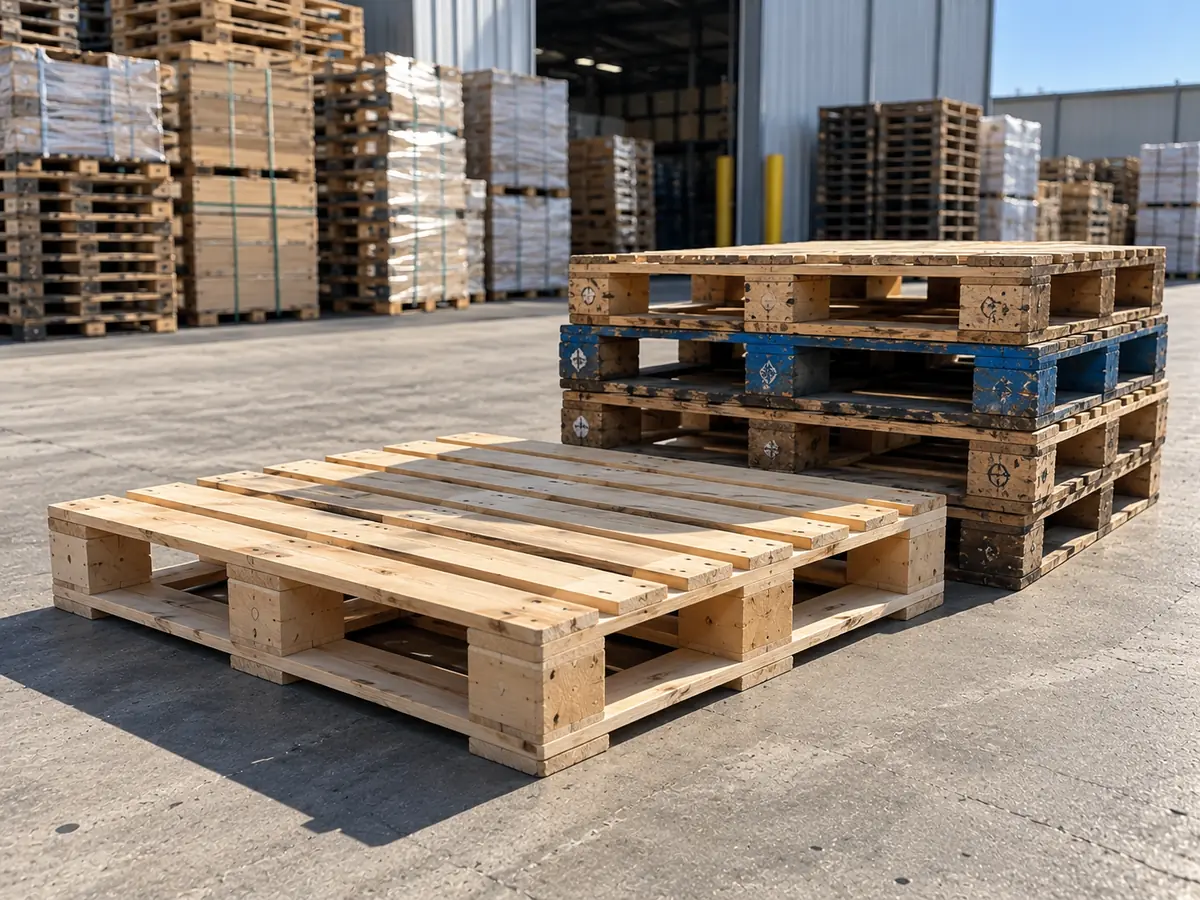
Stringer pallets use three or more parallel boards on edge to support the deck, giving two-way or partial four-way entry. Block pallets use nine solid blocks with perimeter boards, giving true four-way entry for both forklifts and pallet jacks. Stringer pallets are generally cheaper and dominate North America; block pallets are generally sturdier, easier to repair and dominate Europe.
Pallet jacks care
A notched stringer admits forklift tines from the side but not pallet jack wheels. This is the single most consequential difference.
Notches weaken
Every notch removes material at a high-stress point. Deep notches make entry easier and the pallet weaker.
Both repairable
Both constructions can be repaired — block pallets just tend to need it less often. How repair works →
Stringer construction
Three (sometimes four or five) boards on edge running the length of the pallet, with deck boards nailed across them. The stringers do the structural work; the deck boards distribute load and hold the whole assembly square.
A solid stringer gives two-way entry: forks go in from the two ends only. Cutting notches into the stringer faces — commonly around 9 inches wide by 1.5 inches deep, positioned for standard fork spacing — creates partial four-way entry. Forklift tines can enter from all four faces; pallet jacks, whose wheels need to roll along the floor beneath the pallet, still cannot enter the notched sides.
This is why a forklift driver can pick a GMA pallet from any side and a warehouse operator with a pallet jack cannot. It is not a defect. It is the design.
Block construction
Nine blocks — four corners, four edge midpoints, one centre — connected by stringer boards running one direction and deck boards the other. Because the blocks sit proud of the bottom perimeter boards, there is a genuine open channel on all four faces, at floor level, for both tines and pallet jack wheels.
Block pallets are heavier, use more material, cost more and generally last longer. They also fail more gracefully: a single damaged block can be replaced without disturbing the rest of the structure, whereas a cracked stringer usually requires a full-length companion stringer nailed alongside it.
Choosing between them
- Manual pallet jack access from all sides is required → block, without question
- Cost per unit dominates and loads are one-way → stringer
- Pallets circulate in a closed loop and durability pays back → block
- Automated storage with tight height tolerance → block, usually, for dimensional consistency
- Shipping to Europe → block, because that is what the market runs
- General North American domestic freight → stringer, because it is what everyone has
Load behaviour
The constructions fail differently. A stringer pallet under excessive load fails in bending at the stringer, typically starting as a crack at the notch. A block pallet fails at the connection between block and board, usually as nail withdrawal rather than fracture. The practical consequence: stringer failures are sudden and visible, block failures are gradual and often missed. Inspect block pallets by lifting and looking at the block-to-board joints, not just at the deck.
Repair economics
A cracked stringer gets a companion stringer — a second full-length board nailed alongside. It restores rated capacity, it is visible, and it drops the pallet to Grade B. A damaged block is simply replaced, and if done properly the pallet can stay Grade A. Over a long service life this difference compounds in favour of block construction.
At a glance
- Stringer entry2-way, or partial 4-way with notches
- Block entryTrue 4-way from all faces
- Stringer weightLighter (commonly ~37 lb for 48x40)
- Block weightHeavier (~55 lb for 1200x800)
- Stringer costGenerally lower
- Block durabilityGenerally higher service life
- RepairabilityBlock easier; stringer often needs a companion
Next steps
Reference
Reference table
| Property | Stringer | Block | Which wins |
|---|---|---|---|
| Forklift entry | 4-way with notches | True 4-way | Block |
| Pallet jack entry | 2-way only | True 4-way | Block, decisively |
| Unit cost | Generally lower | Generally higher | Stringer |
| Weight | ~37 lb (48x40) typical | ~55 lb (1200x800) | Stringer |
| Service life | Generally shorter | Generally longer | Block |
| Dimensional consistency | Varies, especially repaired | High | Block |
| Repair method | Companion stringer — visible | Block swap — less visible | Block |
| Grade after repair | Drops to B | Often stays A | Block |
| Failure mode | Sudden, at the notch | Gradual, at the joint | Depends on inspection discipline |
| Recycled supply (US) | Very deep | Thin | Stringer |
Applications
Where this gets used
Manual pallet-jack operations
If jacks need side entry, block construction is the only answer. Notches admit tines, not wheels.
Automated storage
Block pallets are dimensionally more consistent, which matters more than appearance in an AS/RS.
Closed loops
Durability is realised rather than theoretical, so the higher unit cost amortises properly.
One-way domestic distribution
Stringer, usually. Paying for durability you will never see is wasteful.
Mechanics
How each construction carries load — and how each one fails
Footprint is half a specification. Construction determines whether a pallet jack can enter from the side, how the pallet fails under load, and how cheaply it can be repaired.
Stringer construction
Three boards on edge running the length of the pallet, with deck boards nailed across them. The stringers do the structural work; the deck distributes load and holds the assembly square.
A solid stringer gives two-way entry. Cutting notches — commonly around 9 inches by 1-1/2 inches, positioned for standard fork spacing — creates partial four-way entry for tines. Pallet jack wheels, which roll along the floor beneath the pallet, still cannot enter the notched sides.
This is not a defect. It is the design, and it is the single most consequential difference between the two constructions.
Block construction
Nine blocks — four corners, four edge midpoints, one centre — connected by stringer boards one direction and deck boards the other. Because the blocks sit proud of the bottom perimeter boards, there is a genuine open channel on all four faces at floor level, for tines and jack wheels alike.
Heavier, more material, higher cost, generally longer life. It also fails more gracefully: a damaged block is replaced without disturbing the rest of the structure.
Failure modes differ, and it matters
A stringer pallet under excessive load fails in bending at the stringer, typically starting as a crack at the notch. Sudden and visible.
A block pallet fails at the block-to-board connection, usually as nail withdrawal rather than fracture. Gradual and often missed.
Sudden failure is worse in a rack. Gradual failure is worse if nobody inspects. Which you prefer depends on your inspection discipline — and operations with a real inspection process prefer the gradual one.
Inspect block pallets by lifting and looking at the block-to-board joints, not just at the deck.
Repair economics compound
A cracked stringer gets a full-length companion stringer: restores rated capacity, visible, drops the pallet to Grade B.
A damaged block is simply replaced, and done properly the pallet can stay Grade A.
Over a long service life that difference compounds in block's favour — which is one of several reasons block construction is slowly gaining ground in North America despite the higher unit cost.
Sustainability, honestly
Block generally wins, because service life is the dominant variable in a pallet's footprint. A block pallet making many more trips beats a stringer pallet making fewer, even though it used more wood.
But only if the trips actually happen. In open distribution where pallets disappear, the extra material is wasted. Used vs new pallets.
Process
How it runs, step by step
Ask whether manual jacks need side entry
If yes, the decision is made — block construction. Nothing else about the comparison matters.
Count your jams and workarounds
Not just your pallet spend. Jams, manual-jack workarounds and rack-level failures over twelve months, with a cost on each.
Check return rate
Block durability only pays if the pallets come back. In open distribution it does not.
Trial a small batch in the affected process
A trial tells you more than any amount of analysis.
Consider a hybrid
Block in the automated portion, stringer everywhere else. Many sites that switched did not switch entirely.
Decision rules
If this, then that
- If manual pallet jacks enter from the sideThen block, without question. Notches do not admit wheels.
- If pallets are one-way and cost dominatesThen stringer. Durability you never realise is money wasted.
- If the loop is closed and frequency is highThen block. The life advantage is realised rather than theoretical.
- If you are specifying a new automated facilityThen evaluate block properly rather than defaulting to what the market runs.
Avoid
Common mistakes
Assuming four-way means pallet-jack access
A common and expensive misunderstanding. Notched stringer pallets are two-way for jacks.
Inspecting block pallets like stringer pallets
Block failures are at the block-to-board joint and are gradual. Lift and look at the joints, not the deck.
Buying block for open distribution
The durability is real and you will never see it. The pallets leave and do not come back.
Converting stringer pallets to four-way by notching
It works and it reduces stringer capacity at the highest-stress point. Only on pallets carrying well under rating.
Terms
Vocabulary for this page
- Stringer
- A board on edge running the length of a pallet and carrying the deck. Three is standard on a 48x40.
- Block
- A solid timber or composite cube supporting the deck. Nine of them make a block pallet, giving true four-way entry.
- Stringer board
- On a block pallet, the board connecting blocks in one direction — the structural equivalent of a stringer.
- Notch
- A cutout in a stringer face admitting forklift tines from the long sides. Eases entry, weakens the member.
- Companion stringer
- A full-length second stringer nailed alongside a cracked one. The standard stringer-pallet repair.
- Nail withdrawal
- Fasteners working loose under cyclic load. The dominant block-pallet failure mode, and gradual enough to be missed.
The wider reference is in the pallet glossary.
Questions
Before you order
Is a four-way pallet always better?
Only if your operation actually enters from all four faces. Four-way entry costs something — either in notches that weaken stringers or in the extra material of block construction. Two-way pallets are cheaper and perfectly good where handling is consistent.
Can a stringer pallet be converted to four-way?
Notches can be cut into an existing stringer pallet, but it reduces the stringer's capacity at a high-stress point, so it is only sensible on pallets carrying well under their rating. A partner supplier can advise on custom builds.
Which is more sustainable?
Block, generally, because service life is the dominant variable in a pallet's footprint. A block pallet that makes many more trips beats a stringer pallet with fewer, even though it used more wood. Used vs new pallets →
Can a block pallet be repaired to stay Grade A?
Usually. Replacing a damaged block does not leave the visible signature a companion stringer does, so a properly repaired block pallet often keeps its grade.
Are block pallets always more expensive?
Per unit, generally yes. Per trip in a closed loop, frequently not. Divide the unit cost by realised trips before deciding.
Can block pallets be sourced?
Request a quote and say which footprint you need. Recycled block supply in North America is thin compared with stringer, and mostly 1200x800 and 1200x1000 from import flows, plus custom builds, so availability depends on partner suppliers.
Ready to put a number on it?
Send the footprint, the grade and the volume. We'll come back with price per unit and the first window we can hold.