Size guide
The Euro pallet (EPAL, 1200 x 800)
One of the most tightly specified pallets in the world: eleven boards, nine blocks, nails in defined positions, and a licensing regime that makes a counterfeit EPAL a legal problem rather than just a quality one.
Start a quote
Tell us the footprint, grade and volume. A partner supplier follows up with a quote.
Short answer
The Euro pallet (EUR/EPAL 1) measures 1200 x 800 mm (47.2 x 31.5 inches), stands 144 mm tall and weighs approximately 25 kg. It is a four-way block pallet built on nine blocks with eleven boards and 78 nails in specified positions, carrying EUR and EPAL marks on the blocks. Commonly quoted capacity is 1,500 kg dynamic and 4,000 kg static.
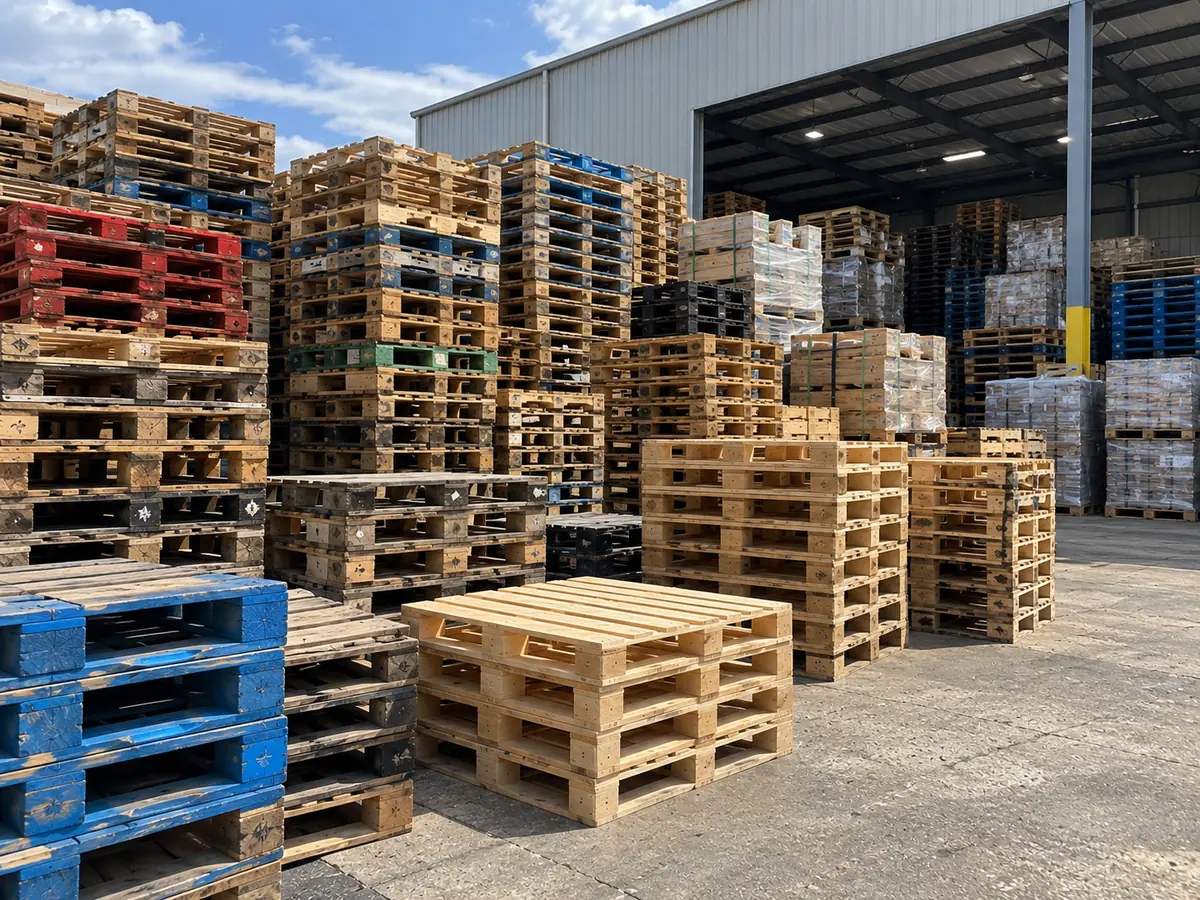
Licensed, not just standard
EPAL pallets are made and repaired by licensed producers under the EPAL system. Repair with non-approved parts can invalidate the mark.
Truly four-way
Block construction gives genuine four-way pallet-jack access — unlike a notched GMA stringer.
Uncommon in the US
They mostly arrive as import returns rather than a domestic production stream, so availability through partner suppliers varies.
What makes it different from a GMA
Construction, not just dimension. A GMA 48x40 is a stringer pallet: three long boards on edge, with notches cut for partial four-way entry. A Euro pallet is a block pallet: nine solid blocks with boards above and below, giving genuine four-way entry from all four faces for both forklifts and pallet jacks.
That construction is why a Euro pallet is heavier than a typical GMA, costs more to make, and tends to last longer. It is also why it does not fit an American trailer efficiently — 1200 mm is 47.2 inches, so two across is 94.5 inches, and the 800 mm direction leaves awkward gaps. The Euro pallet is optimised for European trailer and container dimensions, not North American ones.
The marks, and reading them
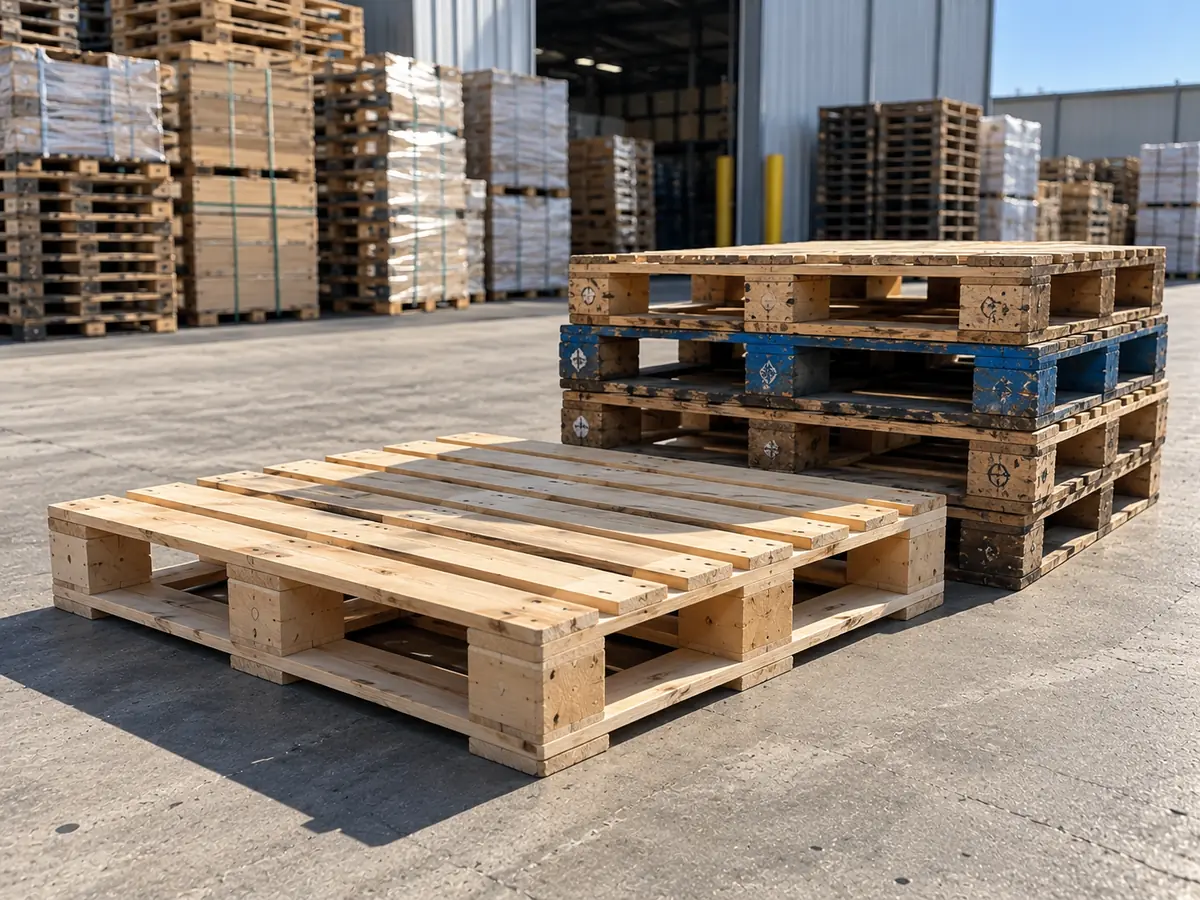
A genuine EPAL pallet carries marks on its blocks, including the EPAL or EUR oval, a producer licence reference and, where the pallet has been heat treated, the IPPC/ISPM 15 mark. Marking layout has changed over the years, so check current EPAL guidance rather than relying on an old rule of thumb.
Older pallets may carry the EUR mark from the railway-administered system. A pallet with neither mark is not a Euro pallet, whatever its dimensions.
Counterfeits and what to look for
- Nail count and pattern. 78 nails in specified positions. Counterfeits frequently use staples or fewer nails.
- Block chamfer. Genuine blocks are chamfered on the bottom edges. Square-edged blocks are a warning sign.
- Wood quality. EPAL specifies debarked, knot-limited timber. Heavy knots in the boards are a warning sign.
- Stamp crispness. Branded marks are burned in, deep and clean. Printed or shallow marks are suspect.
Euro pallets in North America
They exist here largely as import returns. There is little domestic production because the footprint does not suit American trailers. If you need them in volume for export, plan ahead: partner suppliers source from import flows and other recyclers, and availability is genuinely variable.
If you are shipping to Europe and are not locked into the EPAL exchange system, consider whether a custom-built 1200x800 pallet meeting ISPM 15 would serve you better. Unless your consignee participates in a pallet exchange pool, the EPAL mark buys you nothing.
At a glance
- Dimensions1200 x 800 mm (47.2" x 31.5")
- Height144 mm
- Weight~25 kg (55 lb)
- ConstructionBlock, 9 blocks, 11 boards
- Fasteners78 nails, specified positions
- Dynamic load1,500 kg (3,300 lb), commonly quoted
- Static load4,000 kg (8,800 lb), commonly quoted
- MarksEUR and EPAL marks on the blocks, IPPC mark where heat treated
Next steps
Reference
Reference table
| Property | EUR / EPAL 1 | 48x40 GMA | Consequence |
|---|---|---|---|
| Footprint | 1200 x 800 mm | 1219 x 1016 mm | EPAL fits European trailers and containers better |
| Construction | Block, 9 blocks | Stringer, 3 stringers | True four-way vs partial four-way |
| Height | 144 mm | ~140 mm | Close enough to matter in automation |
| Weight | ~25 kg (55 lb) | ~17 kg (37 lb) typical | EPAL costs more to freight |
| Boards | 11 | Typically 10 | EPAL uses more material |
| Fasteners | 78, specified positions | Pattern varies | EPAL is far more tightly defined |
| Dynamic load | 1,500 kg (3,300 lb) | ~1,130 kg (2,500 lb) | EPAL carries more |
| Static load | 4,000 kg (8,800 lb) | ~1,360 kg (3,000 lb) | Block construction spreads load better |
| Licensing | Production and repair licensed | None | Unlicensed repair can invalidate the EPAL mark |
| Per 40ft container | Commonly 24–25 | Commonly ~20 | More pallets per box on an ocean lane |
Applications
Where this gets used
Export into EPAL exchange pools
If your consignee participates, you need genuine EPAL pallets — lookalikes cannot be exchanged and you may be charged.
Container-efficient ocean lanes
More pallets per 40-foot box than a 48x40. On a regular lane that difference adds up.
True four-way handling
Block construction gives genuine pallet-jack access from all four faces, which a notched stringer pallet cannot.
Heavy European industrial freight
EPAL 2 and 3 (1200x1000 and 1000x1200) for loads beyond what EPAL 1 is intended to carry.
Sourcing and authenticity
Why they are uncommon in America, and how to spot a fake
Buyers ask for Euro pallets often. Half the time the right answer is a Euro pallet. The other half it is a 1200x800 pallet that is not a Euro pallet at all — and that distinction is worth real money and a longer lead time.
Why supply is thin here
The footprint is optimised for European trailer and container dimensions. In a 53-foot American trailer it fits poorly: two across at 1200 mm is 94.5 inches, which works but wastes clearance, and the 800 mm direction leaves awkward gaps.
So there is little North American manufacturing at volume. The pallets circulating here arrived under imported freight, which makes availability genuinely variable. If you need a large quantity by a fixed date, say so early in your request.
Licensing is the part buyers miss
An EPAL pallet is not just a dimension — it is a licensed product. Production and repair are restricted to licensed operators and the specification is precise: nine blocks, eleven boards, 78 nails in defined positions.
A repair by an unlicensed operator produces a pallet that is dimensionally fine and no longer a legitimate EPAL asset. And a counterfeit EPAL is a legal problem as well as a quality one.
Reading the marks
Marks sit on the blocks and include the EPAL or EUR oval, a producer licence reference and, on heat-treated pallets, the IPPC/ISPM 15 mark. Marking layout has changed over the years, so check current EPAL guidance before relying on an old rule of thumb.
A pallet with neither the EUR nor the EPAL mark is not a Euro pallet, whatever its dimensions.
Five authenticity checks
- Nail count and pattern — 78 in specified positions. Counterfeits frequently use staples or fewer nails.
- Block chamfer — genuine blocks are chamfered on the bottom edges. Square edges are a warning sign.
- Timber quality — EPAL specifies debarked, knot-limited stock. Heavy knots should make you look harder.
- Stamp crispness — marks are branded in, deep and clean. Printed or shallow marks are suspect.
- Weight — a genuine EPAL 1 weighs about 25 kg. Substantially lighter usually means undersized components.
The alternative nobody suggests
A custom-built 1200x800 block pallet, heat treated and stamped to ISPM 15, built to whatever load rating your product needs.
Often cheaper than a genuine EPAL, easier to source than waiting on import flows, and functionally similar for every purpose except pool exchange. If your consignee simply unloads and disposes, the EPAL mark buys you nothing. Custom pallets.
Process
How it runs, step by step
Ask whether your consignee exchanges pallets
This single question decides whether you need a genuine EPAL or a 1200x800 pallet.
If exchange applies, buy genuine and check the marks
Producer licence reference, IPPC mark, EUR/EPAL ovals. The five authenticity checks above.
If exchange does not apply, ask about a custom build
Often cheaper, easier to source, and specified to your actual load.
Confirm ISPM 15 either way
Solid wood packaging crossing a border needs treating and marking regardless of footprint.
Run the container arithmetic
Commonly 24–25 per 40-foot box against about 20 for 48x40. On a regular lane, do the maths before you standardise.
Decision rules
If this, then that
- If your consignee is in an EPAL exchange poolThen buy genuine EPAL. Lookalikes cannot be exchanged and you may be charged the difference.
- If your consignee unloads and disposesThen consider a custom 1200x800. The mark buys you nothing and adds cost.
- If the pallet will be repaired in EuropeThen use a licensed EPAL repairer or the mark can become invalid.
- If you ship containers regularlyThen compare cube per box across footprints before standardising.
Avoid
Common mistakes
Assuming any 1200x800 pallet is a Euro pallet
It is a footprint. EPAL is a licensed specification with 78 nails in defined positions and marks on the blocks.
Repairing an EPAL pallet in-house
Dimensionally fine, no longer an EPAL asset. Use a licensed repairer if the mark matters.
Specifying EPAL out of habit
If nobody at the far end exchanges pallets, you are paying a premium for a credential nobody will check.
Ordering at short notice
North American EPAL supply depends on import flows. Plan lead time or consider a custom build.
Terms
Vocabulary for this page
- EPAL
- European Pallet Association — licenses production and repair of the 1200x800 pallet and controls its quality standard.
- EUR mark
- The older railway-administered mark. Today the EPAL system licenses the pallet; check current EPAL guidance on marking.
- Block pallet
- A pallet built on nine solid blocks rather than stringers, giving true four-way entry for forks and pallet jacks alike.
- Exchange pool
- A system in which standardised pallets are swapped one-for-one between participants rather than bought and sold.
- Chamfered block
- A bevelled bottom edge on a block. Present on genuine EPAL pallets; commonly absent on counterfeits.
- CP pallet
- The European chemical industry standards, CP1 to CP9 — defined footprints separate from the EPAL system.
The wider reference is in the pallet glossary.
Questions
Before you order
What is the difference between EUR and EPAL?
EUR was the original railway-administered mark; EPAL (European Pallet Association) took over licensing and quality assurance. Both denote the same 1200x800 specification. Marking details have changed over time, so check current EPAL guidance.
Can Euro pallets be repaired?
Only by EPAL-licensed repairers using approved components, if the EPAL mark is to remain valid. An unlicensed repair produces a pallet that is dimensionally fine but no longer a legitimate EPAL asset.
How many Euro pallets fit in a 40ft container?
A commonly quoted figure is 24 to 25 on the floor of a standard 40-foot container, against around 20 for 48x40 GMA pallets. Exact counts depend on container dimensions and loading pattern.
Can Euro pallets be sourced in volume?
Sometimes, with lead time. North American supply comes from import flows and other recyclers, so availability genuinely varies. Give the quantity and date in your quote request so partner suppliers can say what is achievable.
Is a custom 1200x800 pallet acceptable for export?
Yes, provided it is heat treated and marked to ISPM 15. What it cannot do is participate in an EPAL exchange pool.
What is the difference between EPAL 1, 2 and 3?
EPAL 1 is 1200x800, EPAL 2 is 1200x1000 and EPAL 3 is 1000x1200. All block-built; the larger two are used in industrial and chemical logistics.
Ready to put a number on it?
Send the footprint, the grade and the volume. We'll come back with price per unit and the first window we can hold.