Guide
The pallet pricing guide
Why the same 48x40 pallet can be quoted very differently for two buyers, in nine variables, ordered by how much they usually matter.
Start a quote
Tell us the footprint, grade and volume. A partner supplier follows up with a quote.
Short answer
Pallet prices are set by quote from partner suppliers, and nine variables move them. In rough order of impact: grade, order volume, freight terms, footprint, core supply, heat treatment, sorting requirement, lead time and seasonality. Grade and volume usually account for most of the spread between two quotes for the same product category.
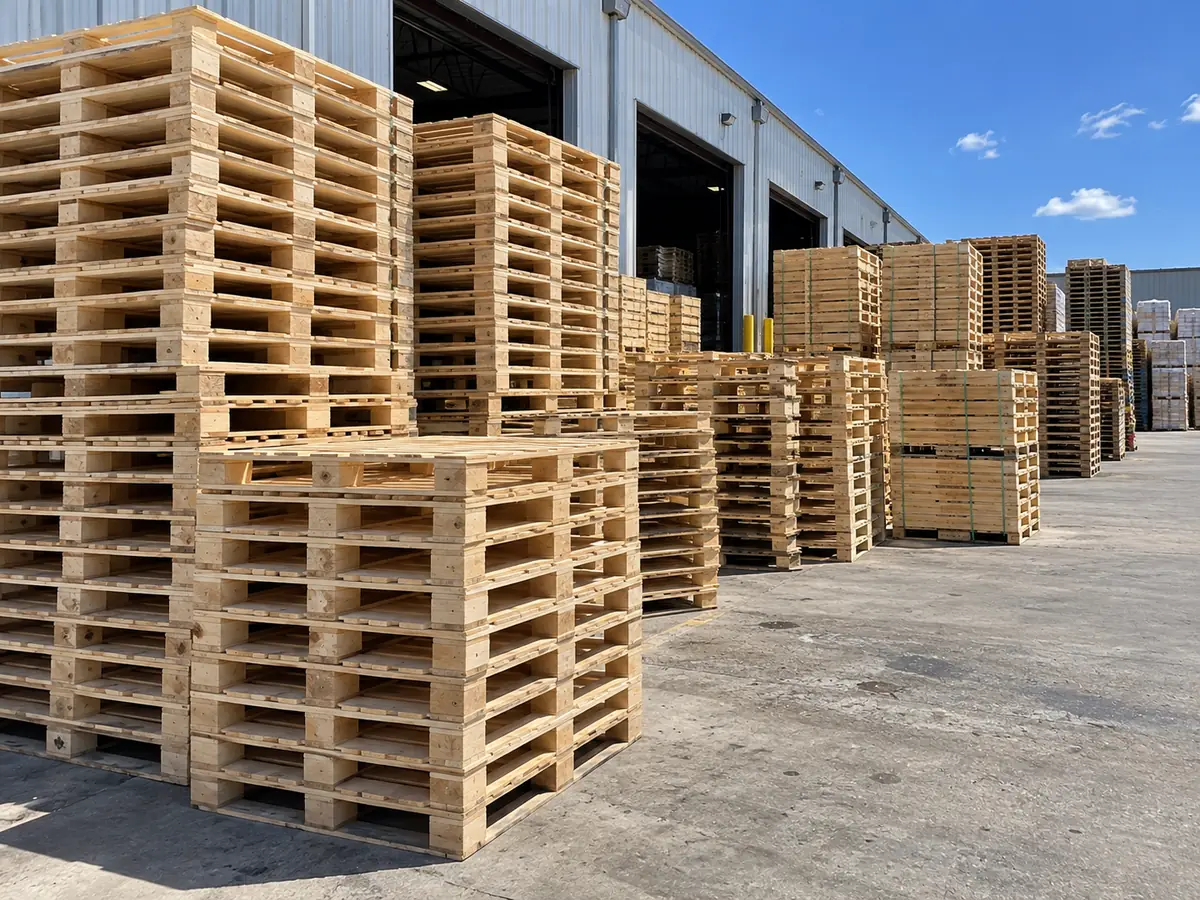
Grade is the biggest lever
Most buyers over-specify. Split your buy →
Pickup usually beats delivery
Freight is a large share of a low-value product's delivered cost.
Ask what is available now
Buying what a supplier already has is usually cheaper than buying what it must build.
1. Grade
Usually the largest variable. Grade A typically costs more than Grade B, and remanufactured pallets are often positioned below B. Most buyers specify a grade higher than their application needs, because nobody was ever criticised for buying the better one.
Splitting a buy (A for customer-facing shipments, B for internal) is usually the quickest saving with no operational change whatsoever.
2. Volume
Pallet economics are dominated by handling and freight, both of which are per-load rather than per-unit. A full truckload is usually much cheaper per unit than a partial one.
If you are ordering small quantities frequently, consolidating into fewer, fuller loads can cost less in total. Ask the partner supplier to run that comparison with you.
3. Freight terms
Pallets are low value and high cube, so freight is a large share of delivered cost. Pickup is usually cheapest. Delivery close to the supplier is next. Delivery far from the supplier costs meaningfully more, and past a certain distance the economics stop working.
Ask about backhaul. If your delivery fits a route the supplier already runs, the freight component can come down. How freight works →
4. Footprint
48x40 GMA is typically the cheapest pallet in North America because the recycled market for it is deepest. Other footprints often cost more, not because they use more wood but because supply is thinner and sorting is harder.
If your application genuinely does not require a specific footprint, 48x40 will usually be the cheapest option. If it does, expect a premium and allow for lead time. Size chart →
5. Core supply
Recycled pallet prices track the availability of used cores, which in turn follows freight activity. When freight is strong, cores are plentiful and prices can soften. When freight slows, cores can dry up and recycled prices can rise.
This is counterintuitive and catches purchasing teams out. A slowdown does not necessarily make pallets cheaper. It can make them scarcer.
6. Heat treatment
ISPM 15 treatment adds both cost and lead time, because treatment capacity is finite. Only specify HT if the pallets are genuinely crossing a border. A great many domestic orders carry an HT requirement that nobody can explain.
7. Sorting requirement
If you need a single grade, a single footprint and consistent appearance, somebody has to sort for it. That labour is in the price. Combo loads, a deliberate blend of A and B in agreed proportion, are cheaper precisely because they require less sorting.
8. Lead time
Buying what is already available is usually cheaper than buying what must be built or sourced. If you can take what a supplier already has, you will usually pay less than if you need a large quantity of a specific footprint by a fixed date.
The single best question to ask any pallet supplier is: what do you have available right now?
9. Seasonality
Core supply and demand both shift through the year, so prices can move with the seasons. Peaks in demand ahead of busy retail periods and slower core recovery in quiet freight months are common pressures. The pattern varies by region and year, so ask your supplier rather than assuming.
If your requirement is flexible, ask whether timing changes the quote.
Putting it together
The cheapest outcome is usually a full truckload of Grade B 48x40, picked up, with no treatment, from available stock, at a quiet time of year. The most expensive is a small quantity of Premium Grade A in a non-standard footprint, heat treated, delivered a long way and needed urgently.
Same product category, very different quotes, and most of the variables between them are decisions rather than accidents. To see where your own request lands, request a free quote.
At a glance
- PricingBy quote from partner suppliers
- Biggest leverGrade
- VolumeFull loads usually cost less per unit than partial loads
- FreightA large share of a low-value product's delivered cost
- Heat treatmentAdds cost and lead time
- Cheapest footprint48x40 GMA, where the application allows
Next steps
Reference
Reference table
| # | Variable | Under your control? | Fastest lever |
|---|---|---|---|
| 1 | Grade | Yes | Split the buy by application |
| 2 | Volume | Partly | Consolidate to full loads |
| 3 | Freight terms | Yes | Pickup, or combine with collection |
| 4 | Footprint | Sometimes | Use 48x40 where the spec allows |
| 5 | Core supply | No | Ask about timing and availability |
| 6 | Heat treatment | Yes | Only specify it for exports |
| 7 | Sorting requirement | Yes | Accept combo loads where possible |
| 8 | Lead time | Yes | Buy what is available now |
| 9 | Seasonality | Partly | Ask whether timing changes the quote |
| Order size | What changes | Note |
|---|---|---|
| Small quantity | Often a pickup or counter-style sale | Highest cost per unit |
| Partial truckload | Freight added, spread over fewer pallets | Freight is a visible share of the price |
| Full truckload | Freight spread over the most pallets | Usually the biggest single step down per unit |
| Multiple loads | Route planning possible | Backhaul opportunities can open |
Applications
Where this gets used
Annual budgeting
Model grade split, order size and timing rather than applying a flat inflation assumption.
Supplier comparison
Ask for product and freight separately. A bundled delivered price hides which component moved.
Tender preparation
Specify grade, footprint, treatment and volume precisely. Ambiguity is priced as risk.
Spot purchasing
Ask what is available now. Buying available stock is usually cheaper than buying a build.
Market mechanics
Why recycled pallet prices behave the way they do
Recycled pallet pricing surprises purchasing teams more than almost any other category, because the supply side works backwards from the way most commodities do.
Used pallets are a by-product
Nobody manufactures used pallets. They arrive as a consequence of goods moving: a pallet enters the recycling stream when it has finished carrying something somewhere. So the volume available in any period is tied to how much freight moved before it.
When freight slows, fewer pallets reach docks, fewer cores reach recyclers, and supply can contract faster than demand does. Prices can rise.
This is why a downturn does not necessarily make pallets cheaper. It can make them scarcer.
The seasonal shape
Core supply and demand both shift through the year. Demand ahead of busy retail periods and slower core recovery in quiet freight months are common pressures. The pattern varies by region and by year, so ask your supplier rather than assuming. The December squeeze.
Why grade is the biggest lever
It is the one variable that is entirely within your control and costs nothing operationally to change.
Most facilities buy one grade for everything because nobody was ever criticised for buying the better one. Splitting, with Grade A for customer-facing and Grade B for internal, usually removes a good share of spend with no change to how anything works.
Why freight matters more here than elsewhere
Pallets are low value and high cube, so freight is a larger share of delivered cost than for almost anything else on a truck. Pickup is usually cheapest. Combining delivery with a core collection removes an entire truck movement.
And ask about backhaul: if your site fits a route a supplier already runs, the rate can reflect an empty mile rather than a full one.
The cheapest and most expensive request
Cheapest: a full truckload of Grade B 48x40, picked up, no treatment, from available stock, at a quiet time of year.
Most expensive: a small quantity of Premium Grade A in a non-standard footprint, heat treated, delivered a long way and needed urgently.
Same product category. The spread can be large, and most of the variables between them are decisions rather than accidents.
Process
How it runs, step by step
Split your buy by grade
The biggest controllable variable. Start by counting how much volume is genuinely customer-facing.
Consolidate to fuller loads
Fewer, fuller orders can cost less in total than frequent small ones.
Separate product and freight in quotes
So you can see which component moves when a price changes.
Ask what is available now
Buying available stock is usually cheaper than buying a build.
Ask whether timing matters
If your requirement is flexible, a supplier may be able to say when it is cheaper.
Decision rules
If this, then that
- If the pallet is not customer-facingThen consider Grade B for that portion of your spend.
- If you order small quantities oftenThen ask the supplier to model fewer, fuller loads. Freight per unit is the difference.
- If a spec carries a heat treatment lineThen check whether anything actually crosses a border. Many do not.
- If core supply is tightThen give the supplier notice and flexibility rather than contacting several at once.
Avoid
Common mistakes
Expecting a downturn to lower prices
It can raise them. Core supply follows freight volume, not demand.
Comparing bundled delivered prices
You cannot see whether the product or the freight moved. Ask for both lines.
Specifying HT domestically
Costs money and treatment capacity for no benefit. It is usually a copied line nobody has reviewed.
Asking several suppliers at once in a tight market
They all draw on the same shrinking pool, and now they all know you are short.
Terms
Vocabulary for this page
- Core supply
- The availability of used pallets entering the market. A dominant driver of recycled pricing.
- Break point
- An order size at which the cost structure changes, typically half and full trailer loads.
- Available stock
- Pallets a supplier already has on hand, as opposed to pallets it must build or source. Usually cheaper and quicker.
- Combo load
- An agreed blend of grades, cheaper than straight Grade A because it needs less sorting.
- Backhaul rate
- Pricing against an empty return leg rather than a dedicated trip. Possible when your site fits an existing route.
- Spot market
- Buying at prevailing prices without an agreement. Expensive precisely when you need it most.
The wider reference is in the pallet glossary.
Questions
Before you order
How much does a used pallet cost?
It depends. Grade, volume, footprint and freight terms account for most of the spread, and local core supply moves it too. Pricing is by quote from partner suppliers, so request a quote for your specification.
Why did pallet prices go up?
Often core supply. Recycled pallet prices track the availability of used cores, which follows freight activity. Slower freight can mean fewer cores and higher prices, which surprises most purchasing teams.
Is it cheaper to buy pallets in bulk?
Usually. Handling and freight are per-load costs, so a full truckload is generally cheaper per unit than a partial one.
Is there a pallet price list?
No published list is reliable. Recycled pricing moves with core supply, and any list would go stale quickly. Request a free quote for a current number from a partner supplier.
Can I lock a price for a year?
That is a conversation to have with the partner supplier that quotes you. Ask how price changes would be handled and what notice applies.
Why is my odd footprint so much more expensive?
Not because it uses more wood. Because recycled supply for it is thin and sorting is harder. At larger quantities a custom build may beat sourcing recycled.
Ready to put a number on it?
Send the footprint, the grade and the volume. We'll come back with price per unit and the first window we can hold.