Product
Crates, boxes & skids
When the thing you are shipping is expensive, fragile, oddly shaped or all three, a pallet is not enough. Crates are where good design pays off most — and where reclaimed lumber does its most useful job.
Start a quote
Tell us the footprint, grade and volume. A partner supplier follows up with a quote.
Short answer
Wooden crates, shipping boxes and skids are engineered wood packaging for freight that a pallet alone cannot protect. Partner suppliers can quote them to spec from reclaimed and new lumber, including ISPM 15 heat-treated export crates, machinery skids and returnable knock-down crates.
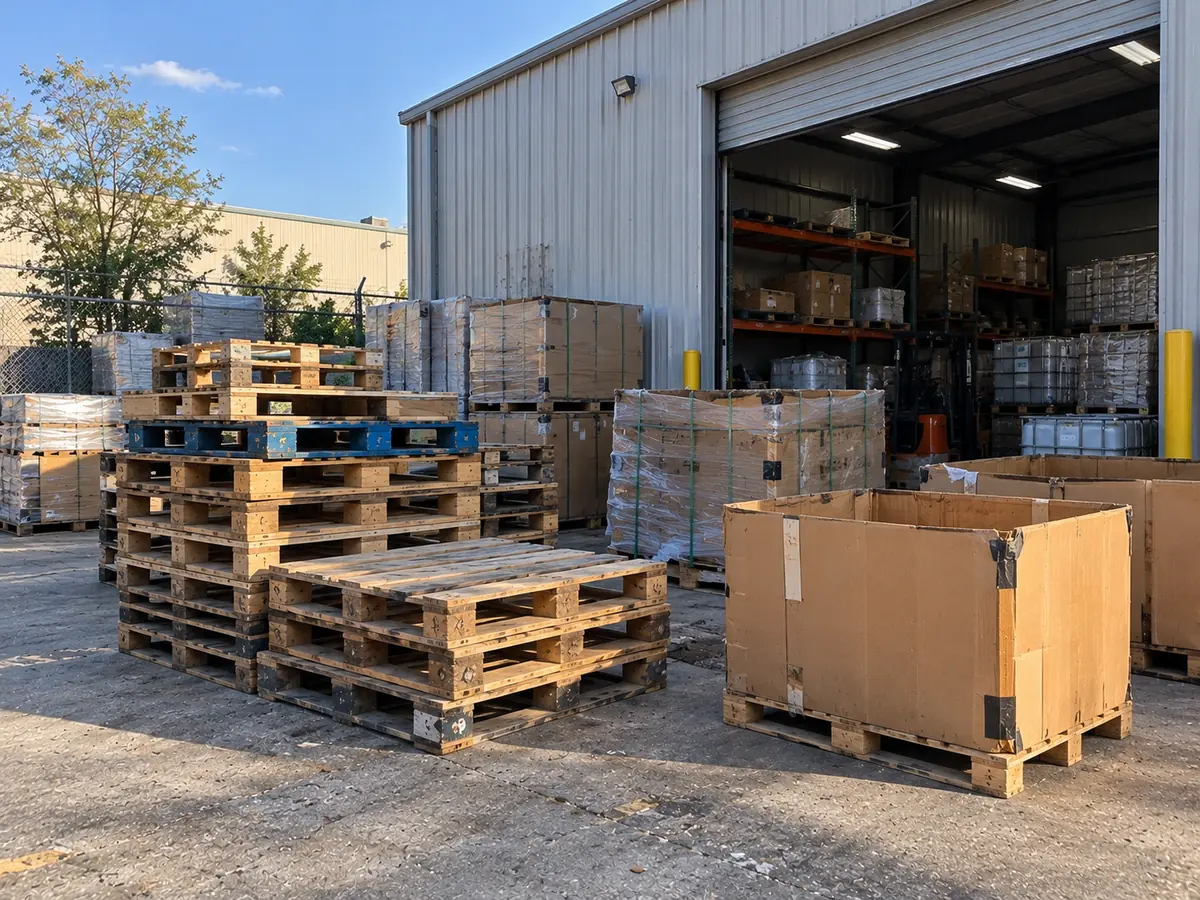
Built around the thing
Bring the machine, or a drawing of it. A good crate is built around the item, not the other way round.
Knock-down option
Flat-pack crates that assemble with lag screws — for returnable loops and for shipping empties cheaply.
Export-ready
Ask about ISPM 15 treatment, stamping and the treatment record.
The four families
Skids. A pallet without a bottom deck. Heavy stringers, usually 4x4, carrying a solid or slatted top. Skids are for machinery: you bolt the load down, you drag or fork it, and the absence of a bottom deck means nothing catches.
Open (slat) crates. Frame and slats, with gaps. Cheaper, lighter, lets inspectors see the contents, and fine for anything not damaged by dust or weather.
Closed crates. Full panel walls in reclaimed board, plywood or OSB. Weather resistance, security and a surface for labelling.
Knock-down crates. Panels that bolt together with lag screws and can be disassembled flat. More expensive up front, dramatically cheaper if the crate comes back.
Engineering a crate that arrives intact
The base does the work. Most crate failures start at the skid: undersized runners, blocking that was not bolted, or a load that was centred by eye rather than by weight. Runners should be sized against the actual load weight and centre of gravity, and heavy items bolted to the base rather than relying on the walls.
Above the base, three details matter. Diagonal bracing on any panel over 48 inches. Cleats on the inside of the joint rather than the outside, so the fasteners load in shear. And a lid that is screwed, not nailed, if anyone is ever going to open it.
For sensitive equipment, foam cradles, desiccant bags sized to the internal volume, and tip-and-shock indicators make damage claims a conversation about evidence rather than opinion.
Export crating and ISPM 15
Any solid wood component of an export crate — runners, cleats, frame, solid panels — must be heat treated to ISPM 15 and stamped. Plywood and OSB are exempt as engineered products, which is why many export crates use a solid frame with sheet panels: it minimises the volume that needs treatment.
The mark is applied after treatment as the standard requires. Ask the partner supplier for treatment documentation, and check current regulations in the destination country. More on ISPM 15 →
Reclaimed material in crating
Crating is the single best use for reclaimed pallet lumber. The boards are short, dry, stable and structurally adequate for panels and cleats. Using reclaimed stock typically lowers the material cost of a crate and takes most of the embodied carbon out with it.
Reclaimed material is best kept out of the primary runners on a heavy skid, because that is where certainty matters most. Everything above the base is fair game.
At a glance
- TypesClosed crate, open crate (slat), knock-down, skid, box
- SizeLarge envelopes possible; ask the supplier about maximum dimensions
- Load ratingsEngineered builds possible on request
- PanelsReclaimed board, plywood, OSB
- ExportISPM 15 treatment available; ask for treatment documentation
- ExtrasBolt-down blocking, foam cradles, desiccant, shock indicators
Next steps
Reference
Reference table
| Type | Weather | Security | Reusable | Relative cost | Typical load |
|---|---|---|---|---|---|
| Skid (no walls) | None | None | High | Lowest | Machinery bolted to the base |
| Open / slat crate | Low | Low | Medium | Low | Robust equipment, inspection-friendly freight |
| Closed crate | High | Medium | Low–medium | Higher | Weather-exposed, valuable or fragile goods |
| Knock-down crate | High | Medium | Very high | Higher | Returnable loops, high-value repeat shipments |
| Crate + foam cradle | High | Medium | Medium | Highest | Finished surfaces, precision assemblies |
| Component | Material | Needs ISPM 15? | Note |
|---|---|---|---|
| Runners / skids | Solid lumber | Yes | Primary structure; new lumber is common on heavy builds |
| Frame posts & rails | Solid lumber | Yes | Reclaimed stock acceptable above the base |
| Cleats | Solid lumber | Yes | Fit inside the joint so fasteners load in shear |
| Panels | Plywood / OSB | No | Engineered products are exempt — minimises treatment volume |
| Blocking & bracing | Solid lumber | Yes | Counts as dunnage; frequently overlooked |
| Fasteners, hardware | Steel | No | Screw the lid if anyone will open it |
Applications
Where this gets used
Machinery and tooling
Bolted to an engineered skid with load spreaders. Walls keep weather and hands out; the base does all the structural work.
Aerospace and precision
Foam cradles at finished surfaces, calculated desiccant, and tip-and-shock indicators that turn damage claims into evidence.
Returnable loops
Knock-down crates that bolt together with lag screws and flat-pack for the return leg. More expensive up front, dramatically cheaper if the crate comes back.
Barge and project cargo
Longer exposure, more handling, more humidity. Water freight calls for different design; say so at quote stage.
Design
Almost every crate failure starts at the base
In crate failures, the walls are almost never the problem.
Size the runners to the real load
Not to the overall dimensions — to the actual weight and the actual centre of gravity. An assembly with most of its mass in a casting at one end needs heavier runners than a uniform load of the same weight, and the bolt pattern has to be laid out around where the weight actually sits.
Bolt the load down
Not blocked, not strapped, not nestled in foam and hoped for. Bolted, through the base, with load spreaders under the nuts. Walls restrain nothing on a heavy crate — they keep weather and hands out.
Brace anything over 48 inches
An unbraced panel that size racks under handling and takes the whole box out of square. Diagonal bracing is cheap and it is the difference between a crate that arrives square and one that arrives as a parallelogram.
Cleats inside, not outside
Fasteners then load in shear rather than in withdrawal, which is much stronger. This single detail separates crates built by people who have opened a failed one from crates built to a drawing.
Screw the lid
If anybody is ever going to open it, screw the lid rather than nailing it. The difference is a screwdriver versus a pry bar near a valuable assembly, and the receiver will remember which one you chose.
Minimise the treatment volume
Plywood and OSB are exempt from ISPM 15 because the manufacturing process already destroys pests. Solid lumber is not. A solid frame with sheet panels therefore minimises the volume that has to go through a treatment chamber, which saves both money and time.
This is why well-designed export crates look the way they do. It is not aesthetics, it is a treatment-volume decision.
Desiccant, calculated
Sized to the internal air volume and the transit length, not handed out by the fistful. A container crossing an ocean goes through a daily condensation cycle, and undersized desiccant is worse than none because it creates false confidence.
On-site crating
For machinery that cannot be moved before it is packaged, some suppliers will bring lumber and tools and build in place. From a crating point of view that is considerably easier — you build around the actual object rather than around a drawing of it. Availability depends on the supplier and your location.
Process
How it runs, step by step
Send weight, dimensions and centre of gravity
Plus destination, transport mode and what will unload it at the far end. That last question changes designs more often than any other.
Size the base first
Runners against the real load and CG, with the bolt pattern laid out around the mass.
Frame, brace and panel
Diagonal bracing over 48 inches, cleats inside the joint, plywood panels to minimise treatment volume.
Treat and stamp
Every solid component treated, marked after treatment on two opposing faces. Ask the partner supplier for treatment documentation.
Mark for handling
Sling points, centre of gravity, do-not-stack, orientation — in symbols that do not need translating.
Decision rules
If this, then that
- If the crate will come backThen build knock-down. Higher up-front cost, dramatically lower cost per trip.
- If the load is machinery that bolts downThen use a skid, not a crate. Nothing should catch underneath.
- If the freight crosses a borderThen design a solid frame with sheet panels to minimise ISPM 15 treatment volume.
- If the item cannot be moved before packagingThen ask a supplier whether on-site crating is available in your area.
Avoid
Common mistakes
Sizing runners from the crate dimensions
Size them from the load weight and centre of gravity. An off-centre mass needs a different base from a uniform one.
Relying on walls to restrain the load
Walls are weather and security. The base carries everything. Bolt the item down.
Nailing a lid somebody has to open
Screwed lids get opened with a screwdriver. Nailed lids get opened with a pry bar, next to your product.
Forgetting blocking counts as dunnage
Solid wood blocking and bracing inside a container falls under ISPM 15 exactly like the crate does.
Terms
Vocabulary for this page
- Skid
- A pallet without a bottom deck. Heavy runners carrying a solid or slatted top, used for machinery that is bolted down and dragged or forked.
- Cleat
- A batten reinforcing a panel joint. Fitted inside the joint so fasteners load in shear rather than in withdrawal.
- Knock-down crate
- Panels that bolt together with lag screws and disassemble flat for the return leg.
- Container rain
- Condensation forming on a container's steel surfaces during the daily temperature cycle, then falling onto the load.
- Shock indicator
- An externally mounted device that records impact above a threshold. Turns damage claims into evidence rather than opinion.
- Load spreader
- A plate under a bolt head or nut that distributes the clamping force into the timber rather than crushing it.
The wider reference is in the pallet glossary.
Questions
Before you order
How quickly can a one-off crate be built?
Timing depends on the partner supplier, the size and whether treatment is needed. Say when you need it on your quote request and the supplier will tell you what is realistic.
Is on-site crating possible?
Some suppliers will crate in place for machinery that cannot be moved before it is packed. Availability depends on the supplier and your location; describe the job on the request.
Can crates be reused?
Knock-down crates absolutely — that is the point of them. Fixed crates can usually survive a few round trips if they are opened with a screwdriver rather than a pry bar. At end of life, wooden crates can enter a recycling stream.
How fast can a one-off crate be built?
That depends on the partner supplier, the size and whether heat treatment is needed. Say when you need it on your quote request.
Can crates be taken back at end of life?
Some suppliers will take them into a recycling stream like pallets. Wooden crates tear down into excellent reclaimed stock, particularly the panels.
Can crating be done at my site?
Some suppliers will crate in place, depending on location. Describe the job and your location on the request and the partner supplier will say whether it is possible.
Ready to put a number on it?
Send the footprint, the grade and the volume. We'll come back with price per unit and the first window we can hold.