Service
Pallet delivery through partner suppliers
Pallets are a low-value, high-volume commodity, which makes freight one of the biggest variables in what you actually pay. Delivery is arranged by the partner supplier, so it is worth knowing how it works.
Start a quote
Tell us the footprint, grade and volume. A partner supplier follows up with a quote.
Short answer
Pallet delivery is the transport of pallets from a supplier to your dock. RePallet Market is a referral service: you submit a free, no-obligation request with your location and volume, and a partner supplier in our network follows up on how it would deliver and on what terms. Delivery methods and coverage vary by supplier.
Ask for freight separately
Asking for product and freight as separate lines shows which part of a price moves when rates change.
One truck, both ways
Delivery and collection on the same visit can be a large saving, where a supplier offers it. Ask.
Closer is usually cheaper
Pallets do not travel well economically, so a nearby partner supplier is typically the better answer.
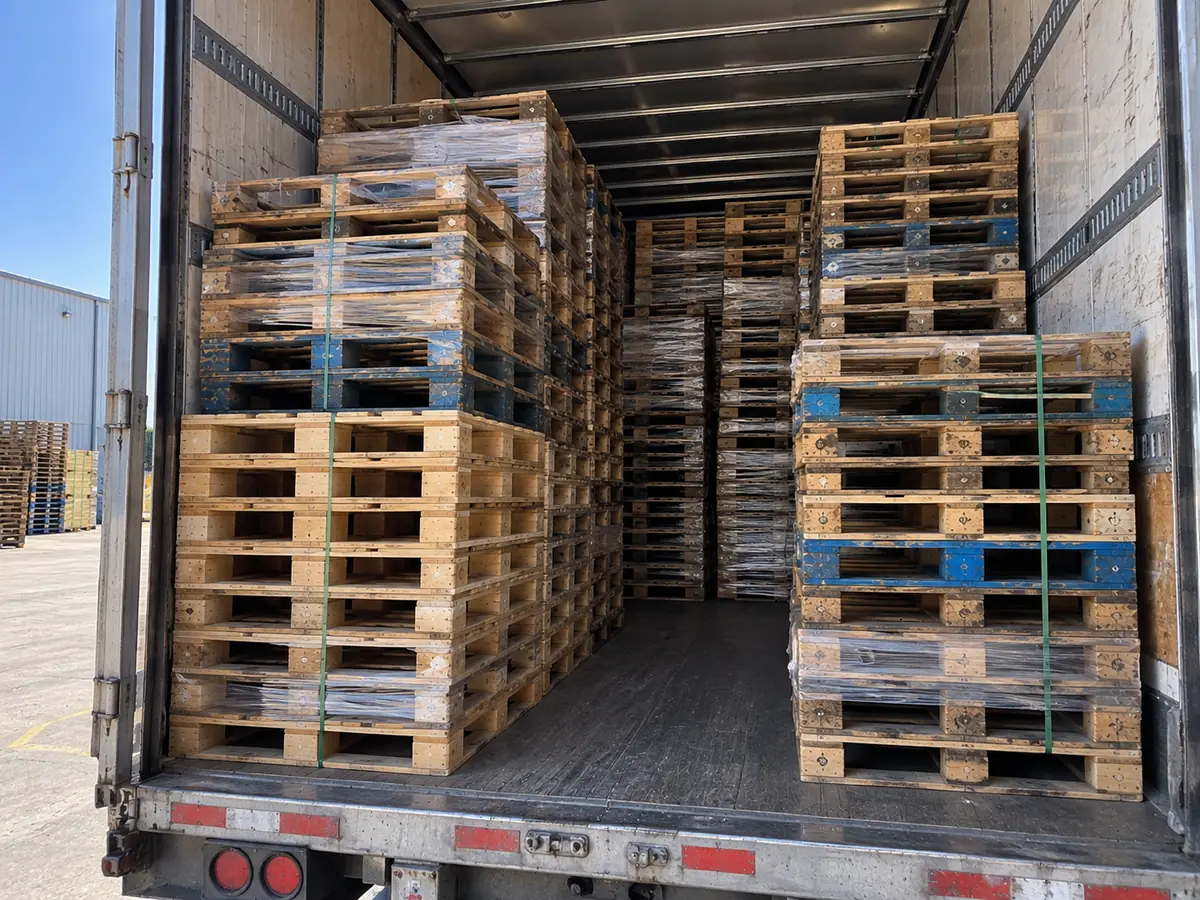
What a truck actually holds
A 53-foot dry van carries a large number of standard 48x40 pallets, and the exact count depends on stack height and whether the pallets are uniform. Flatbeds can stack higher, but need side unloading capability and tarping in bad weather. Most buyers are better served by a dry van unless they have a reach truck or a crane. Ask the supplier what it expects the load to be.
Weight is rarely the binding constraint with pallets; cube is. The exception is wet pallets, which weigh considerably more and can occasionally make weight the constraint.
Supplier trucks versus third-party carriers
Some suppliers deliver on their own trucks; others hand freight to a third-party carrier. The difference matters for scheduling. Delivery windows are much easier to hold on a supplier's own trucks than on arranged freight. If a window is critical, say so in your request.
Hauling low-value wood a long way is bad economics and worse carbon. If a partner supplier near you cannot serve your request, the follow-up may be from one that can, or it may be that a closer supplier is the better answer.
Backhaul, and why it is worth asking about
A truck that delivers pallets on a Tuesday is coming back empty unless it has something to carry. Freight that fits a lane a supplier already runs can be priced against an empty return leg rather than a full dedicated trip. Lanes change, so ask whether anything suitable is running when you need delivery.
Combining delivery and collection
Putting the delivery and the collection on the same truck visit is one of the largest cost reductions available to a pallet customer. New pallets go in, used pallets come out, one trip, one set of miles. It also reduces the carbon of the movement and removes a scheduling conversation. Not every supplier offers it, so mention it in your request. See pallet removal.
If you buy from one source and dispose of pallets somewhere else, you may be paying for two trucks to do one truck's work.
At a glance
- Handled byPartner suppliers in our network
- Typical equipmentDry van, flatbed, curtain-side, or box truck for small orders
- PricingBy quote; product and freight can be quoted separately
- CoverageRequests from across the US; availability depends on partner suppliers
- CollectionSome suppliers can take used pallets away on the same visit
Next steps
Reference
Reference table
| Equipment | Unloading | Best for |
|---|---|---|
| 53' dry van | Rear dock or forklift | The default for pallet freight |
| 48' dry van | Rear dock | Sites with limited dock depth |
| Flatbed | Side, reach truck or crane | Yards with side access; tarped in weather |
| Curtain-side | Side or rear | Mixed access and weather protection |
| Box truck | Rear or liftgate | Small orders and restricted access |
| Roll-off / stillage | Hook or forklift | Indoor accumulation, restricted docks |
| Dropped trailer | Your crew, over days | High, steady pallet generation |
Applications
Where this gets used
Delivery of graded stock
Pallets delivered to your dock by the partner supplier or an arranged carrier. Ask which applies to your order.
Combined delivery and collection
One truck, both directions. One of the largest cost and carbon reductions available to many pallet buyers.
Freight-only work
Some suppliers will haul pallets they did not sell you. Whether yours does is part of the follow-up.
Backhaul opportunities
If your freight fits a lane already running, it can be priced against an empty return leg. Ask what is running when you need it.
Economics
Why freight decides what a pallet actually costs you
Pallets are low value and high cube. That single fact makes freight a larger share of delivered cost than for almost anything else that moves on a truck, and it drives most of what looks like odd behaviour in this industry.
Cube, not weight
A dry van of recycled 48x40 pallets is normally well inside legal weight limits. You will cube out long before you weigh out.
The exception is wet pallets, which weigh considerably more and occasionally do make weight the binding constraint. Another reason covered staging matters.
Backhaul is where discounts can live
A truck delivering to one town on a Tuesday returns empty unless somebody gives it something to carry. That empty leg is a cost already committed, so freight that fits it can be priced against a cost that exists regardless.
Lanes change, so a supplier cannot usually publish them. Just ask what is running the week you need something moved.
The one-truck principle
Combining delivery and collection on a single visit removes an entire truck movement from your week. Fewer miles, less fuel, one booking, one gate arrival. Many buyers still do not realise the collection can ride on the delivery.
Why long hauls rarely make sense
Past a few hundred miles, the freight component of a pallet order stops making sense against the value of the pallets. The emissions from hauling a trailer a long way can rival the entire benefit of reusing the pallets.
So a closer supplier is usually the right answer for both cost and carbon. That is why requests are matched to partner suppliers near you where possible.
Access constraints are freight constraints
A 53-foot trailer needs somewhere to turn. A gate needing a permit adds time. A dock with a height restriction means different equipment and a different rate.
None of these are problems. All of them are problems discovered when the truck arrives. Mention them in your request and they simply become part of the plan.
Process
How it runs, step by step
Send origin, destination and volume
Plus dock type, access constraints and how flexible the window is. Flexibility is the currency in backhaul pricing.
Ask what lanes are running
A week or two ahead rather than on the day. Capacity changes and there is usually no published list.
Ask for product and freight separately
It makes the quote look more complicated and makes any future conversation about an increase much shorter.
Combine directions where possible
Delivery in, cores out, one visit. Ask whether the supplier offers it.
Confirm the window
Windows are easier to hold on a supplier's own trucks than on arranged freight. If it is critical, say so.
Decision rules
If this, then that
- If your site is on a lane a supplier already runsThen ask for backhaul pricing.
- If you buy and dispose of pallets separatelyThen ask whether one supplier and one truck can do both. It is one of the larger savings available.
- If the nearest supplier is far awayThen expect freight to dominate the cost, and ask whether a closer supplier can serve you.
- If you generate high, steady volumes of used palletsThen ask about a dropped trailer instead of booking collections.
Avoid
Common mistakes
Comparing delivered prices without splitting freight
A bundled delivered price hides which component moved when a rate changes. Ask for product and freight separately.
Assuming a flatbed is cheaper because it holds more
It holds more and it needs side unloading and tarping. Unless your site has the equipment, a dry van is usually the better total cost.
Booking tight windows on arranged freight
A supplier controls its own trucks and not somebody else's. If the window is critical, say so up front.
Not mentioning access until the truck arrives
Every access constraint is solvable with notice and expensive without it.
Terms
Vocabulary for this page
- Backhaul
- A return leg that would otherwise run empty. Freight fitting it is priced against an empty mile rather than a full one.
- Cube out
- Filling a trailer's volume before reaching its weight limit. The normal constraint for pallet freight.
- Dropped trailer
- A trailer left on site and swapped when full. Removes scheduling and keeps cores under cover.
- Own-fleet delivery
- Delivery on a supplier's own trucks, where the supplier controls the schedule and can promise a window.
- Arranged freight
- A third-party carrier moving the load. A different service level, and the carrier's window applies.
- Liftgate
- A powered platform on a truck's rear used where there is no loading dock.
The wider reference is in the pallet glossary.
Questions
Before you order
Do partner suppliers deliver everywhere?
Requests come from across the US, and availability depends on partner suppliers near you. Submit the request with your location and see who follows up.
Can I get a specific delivery window?
Ask the partner supplier. Windows are easiest to hold when a supplier delivers on its own trucks. On arranged third-party freight the carrier's window applies, and a good supplier will say so.
Can I pick up pallets myself?
Some suppliers allow it and it is often the cheapest way to buy, but it is the supplier's decision. Mention in your request that you can collect.
Can I pick up the pallets myself?
Some suppliers allow it and it is often the cheapest way to buy, but it is the supplier's decision. Mention in your request that you can collect.
Is weekend delivery possible?
Some suppliers deliver outside weekdays by arrangement, and most receiving docks are closed on Sundays. Give your receiving hours in the request.
What happens if a delivery is late?
That is between you and the delivering supplier or carrier. Ask how late deliveries are communicated before you commit.
Ready to put a number on it?
Send the footprint, the grade and the volume. We'll come back with price per unit and the first window we can hold.