Size guide
The 48x40 GMA pallet
The most widely used pallet in North America. If you only ever learn one footprint, learn this one, including the things about it that are quietly misunderstood.
Start a quote
Tell us the footprint, grade and volume. A partner supplier follows up with a quote.
Short answer
The 48x40 GMA pallet measures 48 inches long by 40 inches wide (1219 x 1016 mm) and stands about 5.5 inches tall. Weight commonly runs from the mid-30s to the high-40s in pounds depending on species and moisture. It is a four-way notched stringer pallet, typically with seven top deck boards and three or more bottom boards. Commonly quoted ratings are around 2,500 lb dynamic and 3,000 lb static; actual figures vary with build quality and condition.
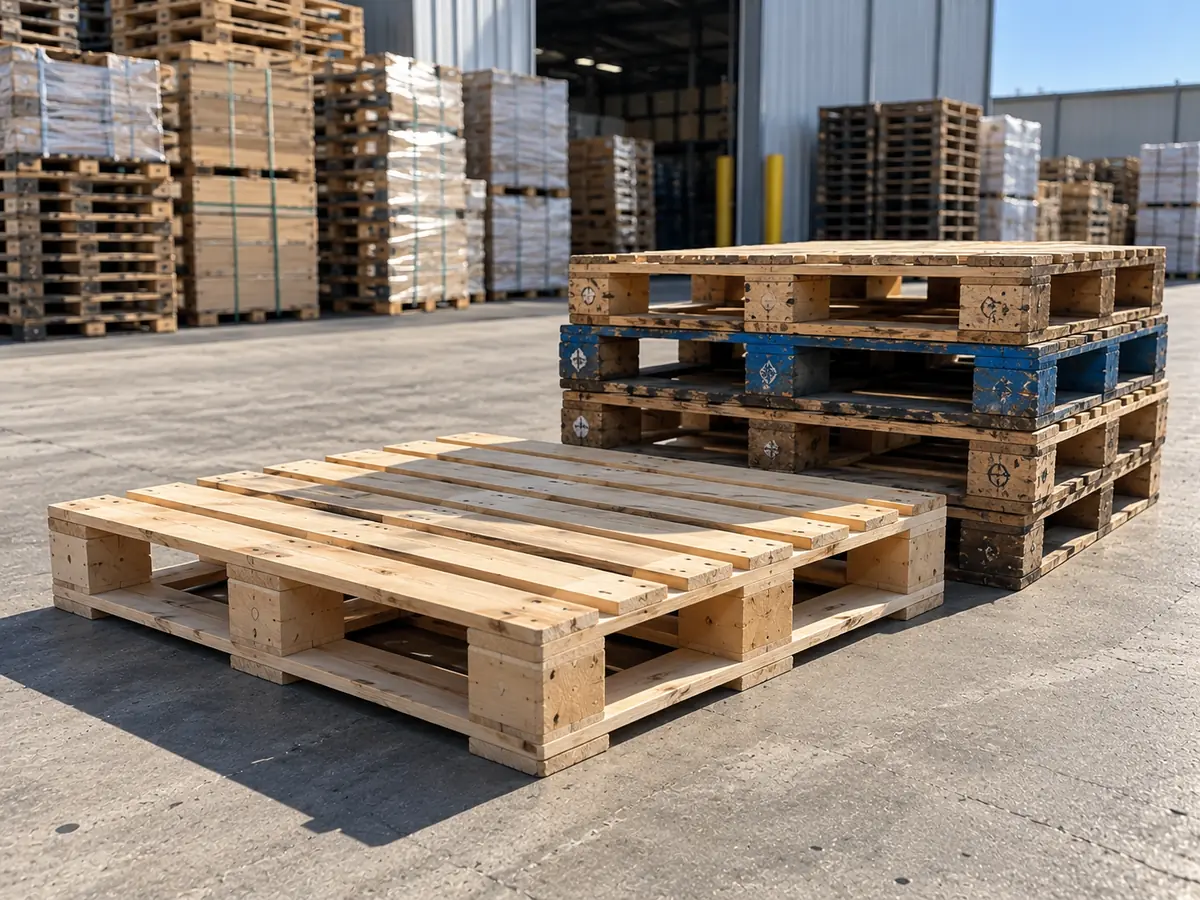
It fits a trailer
Two across a standard trailer with room to spare. That is the practical reason the footprint exists.
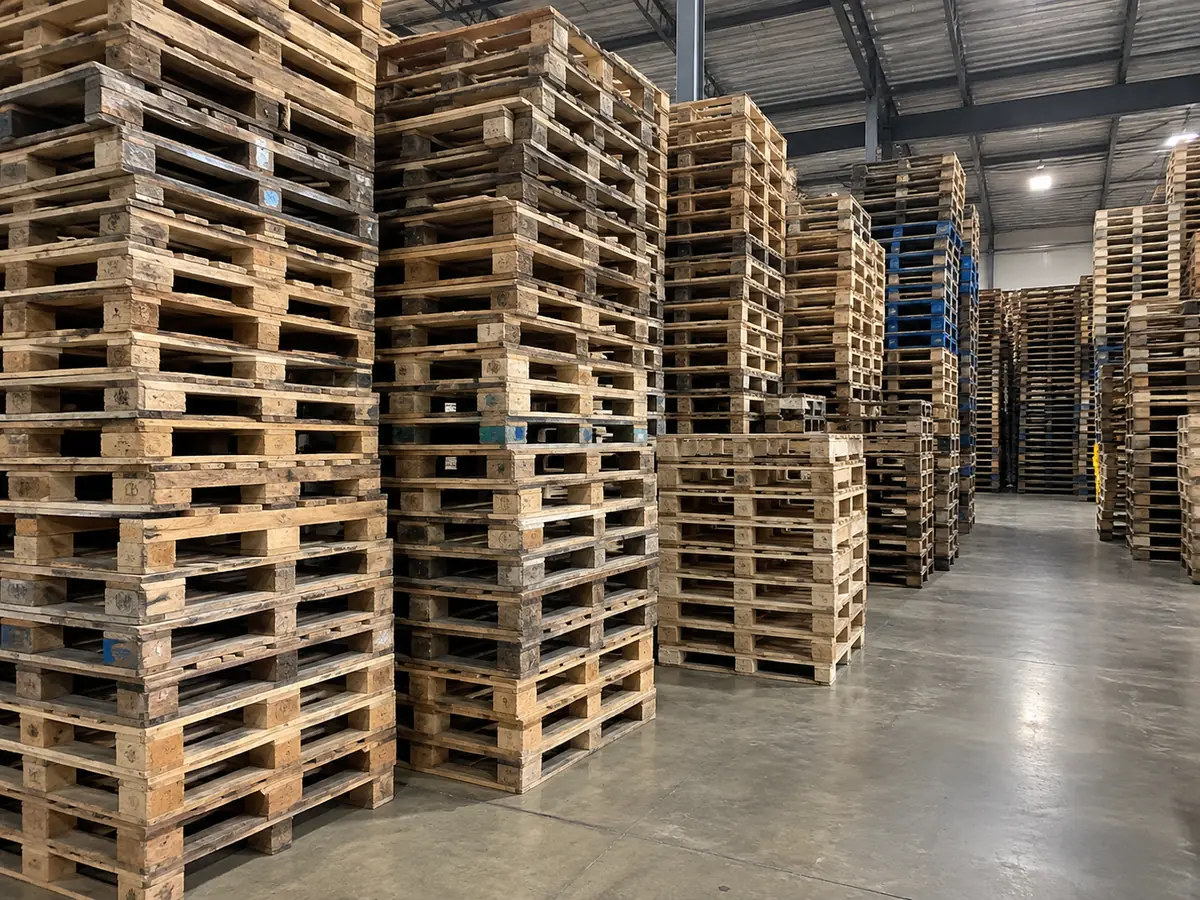
Deep used supply
This is the footprint where the recycled market is deepest. Request a quote →
Length first
48 is the stringer length. Stating it second is a common spec error in the industry.
Why 48 by 40, specifically
The dimension is derived from the truck, not the product. A standard 53-foot dry van has an internal width of roughly 98 to 100 inches. Two 48-inch pallets side by side is 96 inches, which leaves clearance for the load to be placed without scraping the walls. Turn them and two 40-inch pallets is 80 inches, wasting a large strip of width. Much about the footprint follows from that single constraint.
The specification takes its name from the Grocery Manufacturers Association, which is now the Consumer Brands Association. The name changed; the pallet kept its label.
Reading the spec properly
48 is the length, and it is the stringer dimension — the direction the three stringers run. 40 is the width, and it is the deck board dimension. Length always comes first. Write it as 40x48 and you have specified a different pallet, one where forks enter from a different face and the deck boards run the other way. It happens constantly.
The usual deck configuration is seven top boards and three bottom boards, 5/8 inch nominal on a typical build. Lead boards — the outer top boards and outer bottom boards — take the fork impact and are frequently thicker or made from stronger stock on well-built pallets.
Four-way entry, sort of
A GMA pallet is described as four-way, but it is not symmetrically four-way. The two 40-inch ends are true openings between the stringers, suitable for forks and pallet jacks. The two 48-inch sides have notches cut into the stringers, which admit forklift tines but not pallet jack wheels. This is 'partial four-way' or 'four-way notched', and knowing the difference will save you a frustrating afternoon at a dock. Block vs stringer explained →
Load ratings, and the racking trap
Commonly quoted figures for a sound 48x40 are roughly 2,500 lb dynamic (moving, on forks), 3,000 lb static (sitting on the floor, or stacked), and about 2,000 lb racked on unsupported edges. These vary with build and condition. The racking figure is the one that catches people, because it is the lowest and the least intuitive: a pallet supported only at its two ends, spanning a rack bay, is in bending and behaves nothing like a pallet on a floor.
If you rack heavy product on 48x40 pallets, either add wire deck or safety bars, or specify a heavier construction. The load capacity guide covers the reasoning.
Requesting used 48x40
This is the footprint where the recycled market is deepest. Grade A recycled carries a premium for appearance; Grade B is the common volume product; remanufactured is typically the lowest-priced and suits internal movement. Pricing comes by quote from partner suppliers. Grades compared →
One practical tip: if you buy recycled 48x40 for automated systems, specify 'no plugs, no companion stringers, height within 1/4 inch'. Automation does not care about appearance but it cares enormously about height variance.
At a glance
- Dimensions48" x 40" (1219 x 1016 mm)
- Height5.5" nominal
- WeightCommonly 33–48 lb, species and moisture dependent
- ConstructionStringer, 3 stringers, 4-way notched
- Top deckTypically 7 boards, 5/8" nominal
- Bottom deckTypically 3 boards (some builds use more)
- Dynamic load~2,500 lb (commonly quoted, varies)
- Static load~3,000 lb (commonly quoted, varies)
- Racking load~2,000 lb (commonly quoted, edge-rack, unsupported)
Next steps
Reference
Reference table
| Component | Nominal | Count | Notes |
|---|---|---|---|
| Overall length | 48 in (1219 mm) | — | The stringer direction — always stated first |
| Overall width | 40 in (1016 mm) | — | The deck board direction |
| Overall height | 5.5 in (140 mm) | — | 5/8 deck + 3.5 stringer + 5/8 deck + tolerance |
| Top deck boards | 5/8 in x 3.5–5.5 in | Typically 7 | Lead boards often thicker or stronger stock |
| Bottom deck boards | 5/8 in x 5.5 in | Typically 3 | Chamfered edges on well-built pallets |
| Stringers | Commonly 1-3/8 x 3-1/2 x 48 in | 3 | Notched for partial four-way entry |
| Notches | Commonly about 9 x 1-1/2 in | 4 | Two per outer stringer face |
| Fasteners | Helical or screw-shank | Varies | More fasteners per joint on lead boards |
| Deck coverage | Varies by build | — | Narrow gaps suit mixed-case loads |
| Condition | Rating | Why |
|---|---|---|
| Static (on a floor) | ~3,000 lb | The floor carries the load; the pallet must not crush |
| Dynamic (on forks) | ~2,500 lb | Bending and shear through deck into stringers |
| Racked, unsupported | ~2,000 lb | Stringers become beams spanning 40 in |
| Racked, wire deck fitted | Rack rating | Load transfers into the rack structure |
| Racked, wrong orientation | Sharply lower | Only the 5/8 in deck boards span the gap |
Applications
Where this gets used
Grocery and food distribution
The footprint takes its name from the Grocery Manufacturers Association and the sector still runs on it heavily.
Third-party logistics
The footprint with the deepest recycled supply, which is why 3PLs standardise on it wherever a client will allow.
General manufacturing
Fits standard racking, standard trailers and standard handling. Departing from it costs money in every direction.
Retail back-of-house
Grade A 48x40 for anything that reaches a shop floor; Grade B for everything behind the doors.
Why this footprint
It was derived from a trailer, not from a product
The most useful thing to understand about 48x40 is that the dimension has little to do with what goes on top of it.
The trailer arithmetic
A standard 53-foot dry van has an internal width of roughly 98 to 100 inches. Two 48-inch pallets side by side is 96 inches, leaving clearance to place the load without scraping the walls.
Turn them and two 40-inch pallets is 80 inches, wasting a large strip of width across the entire trailer. Much about the footprint follows from that.
The specification takes its name from the Grocery Manufacturers Association, now the Consumer Brands Association. The name changed. The pallet did not.
Length first, and why it matters
48 is the length and it is the stringer dimension — the direction the three stringers run. 40 is the width and it is the deck board dimension.
Write it as 40x48 and you have specified a different pallet: forks enter from a different face, the deck boards run the other way, and the racking orientation inverts. It is a common specification error in the industry.
'Four-way', with an asterisk
A GMA pallet is described as four-way and it is not symmetrically four-way. The two 40-inch ends are true openings between the stringers, suitable for forks and pallet jacks. The two 48-inch sides have notches cut into the stringers, which admit forklift tines but not pallet jack wheels.
This is 'partial four-way' or 'four-way notched'. Knowing the difference saves a frustrating afternoon at a dock — and if your operation runs manual jacks from the side, you need block construction rather than a notch.
The racking trap
Commonly quoted ratings are roughly 3,000 lb static, 2,500 lb dynamic and 2,000 lb racked on unsupported edges. The racking figure is lowest and least intuitive, because a pallet supported only at its two ends is in bending and behaves nothing like a pallet on a floor.
Bending stress rises with the square of span, and a concentrated load at mid-span produces roughly twice the moment of the same weight distributed evenly. Wire decking or safety bars transfer load into the rack and effectively remove the constraint. Load capacity guide.
Requesting recycled 48x40
This is the footprint where the recycled market is deepest. Grade and quantity account for much of the price spread, and pricing comes by quote from partner suppliers. Request a quote.
For automated systems, specify beyond the grade letter: *no plugs, no companion stringers, height within 1/4 inch, square within 1/4 inch, bottom boards chamfered, no protruding fasteners.* Automation does not care about appearance and cares enormously about dimensional consistency.
Process
How it runs, step by step
Confirm it is genuinely 48x40
Measure a sample. Footprint drift is real and easy to miss; a site that believes it runs all GMA may not.
Decide the grade by where the pallet goes
Grade A if it is seen or automated; Grade B otherwise. This split is one of the easiest savings available.
State the dimension length-first
48x40. Not 40x48. On a quote, in the PO, and on the rack signage.
Check racking orientation
Stringers must span the beams. Turned ninety degrees, capacity falls sharply.
Specify tolerances if you run automation
Height, squareness, chamfer and fastener protrusion — the grade letter alone is a proxy, not a specification.
Decision rules
If this, then that
- If you need the most readily available pallet in North AmericaThen 48x40 recycled. Nothing else has comparable supply depth.
- If your product is longer than 48 inchesThen stop forcing it. Overhang costs more in damage than a custom footprint costs to build.
- If manual pallet jacks need side entryThen notches will not do it — specify block construction.
- If the pallet will be edge-racked with heavy productThen fit wire decking, or ask about an engineered build.
Avoid
Common mistakes
Writing 40x48
A different pallet with different fork faces and a different racking orientation. Length always comes first.
Assuming GMA means CHEP
GMA is a footprint and construction standard. CHEP is a pooling company whose blue pallets remain its property. Pooled pallets are not for resale.
Racking with stringers parallel to the beams
Only the 5/8 in deck boards then span the gap. Capacity falls sharply.
Buying Grade A for a warehouse-only pallet
You are paying for appearance you will never see. Split the buy.
Terms
Vocabulary for this page
- GMA
- Grocery Manufacturers Association (now the Consumer Brands Association) — the body whose name the 48x40 specification carries.
- Partial four-way
- A notched stringer pallet: four-way for forklifts, two-way for pallet jacks whose wheels need floor-level clearance.
- Deck coverage
- The proportion of the pallet surface covered by boards.
- Lead board
- The outermost deck board at each end. Takes fork impact and is the most frequently replaced component.
- Wire deck
- Mesh decking fitted across rack beams. Transfers load into the rack and removes the pallet's racking limit as a constraint.
- Height variance
- Deviation from the 5.5 in nominal. Beyond about 1/4 in it causes problems in automated storage and conveyor transfers.
The wider reference is in the pallet glossary.
Questions
Before you order
How much does a 48x40 pallet weigh?
Commonly between about 33 and 48 lb. Southern yellow pine at typical service moisture sits toward the lower-middle of that range; hardwood runs heavier; a wet pallet can weigh considerably more, which is one reason rain-soaked stock is less desirable.
How many 48x40 pallets fit in a 53-foot trailer?
Floor-loaded in a single layer, a commonly quoted figure is 26 (two across, thirteen deep). Actual counts depend on loading pattern and trailer dimensions.
Is GMA the same as CHEP?
No. GMA describes the 48x40 footprint and construction standard. CHEP is a pallet pooling company whose blue block pallets are also 48x40 but are a different construction and remain CHEP's property. Pooled pallets are not for resale.
What is the height of a 48x40 pallet?
About 5.5 inches nominal — 5/8" top deck, 3.5" stringer, 5/8" bottom deck, plus tolerance. Height variance beyond about 1/4 inch causes problems in automated storage.
How many 48x40 pallets fit in a 40-foot container?
A commonly quoted figure is about 20 on the floor. A 1200x800 Euro footprint fits 24 or 25 in the same box, which is worth knowing before you standardise a container lane.
What does a 48x40 pallet cost new?
New and recycled pallets are both priced by quote from partner suppliers. As a rule of thumb new pallets cost more than recycled ones of the same footprint.
Can 48x40 pallets be double-stacked in a trailer?
Loaded, only if the product is stackable and the bottom pallet stays within its static rating including everything above. The pallet is rarely the limiting factor — the product usually is.
Ready to put a number on it?
Send the footprint, the grade and the volume. We'll come back with price per unit and the first window we can hold.