Size guide
Pallet load capacity guide
Three numbers, three completely different loading conditions, and one of them is far lower than the others. The one that catches people is always racking.
Start a quote
Tell us the footprint, grade and volume. A partner supplier follows up with a quote.
Short answer
Pallets carry three distinct load ratings. Static capacity is the load a pallet can hold sitting on a flat floor — the highest figure. Dynamic capacity is the load it can carry while being moved by forklift, typically lower than static. Racking capacity is the load it can support spanning between rack beams with no deck support underneath, typically the lowest of the three. Commonly quoted figures for a standard 48x40 GMA pallet are roughly 3,000 lb static, 2,500 lb dynamic and 2,000 lb racked; actual ratings vary with build and condition.
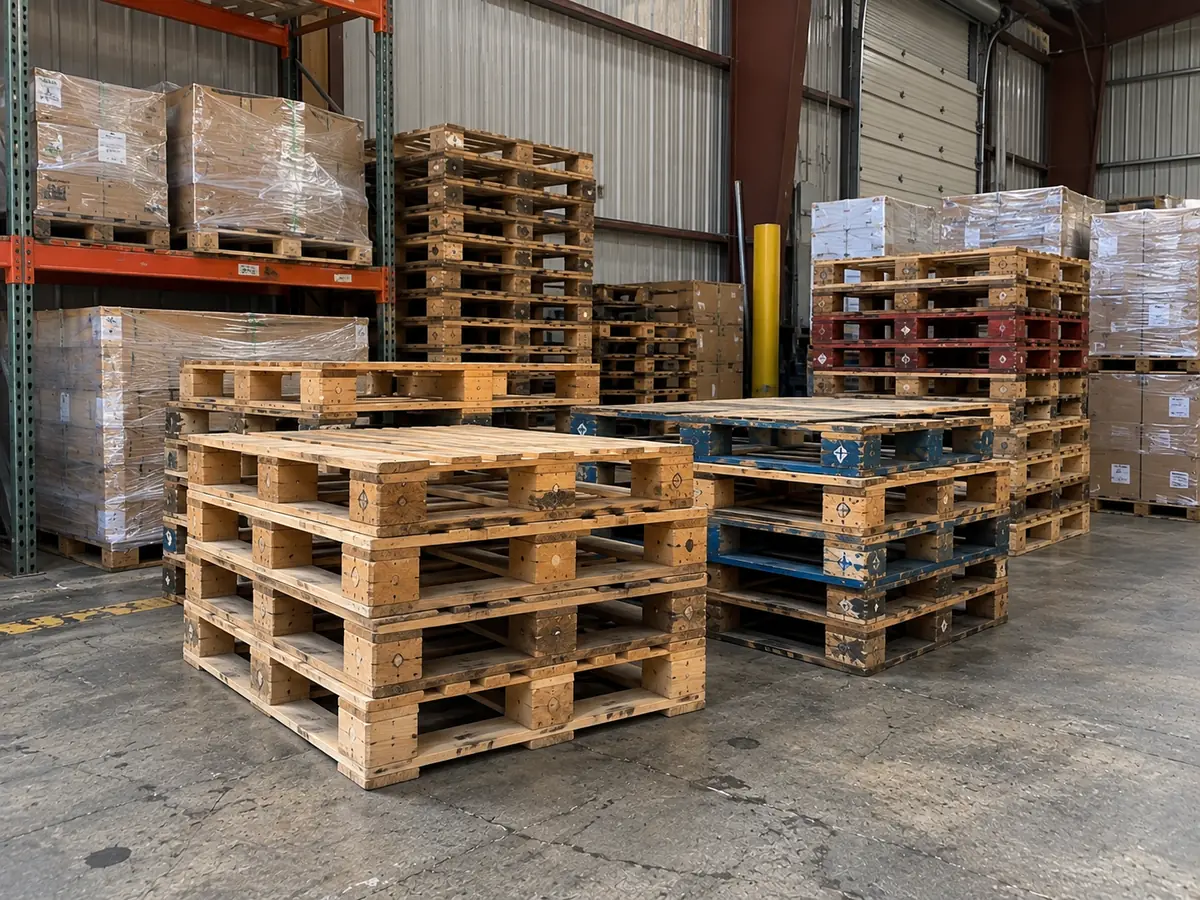
Racking is the trap
A pallet spanning a rack bay is a beam in bending. It behaves nothing like a pallet on a floor.
Wire deck changes everything
Adding wire mesh or safety bars moves the load into the rack and effectively removes the racking limit.
Repaired is not weaker
A properly repaired pallet can carry its original rating. How repair works →
The three ratings, precisely
Static load is the maximum weight a pallet can support while resting on a solid, flat surface. The floor carries almost all of the load; the pallet simply has to not crush. This is always the largest number, and it is also the least useful, because pallets rarely sit still.
Dynamic load is the maximum weight a pallet can carry while being lifted and moved. Now the load passes through the deck boards into the stringers or blocks and out through the fork tines. Bending and shear both appear. Typically meaningfully below static.
Racking load is the maximum weight a pallet can support when placed on rack beams with no continuous support beneath — effectively a simply supported beam spanning between two points. This is the lowest number, and it is the one that causes accidents because it is the least intuitive.
Why racking is so much lower
Consider a 48x40 pallet in a standard selective rack bay. It rests on two beams, front and back, spanning 40 inches with nothing underneath. All the load must travel through the deck boards into the stringers and then along the stringers to the beams. The stringers are now beams in bending with a 40-inch span, and bending stress rises with the square of span.
Worse: the load is not usually uniform. A concentrated load in the middle of the span produces roughly twice the bending moment of the same weight distributed evenly.
The fix is simple and relatively cheap. Wire decking or safety bars across the rack bay transfer load directly into the rack structure and effectively remove the pallet's racking limit as a constraint. If you rack anything heavy, fit them.
Deck orientation matters
In a stringer pallet, the stringers run the 48-inch direction. Place the pallet in a rack so the stringers span the beams (stringers perpendicular to the beams, resting on them) and the pallet is strong. Place it the other way and the deck boards alone are spanning the gap — capacity drops sharply.
This is one of the most common causes of rack-level pallet failure and it costs nothing to get right. Load orientation should be part of your rack signage.
Recycled and repaired pallets
A sound recycled pallet can carry the same rating as a new one of the same construction. A properly repaired pallet — full-length companion stringer, complete deck, correctly fastened — can also carry its original rating. What reduces capacity is unrepaired damage: a cracked stringer, a missing deck board in the load path, backed-out nails.
This is exactly what a good inspection is testing for. Grade is about appearance; inspection is about whether the pallet still carries its number.
Designing with a safety factor
For repeat-use applications, design well under the rated capacity. Ratings are typically determined on new pallets under controlled conditions. Real pallets are wet sometimes, dropped sometimes, and older than you think. A generous margin absorbs all of that.
For heavy or critical loads, ask a partner supplier about an engineered specification with a documented calculation basis; see custom pallets.
At a glance
- Static (48x40 GMA)~3,000 lb, commonly quoted
- Dynamic (48x40 GMA)~2,500 lb, commonly quoted
- Racking (48x40 GMA)~2,000 lb unsupported, commonly quoted
- Euro pallet static4,000 kg (8,800 lb), commonly quoted
- Euro pallet dynamic1,500 kg (3,300 lb), commonly quoted
- Heavy or critical loadsEngineered builds with a documented calculation
- Safety factorDesign to well under the rating for repeat use
Next steps
Reference
Reference table
| Pallet | Static | Dynamic | Racked | Notes |
|---|---|---|---|---|
| 48x40 GMA stringer | ~3,000 lb | ~2,500 lb | ~2,000 lb | The North American baseline |
| EPAL 1 block | 8,800 lb | 3,300 lb | ~2,200 lb | Static benefits most from block construction |
| Plastic nestable | Varies by model | Varies by model | Not rackable | Never edge-rack a nestable pallet |
| Plastic rackable | Varies by model | Varies by model | Varies by model | Steel rod reinforcement; check the maker's data |
| Engineered custom skid | Per design | Per design | Per design | Documented calculation basis |
| Situation | Effect on capacity | Fix |
|---|---|---|
| Floor stacked | Full static rating | None needed |
| On forks, moving | Below static | Design well under the dynamic rating |
| Edge-racked, correct orientation | Far below static | Fit wire deck or safety bars |
| Edge-racked, wrong orientation | Far lower again | Signage and induction — it is free to fix |
| Concentrated mid-span load | Roughly half a distributed load | Spread the load or add a cap |
| Wet pallet | Reduced | Covered staging |
| Unrepaired cracked stringer | Unknown — treat as zero | Repair or remove from service |
Applications
Where this gets used
Selective racking
The most common and most misunderstood condition. Racking capacity is the lowest of the three ratings by a wide margin.
Drive-in and push-back racking
Pallets rest on rails rather than beams. Support condition differs — ask the rack supplier for the assumed pallet spec.
Floor block stacking
Static rating applies, and the bottom pallet carries everything above it including the pallets.
Conveyor and AS/RS transfer
Dynamic loading plus dimensional tolerance. Both matter; the tolerance usually matters more.
Engineering
Why the three ratings are so different
Three numbers, three completely different loading conditions, and one of them is far lower than the others. The one that catches people is always racking.
Static: the floor does the work
A pallet resting on a solid flat surface transfers load almost directly into the floor. The pallet simply has to not crush. This is always the largest number and the least useful, because pallets rarely sit still.
Dynamic: bending and shear appear
Lifted on forks, the load passes through the deck boards into the stringers or blocks and out through the tines. Bending and shear both appear, so the rating is meaningfully below static.
Racking: the pallet becomes a beam
Placed on rack beams with nothing underneath, a 48x40 pallet is a simply supported beam spanning about 40 inches. All the load must travel through the deck into the stringers and along them to the beams.
Bending stress rises with the square of span. And loads are rarely uniform: a concentrated load at mid-span produces roughly twice the bending moment of the same weight distributed evenly.
That is why the racking figure is far below static and why it causes accidents — it is the least intuitive of the three.
Orientation is free to get right
In a stringer pallet the stringers run the 48-inch direction. Place the pallet so the stringers rest on the beams and span the gap, and the pallet is strong. Place it the other way and the 5/8-inch deck boards alone bridge the span — capacity drops sharply.
This is one of the most common causes of rack-level pallet failure and it costs nothing to fix. Put an arrow on the bay signage and cover it in induction. The full write-up.
Wire decking removes the constraint
Mesh decking or safety bars transfer load directly into the rack structure. The pallet is then fully supported and its racking rating largely stops being the limit. Anything heavy, anything valuable, anything above head height — fit them.
They also catch things. A carton that shifts off a pallet on an open beam bay falls into the aisle; on decking it does not.
Moisture reduces capacity
Wood loses strength as moisture content rises. A saturated pallet loses a meaningful share of its dry capacity as well as gaining substantial weight. A pallet rated for a given dynamic load dry is not carrying that soaked.
Design with a margin
Published ratings are generally determined on new pallets under controlled conditions. Real pallets are wet sometimes, dropped sometimes, and older than you think. For repeat-use applications, design well under rated capacity; the margin absorbs all of it.
For heavy or critical loads, ask about an engineered build with a documented calculation basis.
Process
How it runs, step by step
Identify the support condition
Floor, forks, or racked without deck support. Three different numbers apply.
Check load distribution
Concentrated loads roughly double the bending moment of the same weight spread evenly.
Check orientation in the rack
Stringers must span the beams. Walk an aisle and look up — you should see stringer ends facing you.
Fit wire deck for anything heavy
It transfers load into the rack and effectively removes the pallet's racking limit.
Apply a margin
Design well under the rating for repeat use. Ratings assume new, dry, undamaged pallets.
Decision rules
If this, then that
- If the load is heavy and rackedThen fit wire decking or safety bars. Do not rely on the pallet.
- If the load is concentrated rather than distributedThen assume a much lower effective rating, or add a cap to spread it.
- If pallets are stored outdoorsThen assume reduced capacity until they are dry.
- If the application is criticalThen ask for an engineered build with a documented calculation rather than relying on published figures.
Avoid
Common mistakes
Quoting one number as 'the' capacity
Static, dynamic and racked are three different figures. A supplier quoting one without saying which is not being helpful.
Racking to the static rating
This is how rack-level failures happen. Racked capacity is far lower.
Ignoring orientation
Turned ninety degrees, a stringer pallet loses much of its racking capacity. Free to fix, invisible when wrong.
Assuming repaired means weaker
A properly repaired pallet can carry its original rating. Unrepaired damage is what reduces capacity.
Terms
Vocabulary for this page
- Static load
- Maximum weight on a flat solid surface. The highest rating and the least useful.
- Dynamic load
- Maximum weight while being moved by forklift. Lower than static.
- Racking load
- Maximum weight spanning rack beams without deck support. Typically the lowest of the three.
- Bending moment
- The internal force that bends a beam. Rises with the square of span and roughly doubles for a concentrated mid-span load.
- Wire deck
- Mesh decking across rack beams. Transfers load into the rack structure and removes the pallet's racking limit.
- Safety bar
- A steel bar across a rack bay serving the same purpose as wire decking at lower cost and lower coverage.
The wider reference is in the pallet glossary.
Questions
Before you order
How much weight can a standard pallet hold?
Commonly quoted figures for a sound 48x40 GMA pallet are roughly 3,000 lb static, 2,500 lb dynamic and 2,000 lb racked without support. Treat those as ceilings, not targets, and design well under them for repeat use.
Does a wet pallet carry less?
Yes. Wood strength falls as moisture content rises, and a saturated pallet also gains substantial weight. Keep stock under cover.
Can I stack loaded pallets?
Only if the load itself is stackable and the bottom pallet is within its static rating including everything above it. The pallet is rarely the limiting factor — the product usually is.
Where do published pallet ratings come from?
Industry testing standards and convention, applied to new pallets under controlled conditions. They are not per-unit certifications. For critical loads, ask for an engineered build with a documented calculation.
Does a Grade B pallet carry less?
Not when it is properly repaired. A full-length companion stringer can restore original capacity. Unrepaired damage reduces capacity; visible repair does not.
How do I know if my racking is overloaded?
Compare the beam rating, the pallet racking rating and the actual load — the lowest governs. If the pallet is the limit, fit wire decking; it is often cheaper than heavier pallets.
Ready to put a number on it?
Send the footprint, the grade and the volume. We'll come back with price per unit and the first window we can hold.