Grade
Grade B pallets
The most misunderstood grade. A Grade B pallet is not a damaged pallet — it is a repaired one, and for a large share of applications it is exactly the right thing to buy.
Start a quote
Tell us the footprint, grade and volume. A partner supplier follows up with a quote.
Short answer
A Grade B recycled pallet is structurally sound but carries visible repairs — typically a companion stringer, one or more replaced deck boards, or a plugged notch — and may show colour variation or staining. It carries the same rated load as Grade A of the same construction, at a lower price, and is the appropriate choice for internal movement and non-customer-facing freight.
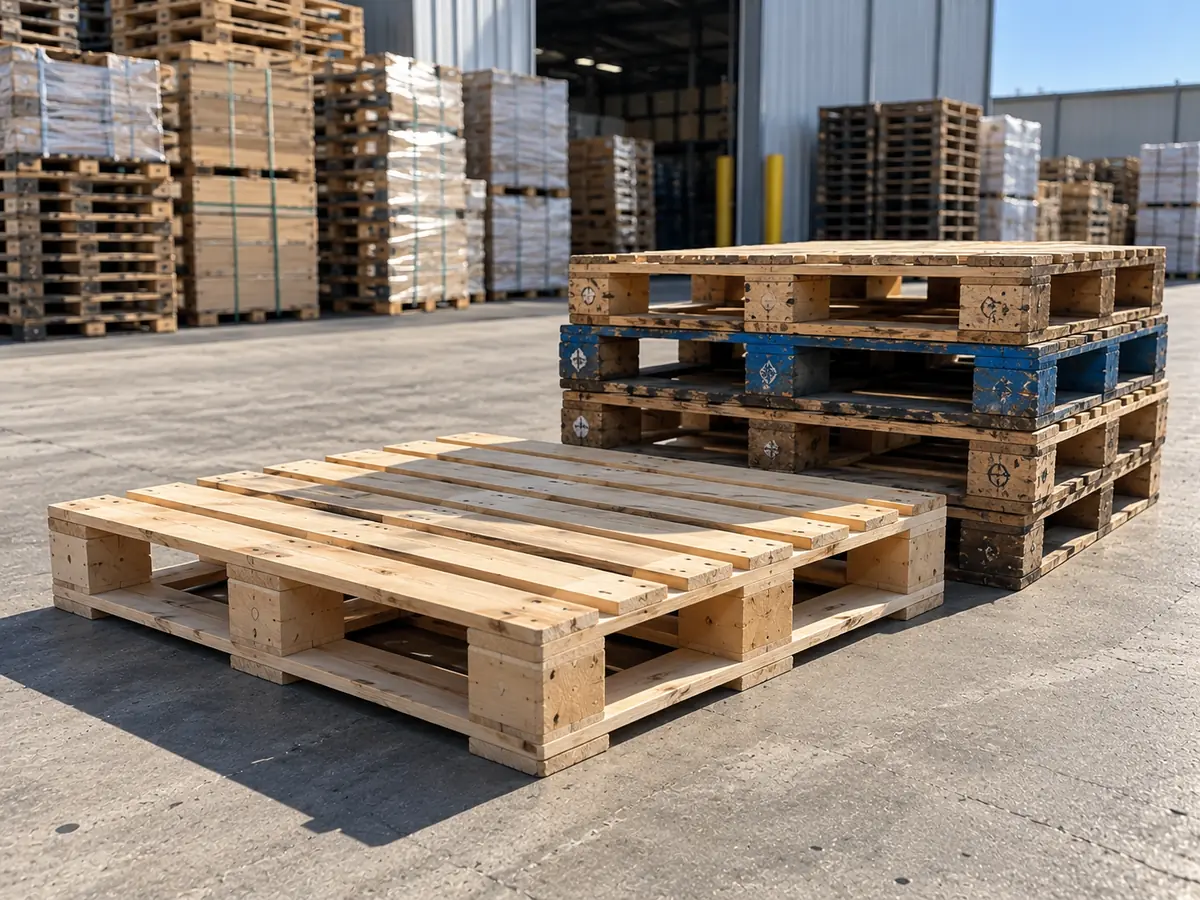
Same load, lower price
The repair restores capacity. What you give up is appearance. Load ratings →
Often newer wood
A repaired pallet contains recently replaced boards. Sometimes the B pallet has more life left than the A.
The volume grade
For most jobs it is the right answer, which is why it is the common volume grade in the recycled market.
What a Grade B pallet actually contains
A companion stringer, most often. When a stringer cracks — usually at the notch, where material has been removed at a high-stress point — the standard repair is to nail a second full-length stringer alongside it. The repaired assembly is stronger than the original stringer was before it cracked. It is also unmistakably visible, which is why it costs a grade.
Beyond that: replaced deck boards, which may be a different colour or a slightly different width; plugged notches, where a block fills damage in a stringer face; and general cosmetic variation — staining, banding marks, forklift scarring, faded stamps.
What a Grade B pallet does not contain: cracked stringers that have not been repaired, missing deck boards, protruding nails, twist, or any contamination. Those are rejection criteria at any grade. How pallets are inspected →
The economics
Grade B is priced below Grade A for the same footprint. For a site buying pallets in volume, choosing B where B is appropriate is a straightforward saving with no operational consequence.
Most facilities over-specify. They buy a single grade for everything because it simplifies purchasing, and that grade is A because nobody was ever criticised for buying the better one. Splitting your buy — A for customer shipments, B for everything internal — is one of the easiest pallet cost reductions available.
When B is the wrong answer
Automated storage with tight tolerance. Repaired pallets vary more in height, and a companion stringer adds width at one edge. Retail floor display, where the pallet is visible to customers. Audited environments where pallet condition is read as housekeeping. And any situation where a receiving dock has a documented grade requirement — arguing about it costs more than the pallets.
The service-life question
People assume a Grade B pallet is older and will fail sooner. It is frequently the opposite. A Grade B pallet has, by definition, had components replaced recently. A Grade A pallet is entirely original, which means every component is as old as the pallet.
It would be wrong to claim B outlasts A — there are too many variables. The assumption that it does not is unfounded, and grade is a statement about appearance at the moment of inspection rather than a prediction about the future.
Requesting it
Grade B is the most commonly available grade in 48x40 and most standard footprints. Quantities, delivery and pickup depend on the partner supplier. For mixed requirements, ask about a combo — a deliberate blend of A and B in an agreed proportion, priced between the two. Request a quote.
At a glance
- StringersOriginal or repaired with full-length companion
- Deck boardsFull count; replacements permitted
- PlugsPermitted
- ColourVariation and staining permitted
- SquareWithin 1/2" across diagonals
- Load ratingSame as Grade A of same construction
- PriceBelow Grade A; by quote
Next steps
Reference
Reference table
| Feature | Permitted in B? | Effect on load | Note |
|---|---|---|---|
| Companion stringer, full length | Yes | None — capacity restored | The defining Grade B feature |
| Replaced deck boards | Yes, any number | None | Colour match not required |
| Plug in a stringer | Yes | Minor | Not permitted at any A grade |
| Colour variation, staining | Yes | None | Cosmetic only |
| Banding and forklift marks | Yes | None | Cosmetic only |
| Short 'sister' stringer | No | Moves failure point | Not an acceptable repair at any grade |
| Unrepaired cracked stringer | No | Severe | Rejection at every grade |
| Missing deck board in load path | No | Severe | Rejection |
| Protruding fasteners | No | None, but damages product | Rejection until re-nailed |
| Twist | No | Rocks in a rack, jams automation | Rejection at every grade |
| Mould, contamination, MB stamp | No | — | Rejected at intake |
Applications
Where this gets used
Internal movement
Warehouse to warehouse, production to staging. Nobody outside the building sees it and the load rating is identical.
Inter-site transfer
Between your own facilities, where the pallets come back and appearance is irrelevant.
One-way domestic freight
The pallet is not returning. Pay for structure, not for looks.
Non-automated racking
Standard selective racking with wire deck does not care about a companion stringer.
The case for B
The most misunderstood grade
A Grade B pallet is not a damaged pallet. It is a repaired one, and for a large share of applications it is exactly the right thing to buy.
What is actually in one
A companion stringer, most often. When a stringer cracks — usually at the notch, where material has been removed at a high-stress point — the standard repair nails a second full-length stringer alongside it. The repaired assembly is stronger than the original stringer was before it cracked. It is also unmistakably visible, which is why it costs a grade.
Beyond that: replaced deck boards, possibly a different colour or width; plugged notches; and general cosmetic variation — staining, banding marks, forklift scarring, faded stamps.
What is not in one
Cracked stringers that have not been repaired. Missing deck boards. Protruding nails. Twist. Contamination of any kind. Those are rejection criteria at every grade, and a Grade B pallet should pass the same structural inspection as a Grade A pallet.
This is the point most buyers miss: B is not a lower structural standard. It is a lower cosmetic one.
The service-life question
People assume a Grade B pallet is older and will fail sooner. Frequently it is the opposite. A Grade B pallet has, by definition, had components replaced recently. A Grade A pallet is entirely original, which means every component is as old as the pallet.
It would be wrong to claim B outlasts A — too many variables. The assumption that it does not is unfounded.
The economics
Grade B is priced below Grade A for the same footprint. For a site buying pallets in volume, choosing B where B is appropriate is a straightforward saving with no operational consequence.
Most facilities over-specify because nobody was ever criticised for buying the better one. Splitting the buy is one of the easiest pallet cost reductions available.
When B is the wrong answer
Automated storage with tight tolerance — repaired pallets vary more in height, and a companion stringer adds width at one edge. Retail floor display. Audited environments. And any receiving dock with a documented grade requirement, where arguing costs more than the pallets.
Process
How it runs, step by step
List where your pallets actually go
Customer-facing, automated, internal. Three categories, two grades.
Assign B to everything internal
For many sites this is most of the volume, and the saving is immediate.
Confirm the structural standard
Ask the supplier what B permits and what it rejects, in writing.
Ask about combo where the split is unclear
An agreed blend of A and B, priced between the two and below straight A.
Check receiving-dock requirements
Some customers specify a grade contractually. Cheaper to know than to argue.
Decision rules
If this, then that
- If nobody outside your building sees the palletThen buy B and keep the difference.
- If the pallet runs through an AS/RSThen buy A — repaired pallets vary dimensionally.
- If the split is hard to predictThen ask for a combo load at an agreed A:B ratio.
- If a customer specifies a grade contractuallyThen meet it. The argument costs more than the pallets.
Avoid
Common mistakes
Treating B as 'seconds'
It should pass the same structural inspection. The difference is cosmetic tolerance and permitted repairs.
Assuming repaired means weaker
A full-length companion stringer restores original rated capacity. Two boards where there was one.
Accepting short sister boards as repairs
A partial stringer moves the failure point rather than removing it. Do not accept it from a supplier.
Buying A everywhere 'to be safe'
Safe from what? The load rating is identical. You are insuring against appearance.
Terms
Vocabulary for this page
- Companion stringer
- A full-length second stringer nailed alongside a cracked one. Restores rated capacity; defines Grade B.
- Sister board
- A short partial stringer spanning only a crack. Moves the failure point rather than removing it — not an acceptable repair.
- Combo load
- A deliberate blend of A and B in an agreed ratio, priced between the two.
- Structural rejection
- A defect that removes a pallet from service at any grade — cracked stringer, missing board, twist, contamination.
- Cosmetic tolerance
- The permitted level of visible repair, staining and colour variation. The only real difference between A and B.
- Grade drift
- A supplier's standard loosening over time without announcement. Why a written standard matters.
The wider reference is in the pallet glossary.
Questions
Before you order
Is a Grade B pallet safe?
Yes. A properly graded B pallet passes the same structural inspection as Grade A, with the same rejection criteria. What differs is cosmetic tolerance and permitted repairs, not structural acceptance.
Will my customers notice?
If the pallet reaches them, probably. Companion stringers and replaced boards are visible. That is exactly why splitting the buy makes sense: Grade A outbound, Grade B internal.
Can Grade B pallets be racked?
Yes, within the same racking rating as any pallet of that construction — commonly around 2,000 lb unsupported for a 48x40. Fit wire decking or safety bars for heavy loads regardless of grade.
Will my customers notice Grade B?
If the pallet reaches them, probably. Companion stringers and replaced boards are visible. That is exactly why it makes sense to split the buy rather than choosing one grade for everything.
Can Grade B pallets be exported?
Yes. Grade has nothing to do with phytosanitary compliance. What matters is ISPM 15 treatment and a legible stamp — and if the repair used untreated components, re-treatment.
Is there a Grade C?
Some suppliers use one. The scale used here stops at B because everything below B is either remanufactured, reclaimed as lumber, or rejected. A grade that means 'worse than B but still sold' is not useful to many buyers.
Ready to put a number on it?
Send the footprint, the grade and the volume. We'll come back with price per unit and the first window we can hold.