Comparison
Used vs new pallets
The honest version, including the four situations where new is the better choice even though used is usually cheaper.
Start a quote
Tell us the footprint, grade and volume. A partner supplier follows up with a quote.
Short answer
Used (recycled) pallets usually cost less than new, can carry the same rated load for the same construction, and avoid building a new pallet from fresh wood. New pallets are the right choice in four situations: regulated environments requiring documented provenance, one-way export to strict jurisdictions, dimensionally critical automation, and heavy point loads beyond what a recovered pallet should carry.
Same strength
Construction determines load rating, not age. Load capacity guide →
Usually lower cost
The single largest lever available on pallet spend. Pricing guide →
Four honest exceptions
Listed below, in detail. New is right in some cases.
Price
A recycled pallet is generally cheaper than a new one of equivalent construction. How much cheaper depends on grade, footprint, volume, freight and local core supply, so the only reliable number is a quote from a partner supplier. Request one. What moves a quote →
For a facility using pallets in volume, the difference between an all-new and a well-split used programme can be large. Selling your own used cores back can offset some of it.
Strength
Identical, for identical construction and condition. A sound recycled 48x40 stringer pallet is commonly quoted at around 2,500 lb dynamic and 3,000 lb static, the same as a new one; real ratings vary with construction and species. A repaired pallet with a full-length companion stringer can also carry its original rating, because there are now two boards where there was one.
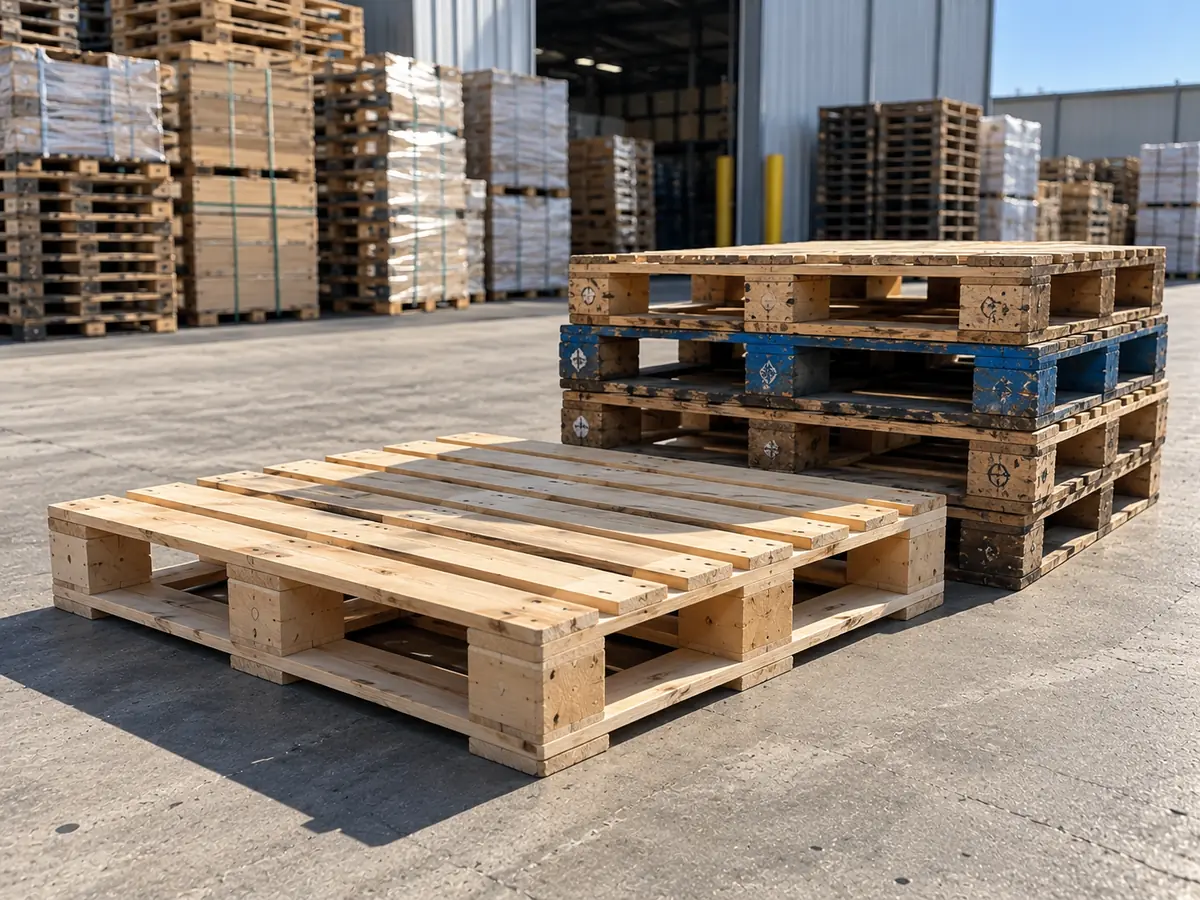
What changes with a used pallet is variance. New pallets are dimensionally consistent to a tight tolerance. Used pallets vary, which is precisely what grading exists to control. Grade A exists so that buyers who need consistency can buy it.
Service life
Harder to compare honestly, because a used pallet's remaining life depends on where it is in its own history. A recycled pallet early in its life has most of it ahead of it. One that has been repaired several times does not.
This is one of the reasons grading matters. A documented grade turns "used" from a single undifferentiated category into something you can specify.
Carbon
Reusing a pallet avoids building a new one: no harvesting, milling, drying or fabrication for that unit. A reused pallet carries only the impact of collection, inspection, any repair and redelivery. The size of the gap depends on distances and processes, so treat any single figure with caution and ask for the method behind it.
Impact also spreads across trips. A pallet that makes many trips amortises its original impact across all of them. A one-way new pallet does not amortise anything.
The four cases where new genuinely wins
1. Regulated environments
Pharmaceutical, medical device and some food-contact applications where an auditor requires unambiguous material provenance. A used pallet's service history is, by definition, incompletely known.
2. One-way export to strict jurisdictions
The pallet is not coming back, and the receiving country enforces phytosanitary rules aggressively. Used pallets can be re-treated and re-stamped, but if the stamp is challenged you want the simplest possible documentation trail.
3. Dimensionally critical automation
Some automated storage installations tolerate very little height or squareness variance. Grade A used pallets often meet the spec; new pallets are more likely to. Where a jam costs a production shift, the premium is trivial.
4. Heavy point loads
Loads beyond what a recovered pallet should carry. Here the answer is usually neither standard new nor used but an engineered custom build.
The recommendation
Split the buy. Grade A used for customer-facing shipments, Grade B used for internal movement, new only for the four cases above. Splitting by application is usually the largest saving available without any operational change.
At a glance
- PriceBy quote from partner suppliers; used is usually lower
- Load ratingSame for identical construction and condition
- ConsistencyNew is tighter; Grade A used is the closest
- CarbonReuse avoids building a new pallet
- AvailabilityUsed depends on local core supply; new can be built to order
Next steps
Reference
Reference table
| Property | Recycled | New | Winner |
|---|---|---|---|
| Unit price (48x40) | By quote; usually lower | By quote; usually higher | Recycled |
| Rated dynamic load | Commonly quoted ~2,500 lb | Commonly quoted ~2,500 lb | Tie — construction decides, not age |
| Dimensional consistency | Varies; Grade A tightest | High | New |
| Embodied impact | Collection, inspection, repair, redelivery | Harvest through manufacture | Recycled |
| Provenance documentation | Service history unknown | Traceable to mill | New |
| Availability in odd footprints | Thin | Built to order | New |
| Remaining service life | Depends on history | Full | New |
| Repairability | Identical | Identical | Tie |
| Suitability for reuse programmes | Already in circulation | Enters circulation | Recycled |
Applications
Where this gets used
General distribution
Recycled, split by grade. This covers most of the market and the decision is rarely close.
Regulated production
New, for documented provenance. A used pallet's service history is by definition incompletely known.
One-way strict-jurisdiction export
New plus ISPM 15, for the cleanest documentation trail.
Dimensionally critical automation
New, or Grade A recycled specified against written tolerances.
Heavy point loads
Neither — an engineered custom build with a documented calculation.
Odd footprints at volume
New or custom, because recycled supply outside standard footprints is thin.
Making the switch
How facilities typically move from all-new to a split buy
Most sites that switch do not switch everything at once, and the ones that try can create a problem that sets the whole programme back. Here is a sequence that works.
Step one: categorise where pallets go
Three buckets. Customer-facing outbound. Automated or dimensionally critical. Everything else.
At many sites the third bucket is the largest and nobody has ever counted it. That bucket is where most of the saving lives.
Step two: trial one bucket
Take the internal-movement bucket and run recycled Grade B for a month. Do not announce it as a cost-cutting exercise; announce it as a trial with a defined review.
The failure mode here is political rather than technical. Somebody notices a companion stringer, decides quality has dropped, and the trial dies before anybody looks at the numbers.
Step three: define receiving criteria
Write down what is acceptable, using the supplier's grading description as the base. Check a sample from every load for four things: cracked stringers, protruding fasteners, twist, contamination.
This takes a minute or two per load and it converts "the quality seems worse" into a checkable claim.
Step four: extend and measure
Once the internal bucket is stable, look at customer-facing. Many sites find that Standard Grade A serves it well and Premium is only needed for retail display.
Measure cost per pallet issued: purchase plus repair plus disposal minus recovery revenue, divided by pallets issued. It is the only number that captures the whole change.
The four exceptions, in detail
Regulated environments. Pharmaceutical, medical device, some food-contact. The requirement is documented provenance, which recycled cannot provide.
One-way strict export. The pallet is not coming back and the destination enforces phytosanitary rules aggressively. Recycled can be re-treated and re-stamped, but if a stamp is challenged you want the simplest possible trail.
Dimensionally critical automation. Where a jam costs a production shift, the premium is trivial. Note that Grade A recycled specified against written tolerances may meet the spec at lower cost.
Heavy point loads. Beyond standard ratings the answer is engineered rather than simply new.
What the switch is worth
That depends on your volumes, your grades and local supply, so ask for quotes on both options. Selling your own used cores can turn a disposal cost into a credit.
Process
How it runs, step by step
Categorise pallet destinations
Customer-facing, automated, internal. Count them — most sites have never separated the third.
Get the supplier's grading description in writing
Without it, "quality" is an opinion and the trial can fail politically rather than technically.
Trial one bucket for a month
Internal movement first. Defined start, defined review, measured outcome.
Set receiving criteria
A sample per load, four checks. Converts impressions into evidence.
Measure cost per pallet issued
Purchase + repair + disposal − recovery revenue, divided by pallets issued.
Decision rules
If this, then that
- If an auditor requires documented material provenanceThen buy new. This is not negotiable.
- If a jam costs a production shiftThen buy new, or Grade A against written tolerances.
- If the load exceeds standard ratingsThen buy engineered, not just new — they are different answers.
- If none of the above appliesThen buy recycled. Same rated load for the same construction, usually at lower cost.
Avoid
Common mistakes
Switching everything at once
One visible defect kills the whole programme. Trial a bucket, measure, extend.
Treating "used" as one category
Grade A, Grade B and remanufactured are different products with different applications and different prices.
Comparing unit price only
Cost per pallet issued includes repair, disposal and recovery revenue. The unit price is only part of the change.
Assuming new means dimensionally certified
It means consistent, not certified. If tolerances matter, write them down regardless of whether you buy new or used.
Terms
Vocabulary for this page
- Cost per pallet issued
- All-in cost — purchase, repair, labour, disposal, minus recovery revenue — divided by pallets issued.
- Provenance
- Documented material origin. The property new pallets have and recycled ones structurally cannot.
- Split buy
- Purchasing different grades for different applications rather than one grade for the whole site.
- Recovery revenue
- Income from selling your own used cores. Can turn a disposal cost line into a credit.
- Receiving criteria
- A short written checklist applied to incoming loads. What turns quality from an impression into a claim.
- Embodied carbon
- Total emissions from harvest through manufacture to delivery. Reuse avoids incurring this for a new pallet.
The wider reference is in the pallet glossary.
Questions
Before you order
Are used pallets less safe?
Not when they are properly graded. A used pallet passing a structural inspection can carry its rated load. The risk with used pallets is ungraded supply, not used supply, which is why how pallets are inspected matters more than the label.
How much can I save by switching to used pallets?
It varies by grade, volume and local supply, so ask for quotes on both. Selling your own used cores and splitting grades by application usually adds to the saving.
Can used pallets be exported?
Yes, with ISPM 15 heat treatment and stamping. Repaired pallets must be re-treated if the repair used untreated components.
Do used pallets void any warranty or insurance?
Check your own policies and contracts. What appears occasionally is a customer contract specifying pallet grade, which is a commercial requirement rather than an insurance one and is worth reading before you switch.
How do I handle a customer who objects to used pallets?
Send them the grading description and the load rating comparison. In many cases the objection is to unknown quality rather than to used pallets, and a written standard answers it.
Is a new pallet worth it for a very heavy load?
Not usually. You want an engineered build rather than a standard new pallet. New and heavy-duty are different specifications and conflating them wastes money.
Ready to put a number on it?
Send the footprint, the grade and the volume. We'll come back with price per unit and the first window we can hold.