Product · Reclaimed wood
Reclaimed lumber
The wood that cannot be a pallet again is still extremely good wood. It has already dried, already moved, already settled. De-nailed and sorted by species and thickness, it is sold by the bundle by suppliers who handle it.
Start a quote
Tell us the footprint, grade and volume. A partner supplier follows up with a quote.
Short answer
Reclaimed pallet lumber is wood salvaged from pallets that are beyond repair — primarily 5/8" and 3/4" deck boards and 1-3/8" x 3-1/2" stringers in southern yellow pine, oak and mixed hardwood. Partner suppliers can quote it de-nailed, sorted and bundled for builders, furniture makers, crate shops and manufacturers.
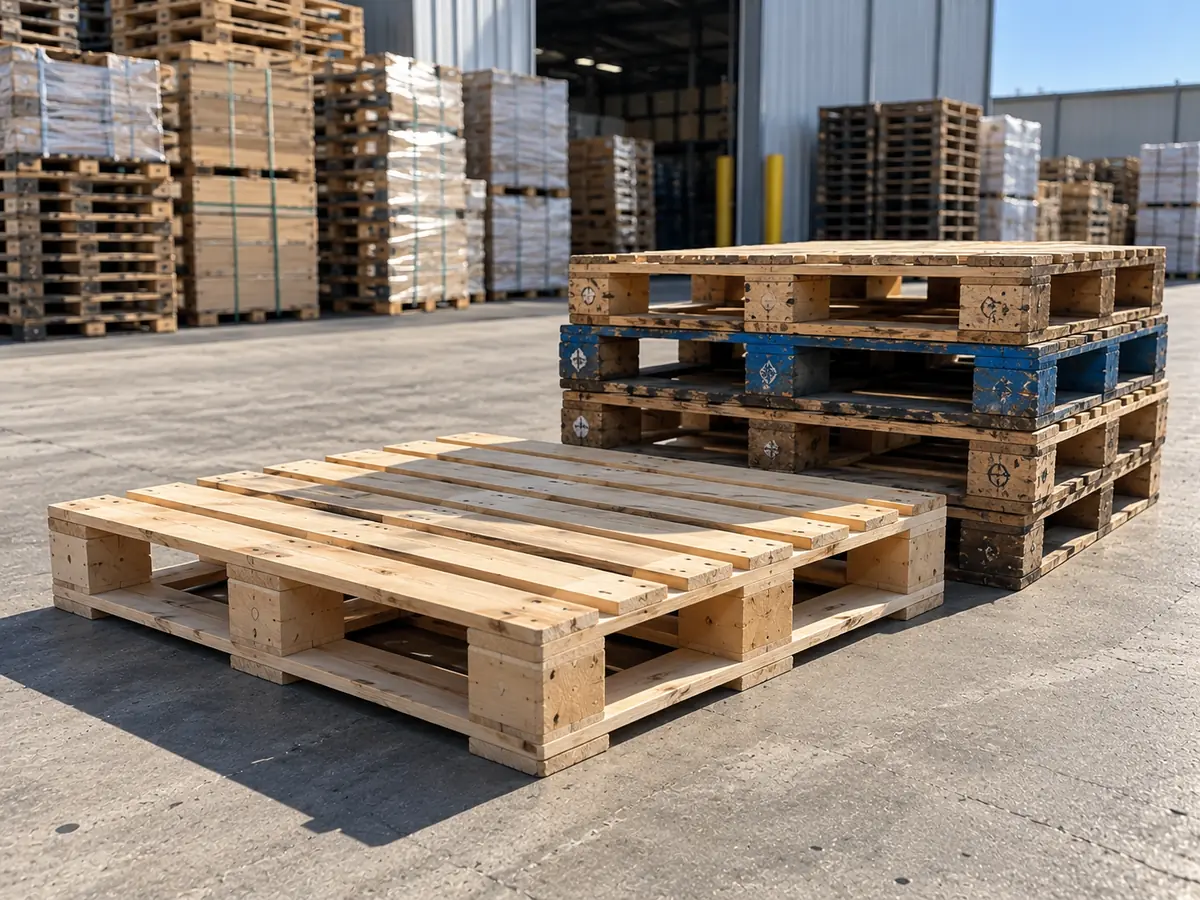
De-nailed
Ask whether stock is machine de-nailed, hand-checked and magnet-swept. Your planer knives will thank you.
Sorted, not shovelled
Ask for stock separated by species and thickness. Mixed bundles are cheaper and should be labelled as mixed.
Safe stock only
Ask for heat-treated (HT) source pallets only, and read the safety note below.
What reclaimed pallet lumber is good for
Furniture and casegoods, wall cladding, shelving, garden structures, crate and skid manufacture, shop fixtures, pattern stock, blocking and dunnage. It is not framing lumber — it is short, it is narrow, and it is not graded for structural use. But for anything under four feet where character matters and cost matters more, it is excellent.
Southern yellow pine deck boards run 5/8 to 3/4 inch thick and 3-1/2 to 6 inches wide. Hardwood deck boards — mostly red oak, some maple and ash — are the prize, and they go fast. Stringers are the useful one nobody asks for: 1-3/8 by 3-1/2 inches, straight, dry, and perfect once you rip the nail line off.
Why it works better than new
This wood has been through its whole moisture cycle. It was milled green, dried in service, absorbed and released humidity through many seasons, and found its shape. What you get is dimensionally stable stock that tends not to cup after you glue it up.
It also has a surface you cannot buy: forklift scars, banding marks, nail shadow, the ghost of a stencil. Some makers plane it off. Most do not.
How it is processed
Pallets destined for teardown go to a dismantler, which shears the deck boards off the stringers. Boards then typically pass through a de-nailer, a hand station where a person pulls what the machine missed, and a magnet sweep. A good operation rejects anything with a through-crack, heavy staining, visible mould, or evidence of chemical spill.
Washing, sanding, planing and kiln-drying are generally not part of standard reclaimed stock — they are things you can do better with your own equipment and your own tolerances. Some suppliers will kiln-dry a bundle on request if you are gluing up panels.
Buying it
Bundles are commonly sold by the board foot. Pallet-loads of mixed stock are cheaper per foot and are how most furniture shops buy. Describe what you need on the quote request and a partner supplier will follow up with what is available.
A word of honesty: reclaimed pallet lumber is not free wood. De-nailing is labour-intensive and the yield off a broken pallet is well under what you would expect from new lumber. What you are buying is the labour, not the wood.
Safety note
Ask about provenance before you use reclaimed lumber for food-contact or children's furniture. Visibly contaminated stock should be rejected, but a pallet's service history is not always knowable. Prefer pallets stamped HT (heat treated) rather than MB (methyl bromide); methyl bromide fumigation has been phased out in many jurisdictions, and MB-stamped pallets should not go into a reclaim stream at all.
At a glance
- Deck boards5/8" and 3/4" nominal, 3.5"–6" wide, 36"–48" long
- Stringers1-3/8" x 3-1/2", 36"–96" long
- SpeciesSouthern yellow pine, red oak, mixed hardwood
- De-nailingMachine de-nailed and hand-checked; always scan before machining
- Sold byBundle or by the pallet-load; confirm with the supplier
- MoistureAir-dried in service; confirm with the supplier
Next steps
Reference
Reference table
| Component | Nominal size | Length | Species | Best used for |
|---|---|---|---|---|
| Top deck board | 5/8" x 3-1/2"–6" | 36"–48" | SYP, oak, mixed hardwood | Cladding, shelving, box sides, crate panels |
| Bottom deck board | 5/8" x 5-1/2" | 36"–48" | SYP mostly | Shop fixtures, garden structures, dunnage |
| Wide board | 5/8"–3/4" x 7"–8" | 36"–48" | Red oak mostly | Single-board tabletops, feature panels |
| Stringer | 1-3/8" x 3-1/2" | 36"–96" | SYP, hardwood | Frames, legs, carcasses, jigs — often the best value |
| Block (block pallets) | ~100 x 100 mm | 100 mm | Compressed or solid | Feet, spacers, small turning stock |
| Crate panel | Ply / OSB | Variable | Engineered | Jig bases, templates, shop fixtures |
Applications
Where this gets used
Furniture and casegoods
Short, dry, dimensionally settled stock with a surface you cannot buy. Plan around 36–48 inch lengths and it is excellent.
Wall cladding
Specified by square footage and colour range rather than species. Sort to a five-tone palette and distribute across the wall so the variation reads as intentional.
Crate and skid manufacture
The single best industrial use. Lowers the material cost of a crate with no performance penalty above the base.
Shop fixtures and retail fit-out
Display risers, shelving, counter fronts.
Garden and outdoor
Raised beds, planters, compost bays. HT-stamped stock only — never MB.
Dunnage and blocking
Rail and container bracing. Cheap, structurally adequate, and it was going to be blocking anyway.
Working with it
What you are actually buying, and how to handle it
Reclaimed pallet lumber is not free wood that somebody is marking up. It is a partial yield from a low-cost input with several labour stages between the pallet and the rack. Understanding those stages tells you how to use the material well.
Why it is dimensionally better than new
This wood has been through its entire moisture cycle. Milled green, dried in service, absorbed and released humidity through many seasons, and found its shape.
What you get is settled stock that tends not to move after you glue it up. New kiln-dried hardwood may find a new equilibrium in your shop and cup after you thought you were finished. Reclaimed stock, broadly, is less prone to it.
Assume metal until proven otherwise
Even well de-nailed, hand-checked and magnet-swept stock deserves a metal detector before anything goes near a planer. A missed staple costs more than the board.
The fragments are what matter: a snapped nail head, a piece of staple crown, the tip of a shank broken off below the surface. Whole nails standing proud get spotted. Buried fragments do not.
Skim, do not thickness
A 5/8 inch board has little tolerance before it stops being useful. Take the minimum off.
Most of the character lives in the top couple of millimetres — banding marks, forklift scars, nail shadow, the occasional stencil from a company that no longer exists. Planing it to clean uniform timber removes precisely what you bought it for.
Design around the length
Thirty-six to forty-eight inches is the constraint on everything. Design pieces that want short components — small tables, benches, boxes, cladding — rather than fighting it.
For anything over four feet, plan a deliberate joint and make it a feature. A contrasting darker board at each break reads as intentional.
Over-order
Allow generous wastage. Reclaimed material reveals defects after machining that were invisible before, and the yield from a bundle is always lower than the yield from the same volume of new lumber.
The stringers nobody asks for
1-3/8 by 3-1/2 inches, up to eight feet, straight and dry. Almost nobody buys them because they are not pretty. Rip the nail line off one edge and you have clean stock for frames, legs, shelving carcasses and jigs, often at a fraction of the price of the boards.
Safety, precisely
Look for stock from HT-stamped pallets — heat treated, which means chemically untreated, because the treatment is literally heat. Reject MB-stamped (methyl bromide fumigated), stained, oily and mouldy stock.
If you buy reclaimed pallet wood anywhere, check the stamp on the source pallets and walk away from MB. Not every supplier rejects it.
Process
How it runs, step by step
Say species, dimension and quantity
Availability changes over time. A partner supplier will tell you what is currently available.
Buy by the bundle or by the load
Pallet-loads of mixed stock are cheaper per foot and are how most furniture shops buy.
Sort before you build, not while
Especially for cladding. Sort into five tonal bins, then lay from all five simultaneously.
Detect, then machine
Run a detector over every board before it meets a knife, however good the de-nailing was.
Acclimatise indoors
Even settled wood moves a little between storage and a heated shop. A week costs nothing.
Decision rules
If this, then that
- If you need dimensional stability more than perfectionThen reclaimed is a strong choice — it has already finished most of its moving.
- If you need a flawless uniform surfaceThen buy new hardwood. Reclaimed is the wrong material for that.
- If the piece is structural and people will stand on itThen use graded lumber for structure and reclaimed for surfaces.
- If the project is food-contact or for childrenThen use HT stock only, reject anything stained, and read the safety note above.
Avoid
Common mistakes
Thicknessing to clean timber
You remove the surface you paid for and you run out of thickness. Skim only.
Under-allowing for waste
Allow generously. Reclaimed material reveals defects after machining that were invisible on the rack.
Sorting by species instead of by tone
For cladding, colour range is the design. Sorting by species produces a wall that looks like leftovers.
Assuming all pallet wood is safe
HT is heat treated. MB is fumigated. Stained and oily boards are unknown. Check before you build furniture from it.
Terms
Vocabulary for this page
- Board foot
- 144 cubic inches of lumber — nominally 12 x 12 x 1 inches. Reclaimed stock is usually sold this way.
- De-nailing
- Machine extraction, hand-station check and magnet sweep. The labour you are actually paying for when you buy reclaimed lumber.
- Nail shadow
- The dark ring around a fastener hole where iron has reacted with tannin. A visual marker experienced sorters spot quickly.
- HT stamp
- Heat treated to ISPM 15 — a physical process, so the wood is chemically untreated.
- MB stamp
- Methyl bromide fumigation. An ozone-depleting chemical treatment. Avoid it for reclaimed use.
- Yield
- The proportion of a dismantled pallet that is sound enough to sell. Well under 100%, and lower if the dismantler is pushed.
The wider reference is in the pallet glossary.
Questions
Before you order
Is pallet wood safe to use indoors?
Heat-treated (HT stamped) pallet wood is chemically untreated — the treatment is literally heat. Avoid any pallet stamped MB (methyl bromide) and avoid visibly stained or oily boards. Ask the supplier to confirm that stock comes from HT pallets only.
Is it available in small quantities?
That depends on the partner supplier. State the quantity you need on the quote request; smaller amounts may be possible.
Can the lumber be planed or dimensioned for me?
Some suppliers will rip and cut to length. Planing and thicknessing are generally left to the buyer, because your tolerance is tighter than a pallet recycler's and the wood only gets thinner once.
Is reclaimed lumber kiln-dried?
Generally no. Service-dried stock is usually more stable than a kiln would make it, but some suppliers will kiln-dry on request for customers gluing up panels. Ask.
Can it be cut to length or ripped?
Some suppliers will rip and cut to length. Planing and thicknessing are generally left to the buyer, because your tolerance is tighter than a pallet recycler's and the wood only gets thinner once.
How much reclaimed lumber is available at once?
That varies by supplier. Wide hardwood is the usual constraint — it arrives in small quantities and goes quickly. State your quantity on the quote request.
Ready to put a number on it?
Send the footprint, the grade and the volume. We'll come back with price per unit and the first window we can hold.