Product · Core line
Recycled wood pallets
The backbone of the used-pallet market. Pallets that were built once, used hard, inspected board by board, repaired where it mattered, and sent back out to work — at a lower cost and a fraction of the embodied carbon of new.
Start a quote
Tell us the footprint, grade and volume. A partner supplier follows up with a quote.
Short answer
Recycled wood pallets are used pallets that have been recovered, inspected, repaired and re-graded for another service life. RePallet Market is a referral service: tell us the footprint, grade and quantity and we pass your request to partner suppliers, who follow up with availability and a quote. 48x40 GMA is the footprint most suppliers handle most often.
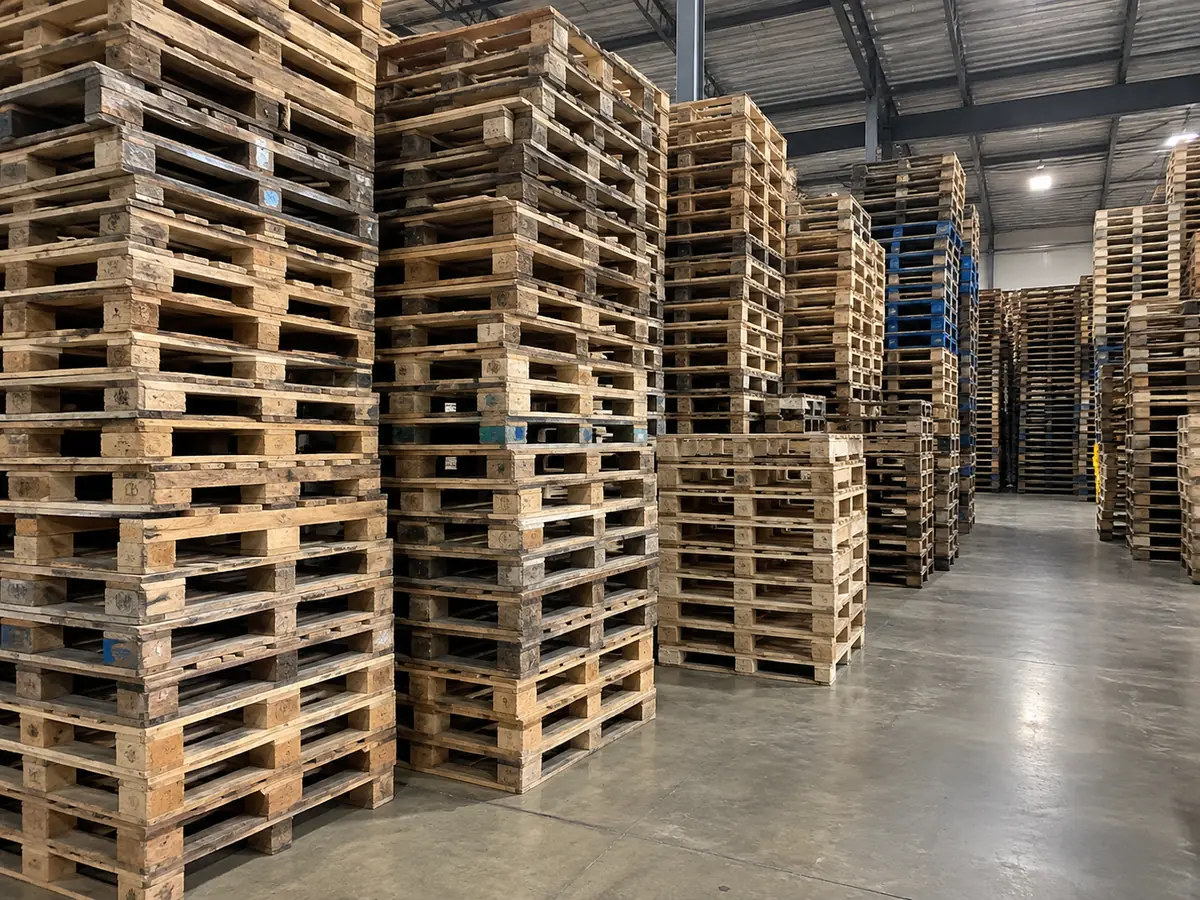
Graded, not guessed
A properly graded pallet passes a structured inspection before it gets a grade label. Ask the partner supplier for their written standard.
Consistent stacks
Ask for an order drawn from a single grade band, so your rack profile and your automation stay predictable.
Grades you can compare
Use the grade guide to describe exactly what you want on your quote request.
What 'recycled' actually means
A recycled pallet is not a pallet somebody found behind a building. It is a pallet that was recovered from a user, unloaded onto a bench, and assessed by a person trained to look at them in volume. Stringers are checked for through-cracks and for the tell-tale splitting around fork entry. Deck boards are counted, sounded and checked for nail protrusion. Moisture may be spot-metered. The stamp — GMA, IPPC, HT — is checked for legibility, because an illegible stamp is a rejected shipment waiting to happen.
From there a pallet typically goes one of four ways: straight to graded stock, to the repair line, to teardown for component salvage, or — rarely — to the grinder. Pallets that come back as boards become reclaimed lumber or crate stock, and the remainder is processed into mulch and boiler fuel.
Footprints
48x40 GMA is the one everybody wants and the one recyclers handle most. Beyond it, suppliers commonly deal in 48x48 (drum and chemical), 42x42 (telecom and beverage), 36x36 (retail and beverage), 40x48 reversed, 48x45 (automotive), 44x44 (chemical drums) and assorted odd sizes. If your footprint is unusual, say so on the request — partner suppliers vary in what they carry.
- 48x40 GMA, 4-way, stringer — the North American default. Full spec →
- 1200x800 Euro / EPAL — block-built, four-way, stamped. Full spec →
- 48x48 — chemical drums, four per pallet, usually heavy-duty stringer
- 42x42 — beverage and telecom; often reversible deck
- 36x36 — retail floor display and small-format grocery
Grade, honestly explained
Grade is a statement about appearance and consistency, not about strength. A Grade B pallet with a properly nailed companion stringer will carry the same rated load as a Grade A pallet with none. What you pay extra for with Grade A is uniform colour, no plugs, no visible repairs, tight dimensional tolerance and a cleaner look at the point where product meets customer.
If your pallets go into automated storage and retrieval, rack with limited clearance, or a retail-facing floor display, ask for A. If they go into a warehouse, onto a truck and into a receiving dock, B is the honest answer and it will usually cost less. Our grade comparison lays out the whole scale.
Pricing and what moves it
Pricing is by quote from partner suppliers. The variables, roughly in order of impact: grade, volume, whether you take delivery or arrange pickup, how tight core supply is at the time, whether heat treatment is required, and how much sorting the order needs. A full truckload of straight Grade B is generally the most economical way to buy; a small quantity of Grade A delivered to a dock is generally the most expensive.
The pallet pricing guide walks through the variables that move a quote.
Getting them to you
A 53-foot dry van commonly carries several hundred pallets stacked, and a flatbed can carry more if the receiver can unload from the side. Delivery and pickup are arranged by the partner supplier that responds to your request; say on the form which you need.
If you have a standing weekly need, say so on the request. Some partner suppliers will discuss a regular arrangement.
At a glance
- Footprints48x40 GMA plus many others — see the pallet size chart
- GradesA, B, remanufactured, combo
- SpeciesSouthern yellow pine, oak, mixed hardwood
- Typical load ratingCommonly quoted at around 2,500 lb dynamic / 3,000 lb static for a 48x40 four-way; varies by construction
- QuantitiesSet by each partner supplier; state your volume on the request
- PricingBy quote from partner suppliers
- Heat treatmentAsk the partner supplier — ISPM 15 stamped pallets are widely available
- Deck configurationCommonly 7 top / 3 bottom boards, 5/8" nominal (48x40)
- StringerCommonly 1-3/8" x 3-1/2" x 48", three-count, notched
- FastenersHelical or screw-shank are the better choice on repairs
Next steps
Reference
Reference table
| Footprint | Millimetres | Construction | Commonly quoted dynamic load | Usually bought for |
|---|---|---|---|---|
| 48" x 40" GMA | 1219 x 1016 | Stringer, 4-way notched | 2,500 lb | General distribution, grocery, 3PL |
| 48" x 48" | 1219 x 1219 | Stringer, heavy | Varies | Four 55-gallon drums |
| 42" x 42" | 1067 x 1067 | Stringer or block | Varies | Telecom, paint, beverage |
| 40" x 48" | 1016 x 1219 | Stringer, 4-way notched | Varies | Rack-depth loading, military |
| 36" x 36" | 914 x 914 | Stringer | Varies | Retail floor display, small-format grocery |
| 48" x 36" | 1219 x 914 | Stringer | Varies | Beverage, shingles, packaged paper |
| 48" x 45" | 1219 x 1143 | Stringer | Varies | Automotive components |
| 44" x 44" | 1118 x 1118 | Stringer | Varies | Chemical intermediates, drums |
| 1200 x 800 (EPAL) | 1200 x 800 | Block, 9 blocks | Varies | Export to Europe |
| Equipment | Capacity | Notes |
|---|---|---|
| 53' dry van | Several hundred pallets, stacked | The default for full loads. |
| 53' flatbed | More than a van, stacked | Needs side unloading; tarping is a quote item. |
| 48' dry van | A little less than a 53' van | Used where dock depth is limited. |
| Pickup by the buyer | Any | Arranged with the partner supplier, where offered. |
Applications
Where this gets used
Distribution & 3PL
The volume application. Grade B for internal movement, Grade A for customer-facing outbound — splitting the buy often reduces pallet spend.
Food & beverage
48x40 and 36x36 are common, usually with covered staging because wet pallets cost you on both value and weight.
Manufacturing
Heavier footprints — 48x48, 44x44 — for drums, castings and part bins. Ask about engineered builds above commonly quoted ratings.
Retail display
Grade A and half-pallets. The pallet is part of the display, which is the one place appearance genuinely justifies the premium.
Export
Any footprint can be ISPM 15 heat treated and stamped by a supplier with a program; ask for treatment documentation.
Automated storage
Grade A specified against dimensional tolerances rather than appearance — see the automation tolerance note.
The full picture
How a recycled pallet typically reaches you
A recycled pallet goes through a sequence of steps between a customer's dock and yours. Understanding them explains why quality and price differ between suppliers.
Intake
A load is typically weighed in, sorted by material type and broken down onto an intake area. The first decision is coarse: sort now, or dry first. Wet pallets are not graded, because moisture masks defects. A damp stringer sounds different when flexed, and a wet board looks sound when it is not. Wet loads are generally spread in open rows with airflow between them.
The bench
Every pallet should pass a person working a consistent checklist — see how pallets are inspected: stringer through-cracks, notch splits, nail-line splits, board count, lead board condition, splits and cupping, thickness consistency, fastener protrusion, fastener withdrawal, square, height and twist, moisture, stamp legibility, contamination.
The outcome is typically one of four: graded stock, repair bench, teardown, reject. Contamination is a more common reason for rejection than damage.
Repair
The dominant repair is a full-length companion stringer alongside a cracked one; after that, deck board replacement, re-nailing and square-up. Helical or screw-shank fasteners hold substantially more withdrawal resistance than smooth-shank and matter far more to service life than most buyers realise.
A repaired pallet should re-enter the bench and be graded again from scratch. A repair is never a way around a structural failure.
Grading and staging
Grade is assigned on appearance and dimensional consistency on top of a structural pass. Ask for orders drawn from a single grade band, so your rack profile and your automation stay predictable rather than varying load to load.
Dispatch
Pallets ship on dry vans or flatbeds. If you also generate used pallets, ask whether the delivering truck can collect them on the same visit — combining delivery and collection is one of the larger savings available to many buyers, where a supplier offers it.
Process
How it runs, step by step
Send footprint, grade and volume
Length first, width second. If you are unsure of the grade, say so on the request and the partner supplier can recommend one.
A partner supplier follows up
Expect a price per unit and what the supplier has available. Availability varies by supplier and by time of year.
Confirm the details
Agree grade, quantity, footprint and any treatment requirements in writing before anything is scheduled.
Delivery or pickup
Tell the supplier which you need, and what your dock can handle.
Cores
If you generate used pallets, ask whether the supplier can collect them on the delivery trip. Availability depends on the partner supplier.
Decision rules
If this, then that
- If the pallet is seen by a customer, an auditor or an AS/RSThen ask for Grade A — you are paying for appearance and dimensional consistency, both of which you will use.
- If the pallet never leaves your buildingThen ask for Grade B and keep the savings. It carries a comparable rated load.
- If the load is empty totes or internal transferThen ask for remanufactured — typically the most economical structurally sound wooden pallet.
- If the freight crosses a borderThen specify ISPM 15 HT, and KD-HT if the product is moisture-sensitive or the transit is long.
- If product overhangs the deck by more than two inchesThen stop buying standard and specify a footprint that fits — overhang costs more in damage than the pallet costs.
Avoid
Common mistakes
Writing the dimensions backwards
40x48 is not 48x40. On a stringer pallet the first number is the stringer direction, which decides which faces have true fork openings. This is a very common specification error in the industry.
Buying one grade for everything
Many sites over-specify. Splitting the buy — A outbound, B internal — can reduce pallet spend with no operational change at all.
Specifying heat treatment for domestic freight
ISPM 15 applies to international movement. A great many domestic specs carry an HT line nobody can justify, and it costs both money and lead time.
Assuming four-way means pallet-jack access
A notched stringer pallet is four-way for forklifts and two-way for manual jacks, whose wheels need floor-level clearance. If you run jacks, you need block construction.
Terms
Vocabulary for this page
- Core
- A used pallet bought for reprocessing. Cores are the raw material of the recycled market, and their availability — not demand — is a major driver of price.
- Companion stringer
- A second full-length stringer nailed alongside a cracked one. Restores the pallet's rated capacity and typically drops it to Grade B because the repair is visible.
- Lead board
- The outermost deck boards at each end. They take fork impact and are the most frequently replaced component on any pallet.
- Notch
- A 9" x 1-1/2" cutout in a stringer face admitting forklift tines from the long sides. It also removes material where bending stress peaks, which is why many stringer cracks start there.
- Combo load
- A deliberate blend of Grade A and Grade B in an agreed proportion, usually priced between the two.
- Reserve stock
- A supplier setting aside your footprint and grade for a standing arrangement. Some suppliers offer it; ask.
The wider reference is in the pallet glossary.
Questions
Before you order
Are recycled pallets as strong as new ones?
For the same footprint and construction class, a repaired 48x40 stringer pallet with sound stringers and a full deck carries a comparable rated load to a new one. What degrades with age is appearance, dimensional consistency and moisture behaviour — not raw capacity. See the load capacity guide.
Can recycled pallets be heat treated for export?
Yes, in principle. Recycled pallets can be re-treated and re-stamped by a facility with an ISPM 15 program. Ask the partner supplier for treatment documentation. How ISPM 15 works →
What is the minimum order?
Minimums are set by each partner supplier. State your quantity on the quote request and a partner supplier will tell you what they can do.
Are recycled pallets available right now?
Availability depends on the partner supplier. 48x40 GMA is the footprint most commonly available; for anything else, send a quantity and a footprint on the request and a partner supplier will follow up.
How many recycled pallets fit on a truck?
Several hundred on a 53-foot dry van, stacked; a flatbed can carry more if the receiver can unload from the side. Weight is rarely the binding constraint with pallets — cube is, unless the pallets are wet.
Can I mix footprints on one order?
Often, yes. Mixed orders are common. Tell the partner supplier the split by footprint and grade when you send the quantity.
Can I arrange a standing supply?
Some partner suppliers will discuss regular arrangements. Say so on your quote request and ask what is possible.
What happens if a load arrives below the grade I ordered?
Photograph it and raise it with the supplier promptly, in writing. Agreeing a written grade definition up front — such as the one in how pallets are inspected — makes disputes much easier to settle.
Ready to put a number on it?
Send the footprint, the grade and the volume. We'll come back with price per unit and the first window we can hold.