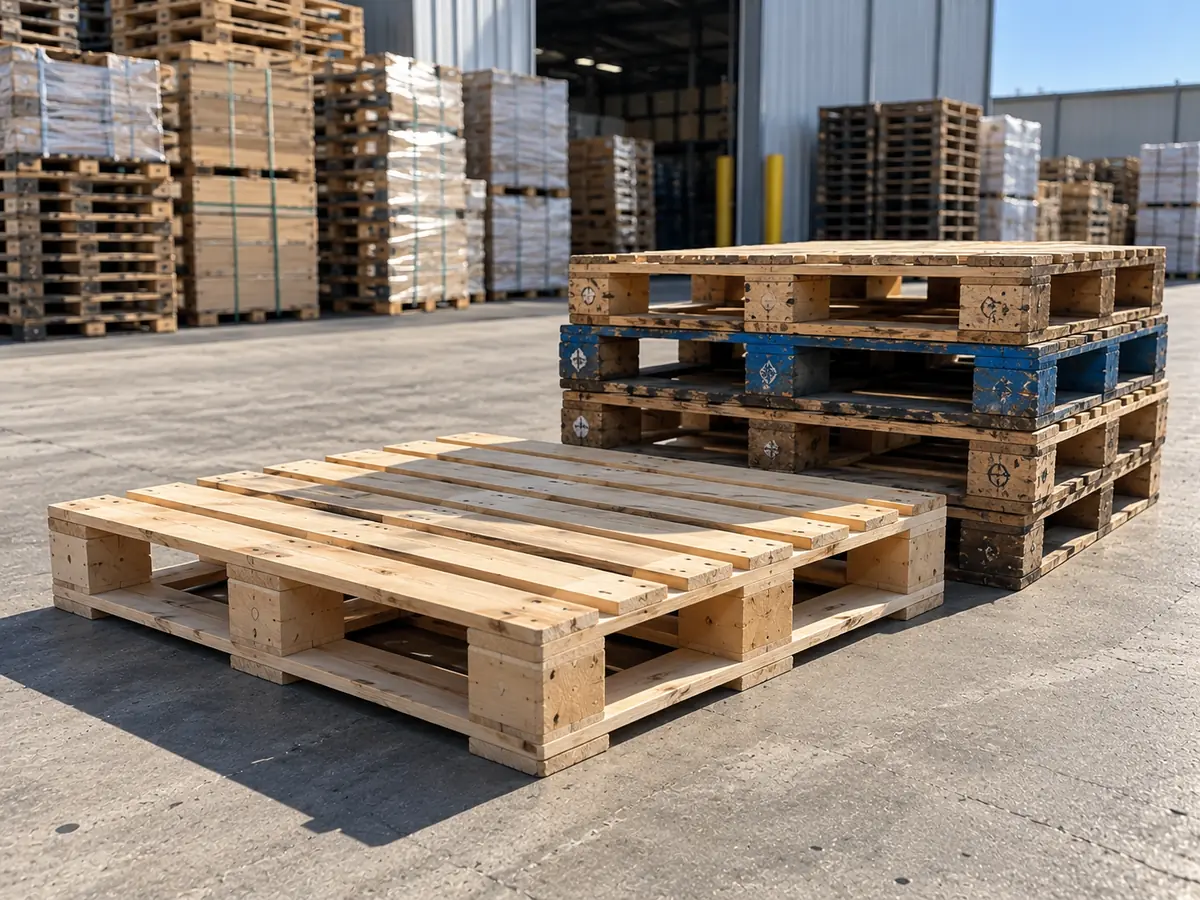
Watch a repair bench for a few minutes and you will see the same operation over and over. A pallet comes up, the operator sights along the centre stringer, finds a crack radiating from the notch, pulls a matched board from the rack, lines it up, and drives a series of nails through the deck boards into it.
That is a companion stringer. It is one of the most common repairs in the pallet industry, and it is responsible for the existence of Grade B as a category.
Why stringers crack where they do
Most often at the notch. The notch, cut into the stringer face to admit forklift tines from the side, removes material at the point where bending stress is highest on a racked pallet.
Add the fact that pallets are made from lumber with knots and grain runout in them, and that a forklift tine entering slightly off-line puts a shock load into the notch corner, and you have a dominant failure mode.
Another common origin is the nail line: splitting along the row of deck board nails, usually from lumber drying and shrinking after the pallet was built green. Those cracks are often shallower and sometimes acceptable without repair.
How the repair is actually done
Properly, it is full length. A companion stringer that runs the whole 48 inches sits under every deck board and restores the continuous load path. A short sister board that only spans the crack does not. It moves the failure point rather than eliminating it.
The fastening matters as much as the board. The nails go down through the top deck boards into the new stringer, which means the deck is doing the clamping. Helical or screw-shank nails are the better choice for this, because withdrawal resistance is the property that decides whether the repair lasts. See nail selection.
Then the pallet should be checked again, as if it had just arrived. A repaired pallet that fails a structural check should not go back into service.
Why it can be genuinely strong
This is the part buyers find hard to believe. After a companion stringer, the pallet has two boards carrying the load where it previously had one. The cracked original is still doing work (a crack does not remove a board's capacity, it reduces it) and the new board is intact, full depth and freshly fastened.
A well-executed repair can bring the assembly back to the pallet's original rated load. The pallets that cause trouble in service are more often those with unrepaired cracks that somebody decided looked fine.
So why does it cost a grade?
Because grade in this industry describes appearance, not strength, and a companion stringer is unmistakably visible. It is a differently coloured board, slightly proud of the stringer beside it, with a fresh line of nail heads.
That matters in a few situations: the pallet ends up on a retail floor, it goes in front of a customer who inspects incoming pallets, or it runs through automation with tight tolerances where the added width at one edge can be a problem. Outside those, it matters little, and Grade B is typically priced lower for the privilege of looking like what it is.
It is slightly absurd, and it is easy to see why it exists. If grade described strength, grading would require testing every pallet, which nobody can afford. Appearance is a proxy that can be assessed in seconds by a trained person, and it correlates well enough with the things that matter that the market has settled on it.
When a repair is not the answer
Multiple structural failures on one pallet and it belongs in teardown instead. Both lead boards broken at the same end, same answer. Any contamination, such as oil, chemical staining or mould, and it should never reach a repair bench at all.
There is also a judgement call about accumulated repairs. A pallet that already carries two companion stringers and several replaced boards has very little original material left in it, and at that point the sensible answer is to tear it down and build a remanufactured pallet from the sound components rather than keep patching.
What to do with this
If you are buying: consider whether you need to pay a Grade A premium for pallets that go into a warehouse and come back. If you are selling cores: a cracked stringer does not make a pallet worthless, so do not throw it in a skip; request a quote. And if you are specifying new pallets, ask for helical or screw-shank fasteners, because that single choice does more for service life than almost anything else on the spec sheet.