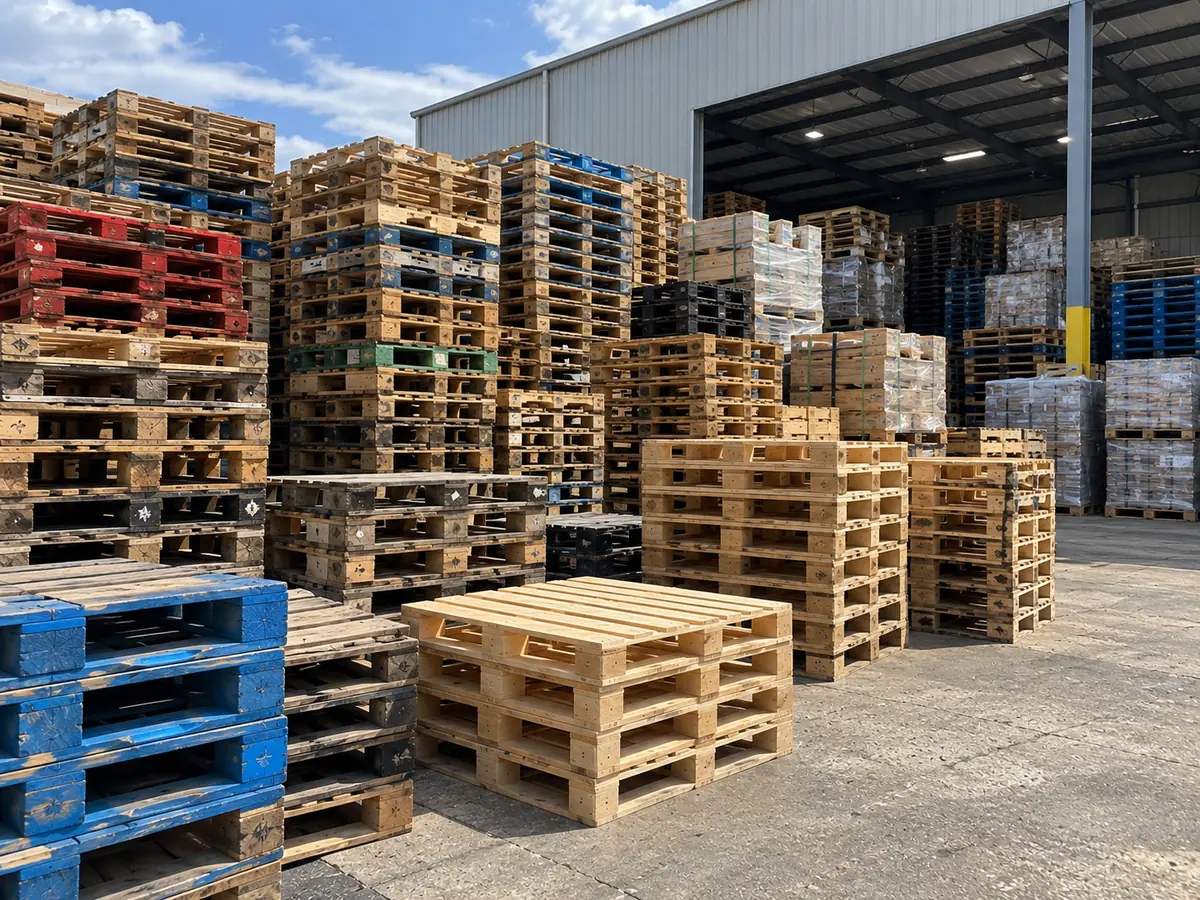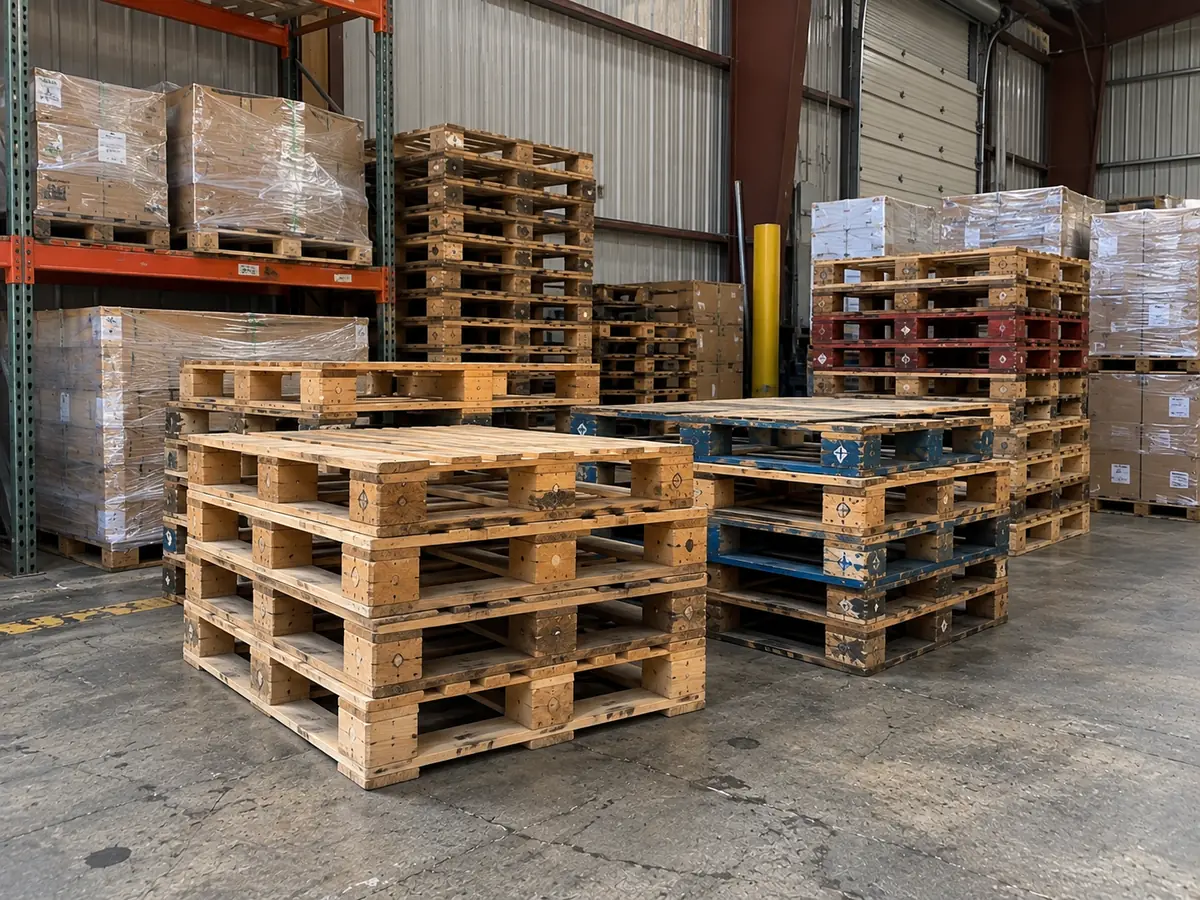
What is the most common avoidable cause of pallet failure in a rack? It is not overloading, and it is not damaged pallets. It is putting the pallet in the bay the wrong way round.
What a racked pallet is actually doing
Take a 48x40 stringer pallet and place it in a standard selective rack bay. It rests on two beams, front and back, with nothing underneath in between. It is now a simply supported beam spanning about 40 inches, carrying whatever is on top of it.
Bending stress in a beam rises quickly with span, and concentrated loads produce roughly twice the bending moment of the same weight spread evenly. This is why the commonly quoted racking rating for a 48x40 is well below its static rating on a solid floor. Actual ratings vary by construction and lumber. The floor carries the load in one case and the pallet carries it in the other.
Now turn it ninety degrees
In a 48x40 stringer pallet, the stringers run the 48-inch direction. Placed so the stringers rest on the beams and span the gap, the load path is: deck boards to stringers, stringers to beams. Three substantial members, on edge, doing what they were designed to do.
Turn the pallet so the stringers run parallel to the beams and the deck boards are spanning the gap. Now the load path is: deck boards to... nothing. The thin deck boards are the only members bridging the span.
Capacity falls sharply. The pallet will often hold anyway, because most loads are well inside rating, and then one day a heavier pallet goes in the same bay the same way and the deck boards fail in the middle.
How it happens
Nobody does it deliberately. It happens because:
- The bay is deeper than it needs to be and the pallet fits either way
- A driver turns the pallet to get a label facing the aisle
- The load overhangs one direction and the pallet is turned to hide it
- A mixed-footprint operation has pallets that genuinely are square, and habits transfer
- Nobody ever told anybody it mattered
That last one is the real cause. This is not knowledge that arrives with a forklift licence.
The two fixes
Signage and training, which is free. Put the correct orientation on bay signage, a simple arrow, and cover it in induction. It is short, cheap and among the highest-return safety training in many warehouses.
Wire decking or safety bars, which is not free but is not expensive. Mesh decking or bars across the bay transfer load directly into the rack structure. The pallet is now fully supported and its racking rating largely stops being the constraint. Anything heavy, anything valuable, anything above a person's head: fit them.
Wire decking has a second benefit: it catches things. A carton that shifts off a pallet on an open beam bay falls into the aisle. On decking it does not.
Block pallets are different
A block pallet has a bottom perimeter deck and blocks at the corners, edges and centre. It is considerably more forgiving of orientation because there is structure in both directions. It is not indifferent, since there is still a preferred direction, but the penalty for getting it wrong is far smaller.
This is one of several reasons block construction is gaining ground in operations with heavy racking, despite typically costing more per unit.
Checking your own operation
Walk an aisle and look up. In a properly oriented bay you will see the ends of three stringers facing you, or on a block pallet the ends of the bottom deck boards. If you are looking at the long faces of deck boards spanning the gap with nothing under them, that bay is wrong.
Do it once. If you find more than a couple, it is a training issue rather than an incident, and it is much cheaper to fix as the former.
The full picture on load ratings (static, dynamic and racking, and why they differ so much) is in the load capacity guide.