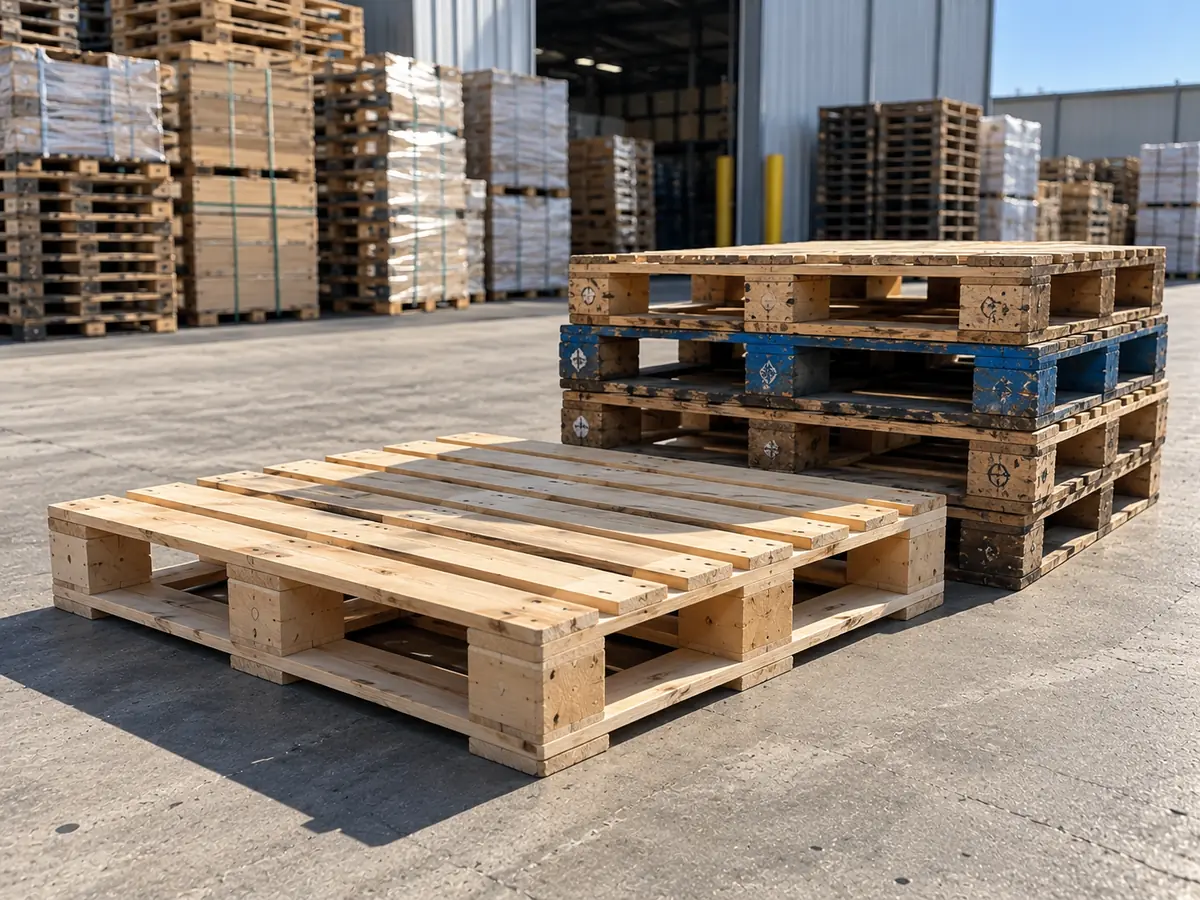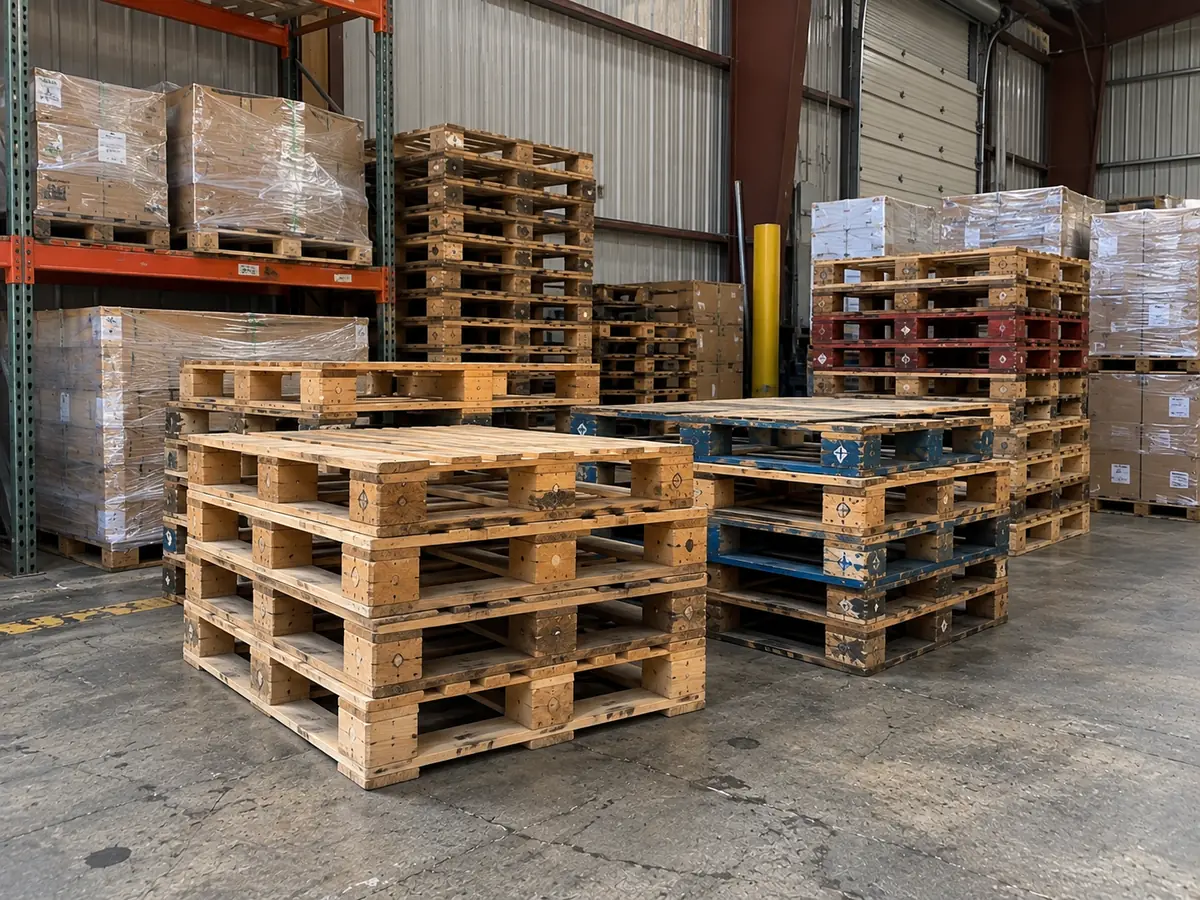
For most buyers, Grade A is the pallet that looks good. That is a fair description of why retail buyers choose it and it is completely beside the point for anybody running automation.
In an automated warehouse, Grade A is a tolerance specification. The appearance is a side effect.
What automation is actually sensitive to
Overall height. A nominal 48x40 GMA pallet is about 5.5 inches tall. Conveyor transfers, shuttle systems and stacker cranes are set up around that number with a tolerance band, often a quarter inch or less. A pallet that is a fraction over, perfectly serviceable with no defect, can catch a transfer lip.
Height varies with board thickness, with repair history, and with how much the stringers have compressed in service. A repaired pallet carrying a companion stringer is not taller, but a pallet with a replaced deck board of slightly different thickness is.
Squareness. Measured across the diagonals. Out of square by half an inch and a pallet will not seat properly in a rack bay, will skew on a conveyor, and will present its corner rather than its face to a stop.
Bottom board profile. This is the one nobody specifies and everybody should. Chamfered bottom boards roll onto a conveyor; square-edged ones catch. A missing chamfer is invisible in a grade description and extremely visible at high throughput.
Protruding fasteners. A nail standing a sixteenth of an inch proud will snag a belt, tear a photo-eye target and eventually stop a lane. In manual handling it is a nuisance; in automation it is a fault.
Bottom deck gaps. Some conveyor types need a specific bottom board layout to bridge the rollers. A pallet with a nonstandard bottom deck, which recycled stock sometimes has because it was repaired with what was available, can drop between rollers.
Why none of that is on a grade card
Because grade descriptions evolved for a market where the buyer was a person with a forklift, and the things that mattered were strength and appearance.
Grade A correlates well with dimensional consistency (an unrepaired, square, uniform pallet is likely to be within tolerance) but it is a proxy, not a specification. Which is why automated sites that simply order "Grade A" and assume the problem is solved sometimes still get jams.
What to actually specify
If you run automation, write the tolerances down rather than trusting the grade letter:
- Overall height 5.5 inches ± 1/4 inch
- Square within 1/4 inch across diagonals
- No plugs, no companion stringers
- Bottom boards chamfered
- No protruding fasteners, either face
- Standard bottom deck layout, three boards, specified positions
- Moisture below a stated figure if the system is sensitive to weight
That is seven lines and it turns a grade into a specification. Put it in the request when you request a quote so partner suppliers can say whether they can meet it.
Why some suppliers can meet it and others cannot
Not because of equipment. Because of sorting discipline. Meeting a dimensional specification consistently requires a bench that is measuring rather than eyeballing, on a defined sample rate, against a written standard. That is a labour decision, not a machinery one. See how pallets are inspected for the kinds of checks involved.
It also requires being willing to reject pallets that are perfectly good and simply do not fit your band. A supplier that cannot afford to do that will quietly send them anyway.
The block pallet question
Block construction is dimensionally more consistent than stringer construction, which is one of several reasons block pallets are gaining ground in automated facilities despite costing more.
If you are specifying a new automated facility from scratch, it is worth evaluating properly rather than defaulting to 48x40 stringer because that is what the market runs. The pallet is part of the system and it should be specified with the system, not bought afterwards by procurement.
The cheap diagnostic
If you have jams and you suspect pallets, measure a good sample of them. Height, diagonals, chamfer present or absent, fasteners proud or flush. A tape and a straight edge are all it takes.
If the distribution is wide, it is the pallets. If it is tight, it is the machine, and you have saved yourself a long argument with a supplier.