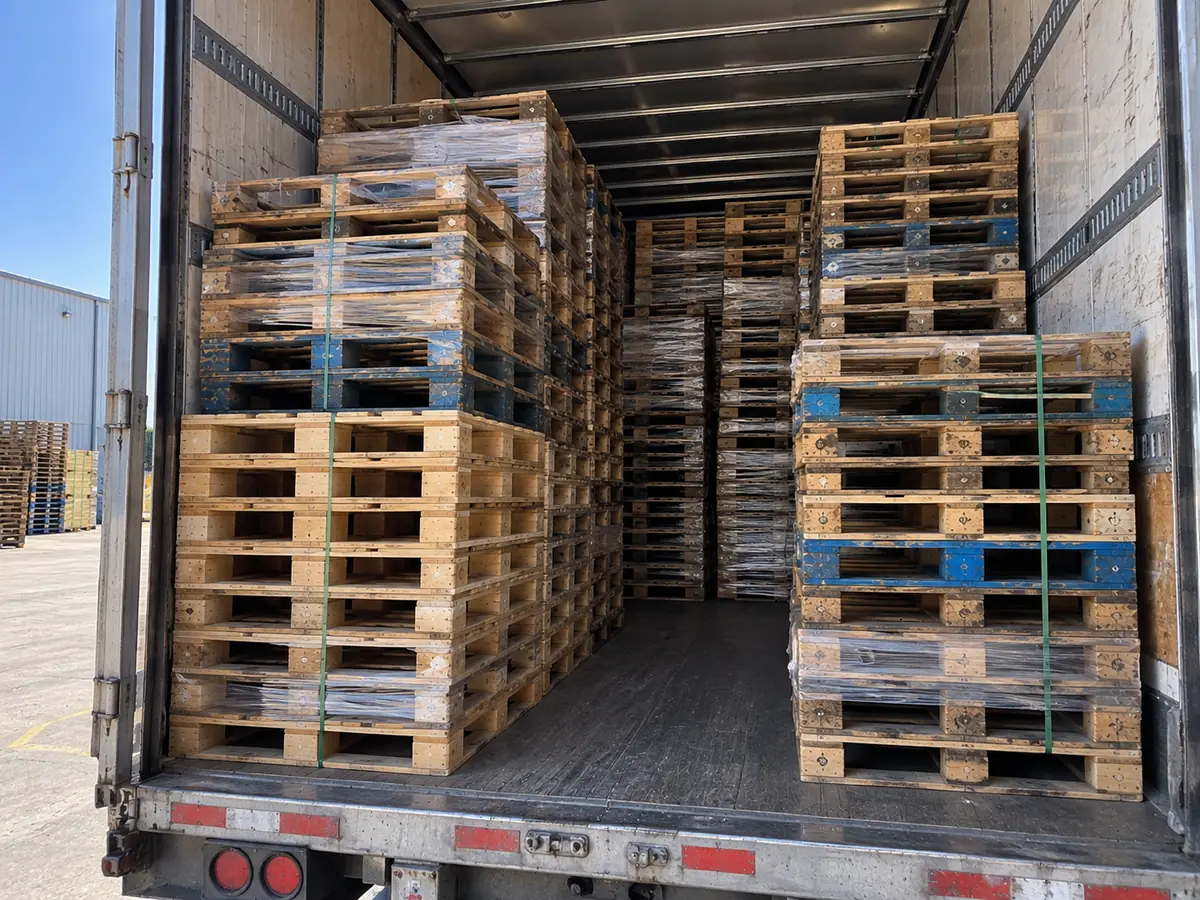
Picture a container arriving at a European port with visible mould across the bottom layer of cartons. The receiver rejects the load. The shipper's first question is whether the pallets had been treated.
They had. Correctly, stamped and logged. The pallets were fully compliant with ISPM 15 and they were also wet when they went into the box.
The two processes do different jobs
Heat treatment (HT) is a phytosanitary measure. Wood is heated until its core reaches 56°C and held there for 30 continuous minutes. The purpose is killing wood-boring insects and larvae. It is what ISPM 15 requires and it is the code that appears in the IPPC stamp.
It says nothing about moisture. A treatment cycle that takes a pallet to 56°C core will drive off some surface moisture, but thick members in the middle of a large stack do not dry meaningfully in a typical cycle. A pallet can complete a fully compliant HT cycle and still come out with a high moisture content.
Kiln drying (KD) is a quality process. Wood is dried in a controlled chamber to a target moisture content, commonly 19% or below. The purpose is dimensional stability, reduced weight, better fastener retention and, critically here, mould prevention.
Kiln drying is not a phytosanitary treatment. Unless it is run under a certified programme and the pallet is stamped accordingly, it does not satisfy ISPM 15.
KD-HT means both were done. It costs more than either alone.
Why containers are the worst case
Mould needs three things: elevated moisture, warmth, and an absence of airflow. A sealed steel box crossing an ocean supplies the second and third abundantly and often adds to the first.
Containers go through a daily temperature cycle. Warm air holds more water vapour than cool air; as the box cools at night, moisture condenses on the coldest surfaces, the steel walls and ceiling, and rains back down onto the load. This is called container rain and it is entirely normal. On a long transit it happens night after night.
A wet pallet in that environment is a mould culture with a floor plan.
The other thing wet pallets do
They stain product. Tannins in oak and extractives in pine migrate into corrugated and into textile packaging. The mark can be permanent.
They lose strength. Wood loses a meaningful share of its dry capacity at saturation. A pallet rated for a given dynamic load dry is not carrying that wet.
They weigh more. Which occasionally makes weight the binding constraint on a container that was cubed out on paper.
What to specify, by situation
- Domestic freight, robust product: neither HT nor KD. Standard pallets are fine and both processes cost money for no benefit.
- Domestic freight, moisture-sensitive product: KD.
- Export, robust product, short transit: HT.
- Export, moisture-sensitive product, or any long ocean transit: KD-HT, explicitly.
That last line is the one people miss. If you have specified HT and your product is paper, textile, powder, electronics or anything with a corrugated outer going into a sealed box for more than a short transit, you have specified half of what you need.
How to verify moisture
There is no marking for kiln drying, because it is not a phytosanitary treatment. The stamp will not tell you. If you need documented moisture content, ask the supplier for documentation stating the target and the measured value.
A handheld moisture meter is inexpensive and takes seconds per pallet. If you ship containers regularly, consider owning one. Check a few pallets from every inbound load and you will know quickly which of your suppliers dries and which does not.
Desiccant is a mitigation, not a fix
Container desiccant bags absorb ambient moisture and they help. They cannot out-absorb a pallet carrying a large volume of water, and they are sized for atmospheric humidity rather than for a wet load.
Use them. Do not rely on them to rescue a pallet specification that was wrong.
The short version
HT is about insects. KD is about water. They are different processes solving different problems and the IPPC stamp only reports the first. If water is your risk, the stamp is not going to save you. The full explanation is here, and the one-line answer is: say KD-HT out loud when you order.