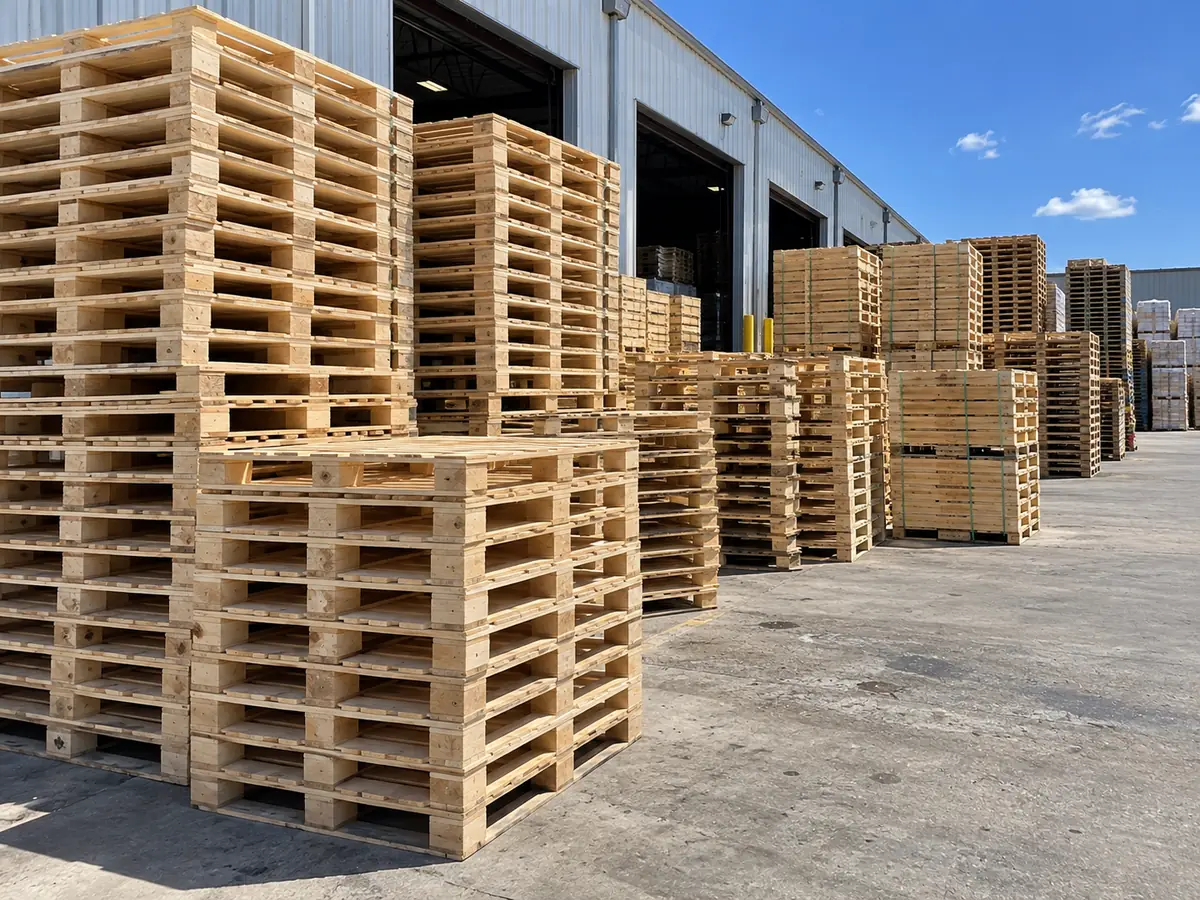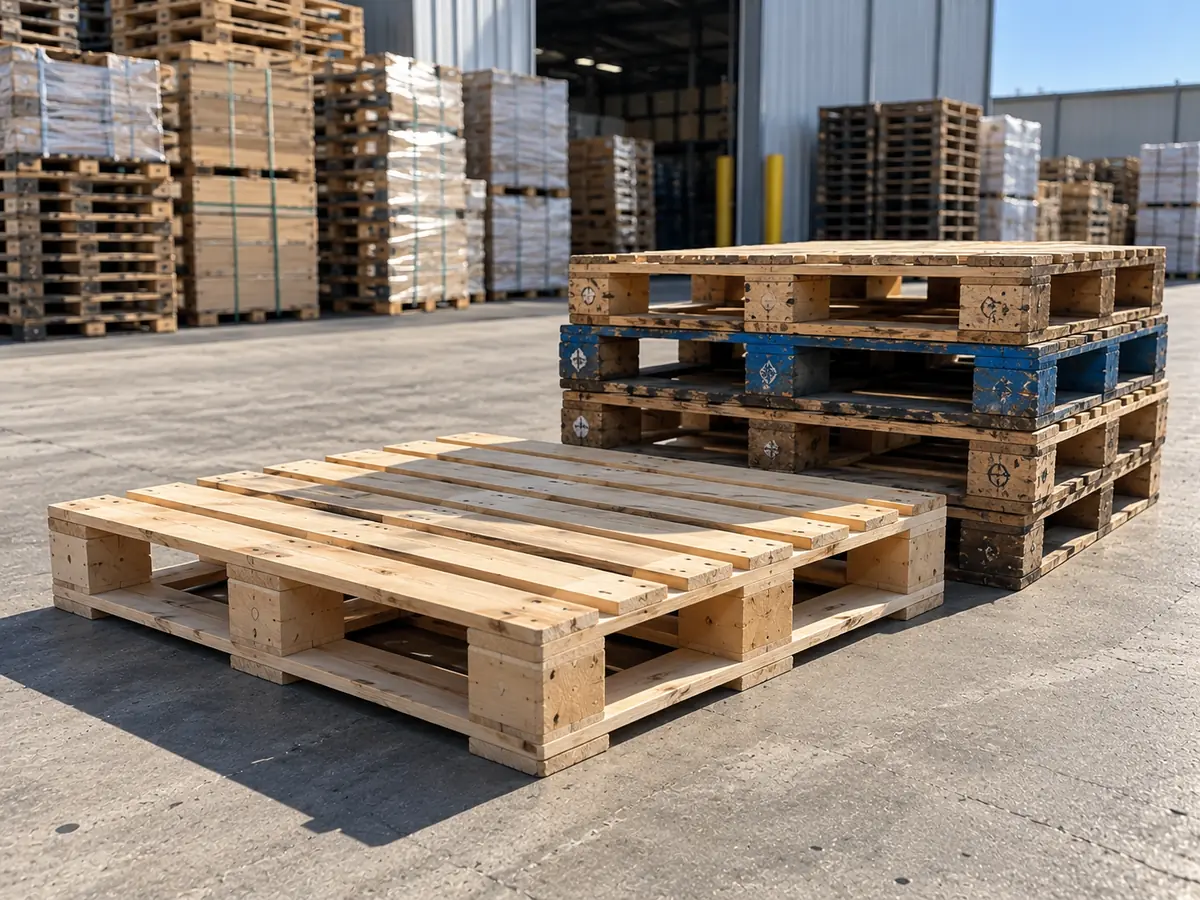
Custom pallets are built for odd footprints, heavy point loads, machine bases and rack profiles that no standard pallet respects. The build is straightforward. Getting the specification complete is where the work is.
Here are the seven questions. If you can answer all of them, you can get a firm quote from a supplier quickly. A partner supplier will follow up on your quote request with anything still missing.
1. Footprint
Length by width, in inches, length first. On a stringer pallet, length is the direction the stringers run. 48x40 and 40x48 are different pallets with fork openings on different faces, and transposing them is the most common specification error in the industry.
Derive the footprint from the loaded product, not from the catalogue. Measure the load, add nothing, and find the pallet that matches. If overhang is currently costing you damage, this is where you fix it.
Then check it against two external constraints: trailer width (roughly 96 to 100 inches internal, so two across means each under about 48) and rack bay width. Allow some clearance per pallet for forklift tolerance.
2. Deck configuration
Number and thickness of top and bottom boards, and the gap between them.
The gap is the part people skip. Wider spacing saves lumber and weight; every extra inch of unsupported span is somewhere a small carton can fall through or sag into. For mixed-case loads, keep gaps tight. For a drum or a single heavy item, gaps barely matter.
Thickness: 5/8 inch nominal is a common standard, with 3/4 inch for heavier duty. Lead boards, the outer ones taking fork impact, are worth specifying thicker or in a stronger species than the rest.
3. Structural members
For a stringer pallet: stringer dimension, count and whether notched. 1-3/8 x 3-1/2 x length, three-count, is the common GMA baseline. Heavier loads get doubled stringers or a four- or five-count.
For a block pallet: block dimensions and layout, and the stringer board and deck board schedule above and below.
Notch depth matters more than people expect. Deep notches make four-way entry easier and make the stringer weaker at precisely the point where bending stress peaks. Keep notches to the shallowest depth the application allows.
4. Entry
Two-way, partial four-way (notched), or full four-way (block).
The question behind the question: do manual pallet jacks need to enter from the side? If yes, notches will not do it. Pallet jack wheels need floor-level clearance, which only block construction provides. This single answer often determines the whole construction.
5. Load and racking
Weight, distribution, and whether it will be racked without deck support.
Racking is the constraint that catches people. A pallet spanning two rack beams with nothing underneath is a beam in bending, and racking capacity is typically well below static capacity. If the answer is "yes, racked, heavy", either fit wire decking or tell the supplier so the pallet can be engineered for it. See the load capacity guide.
Also: is the load concentrated or distributed? A concentrated load at mid-span produces roughly twice the bending moment of the same weight spread evenly.
6. Treatment
Untreated, HT, KD, or KD-HT.
HT only if it is crossing a border. KD only if moisture matters. KD-HT if both. A lot of specifications carry an HT requirement that has been copied forward for years and that nobody can justify, and it costs money. The distinction explained.
7. Marking
IPPC stamp position if treated, customer stencil, colour band, branding iron.
Colour bands are underrated. A sprayed band on one stringer end makes a footprint or grade instantly identifiable across a stack, and it costs almost nothing.
The eighth question: fasteners
It is not on most people's list and it should be at the top.
Helical or screw-shank nails hold markedly more withdrawal resistance than smooth-shank in softwood. Because pallets mostly fail at joints rather than in members, this is among the highest-leverage decisions on the whole sheet. The full argument.
Write it in: "helical or screw-shank, minimum two per deck-to-stringer joint, three on lead boards."
Ask for a first article
For any sizeable custom order, ask the supplier to build a single first article before production. One pallet, built and shipped. Not to look at, but to load, to rack, to run through whatever is going to break it.
Some will come back with a change request. Every one of those is a change that would otherwise have been made hundreds of times. It is the cheapest part of the process and the part buyers most often try to skip.
Send the object if you have one
The most reliable specification method is not a drawing. It is giving the supplier an existing pallet to measure. Every dimension can be taken, every fastener counted, and the new pallet built to match. No ambiguity survives a physical sample.