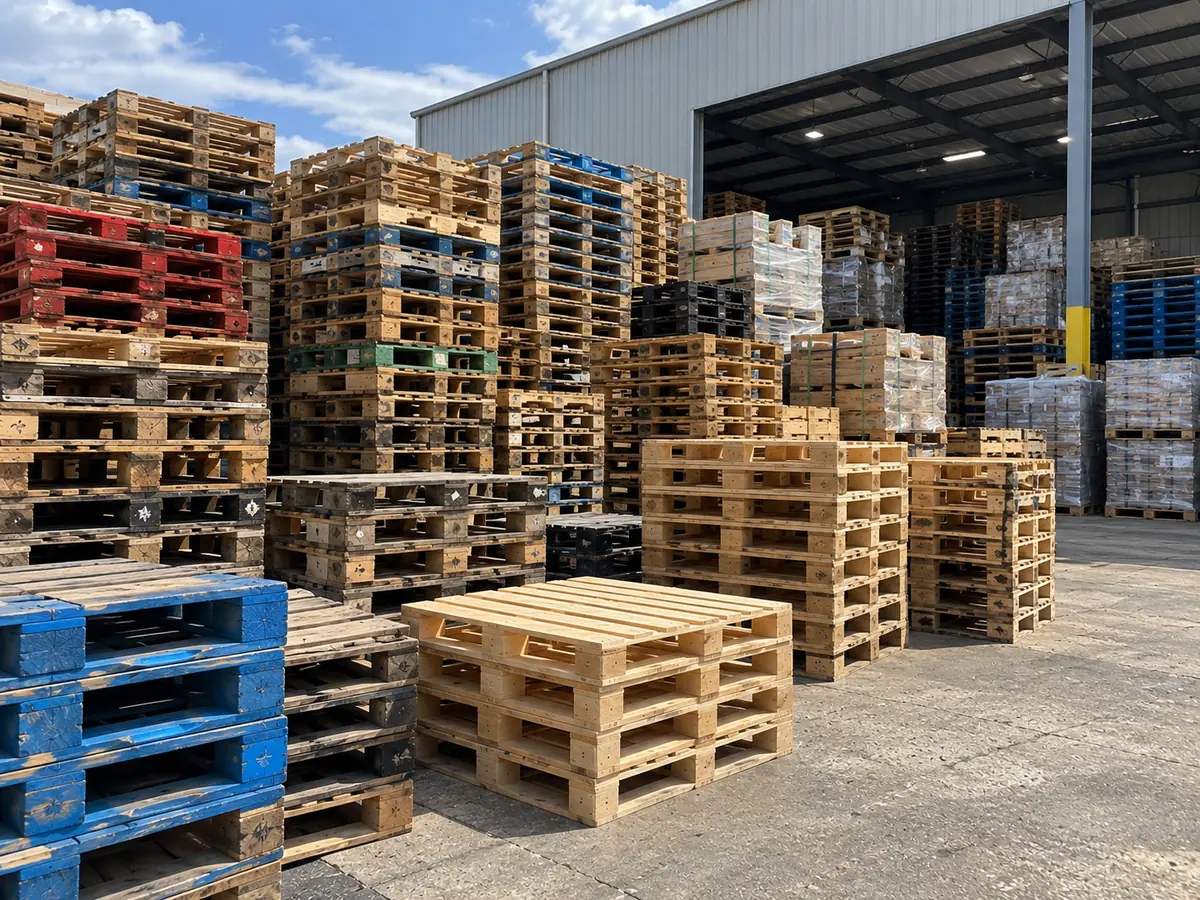
There is a persistent assumption that pallet recycling means shredding. People picture a machine, a pile of wood chips, and a sense of virtue. In a well-run recycling operation the grinder is the last thing that happens to a pallet, and everything interesting happens before it.
Here is where a pallet typically goes when the repair bench says no.
The decision at the bench
A pallet is repaired when it has one or two structural faults. It fails past repair when it has several, or when both lead boards at one end are gone, or when the accumulated repair history means there is very little original material left to fasten to.
There is also an economic line. A pallet needing a companion stringer, several deck boards and a square-up has consumed enough bench time and enough material that the cost approaches that of a graded replacement. At that point the sensible move is teardown and rebuild rather than patching.
Contamination is not a repair decision at all. Chemical staining, oil, mould and MB stamps never reach a bench.
The dismantler
A teardown pallet goes to a machine that shears the deck boards off the stringers. It is fast and it is violent, and it is designed to break the nail joints rather than the boards.
This is the first place yield is won or lost. A dismantler run too aggressively splits boards as it removes them. Run properly, a 48x40 pallet gives up its top boards, bottom boards and stringers, of which only a portion will be sound enough to reuse.
That yield is what determines whether reclaimed lumber is a product line or an aspiration.
Sorting components
Salvaged boards go into bins by thickness and species. Southern yellow pine is the bulk. Hardwood, mostly red oak with some maple and ash, goes into its own bin and it is the prize; it is worth considerably more than pine and it disappears fastest.
Stringers go separately. They are commonly around 1-3/8 by 3-1/2 inches, dry, straight and rarely requested. Once you rip the nail line off, they are excellent stock for framing small structures.
Boards with through-cracks, heavy staining, visible mould or evidence of a spill are rejected at this point rather than sorted.
De-nailing
The unglamorous bottleneck. Salvaged boards pass through a machine de-nailer, then a hand station where a person pulls what the machine missed, then a magnet sweep.
It is slow and labour-intensive, and it is why reclaimed pallet lumber is not free wood. What you are buying when you buy a bundle is the de-nailing, not the timber. A board with one nail left in it will destroy a set of planer knives, so there is no acceptable shortcut.
Where the components go
Remanufactured pallets. Matched stringers and boards assembled on a jig give a structurally sound pallet made entirely from used parts, among the lowest-impact wooden pallets available. How that works.
Crate and skid stock. Crating is one of the best uses for reclaimed boards. Short, dry, stable, structurally more than adequate for panels and cleats. See crates and skids.
Reclaimed lumber. The best boards, such as wide oak, interesting grain and stencilled panels, are sold as reclaimed lumber for woodworking and decor.
And the rest
Split ends, de-nailing offcuts, planer waste and fines go to the grinder, through magnets and a screen, and come out as mulch, animal bedding or biomass fuel. See pallet recycling.
Energy recovery is the one place in the whole cascade where the carbon stored in the wood gets released, which is why it is properly reported separately from recycling.
Why the order matters
Every step down this cascade destroys options. A board ground into mulch cannot become a crate panel. A pallet torn down cannot be repaired. So the discipline is to work from the top and only descend when there is genuinely nothing better available.
It is slower and costs more in labour than shredding everything would. It also produces several outputs instead of one, which is the part that makes it work commercially rather than merely ethically.