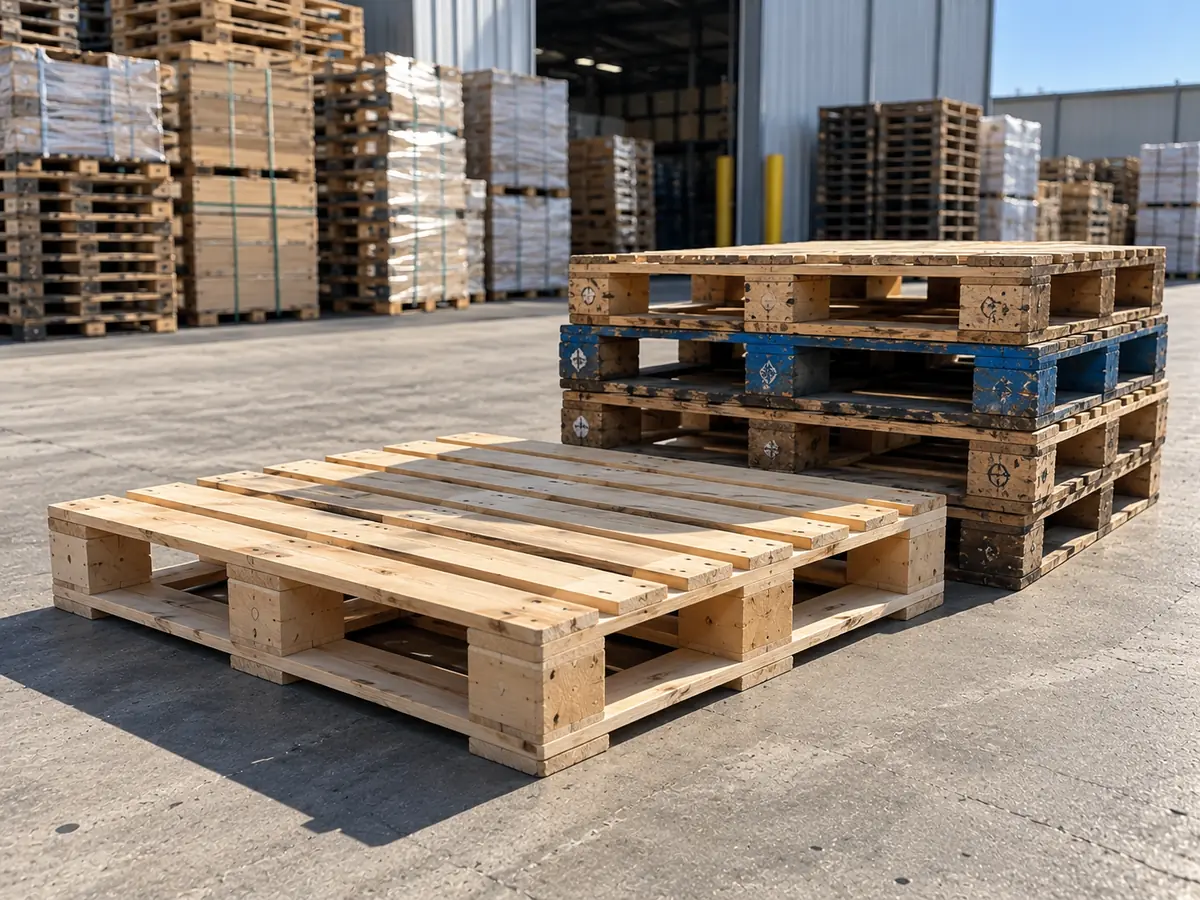
A common question from buyers is why reclaimed pallet boards cost anything at all, given that the pallets they come from are cheap or free. It is a fair question, and the answer is a bench with several people at it.
The yield problem first
A 48x40 pallet has seven top boards, three bottom boards and three stringers. Torn down carefully, only a portion of that material is sound enough to sell as lumber.
Where the rest goes: boards split by the dismantler, boards that were already cracked, boards with through-splits that only become visible once they are off the pallet, heavy staining, and the ends of stringers that have taken forklift damage.
Yield depends heavily on how the dismantling is done. Run the machine harder to get throughput up and yield drops quickly, because the machine starts breaking boards instead of breaking nail joints.
That trade-off between throughput and yield is the most consequential setting in any reclaim operation.
Stage one: the machine
Boards go through a de-nailer that punches or pulls fasteners from the underside. It gets most of them. It does not get all of them, and the ones it misses are predictable: nails driven at an angle, nails that have bent over in service, staples from a repair made with the wrong tool, and anything sitting in a knot.
A machine-only operation running at speed leaves fasteners behind in a meaningful share of boards. That is not good enough for anyone planing or sawing the wood afterwards.
Stage two: the hand station
A person, a pry bar, a pair of nippers and a lot of repetition. Every board gets turned over and looked at on both faces.
This is the expensive part and it is where the price of reclaimed lumber comes from. It is also hard to automate, because the failure modes are so varied and the consequence of missing one is so high.
Good hand-station operators develop an eye for it. They can spot a nail shadow, the dark ring around where a fastener sits, from a distance, and they turn boards to the light without thinking about it.
Stage three: the magnet
Bundles pass a magnet or metal detector before they are sold. It catches the fragments: a snapped nail head, a piece of a staple crown, the tip of a shank that broke off below the surface.
Those fragments are the ones that matter most, because they are invisible. A whole nail standing proud gets spotted by the buyer. A quarter-inch of broken shank buried flush does not, and it will find a planer knife.
What one missed fastener costs
A set of planer knives. A woodworker's afternoon. Occasionally a jointer bed. That is why reputable reclaim suppliers over-invest in this stage, and why any buyer should run a detector over reclaimed boards before machining them, however good the supplier's process.
What gets rejected before any of it
Boards should never reach de-nailing if the pallet they came from is unsuitable. Chemical staining, oil saturation, visible mould, unidentifiable residue, and any pallet marked MB (methyl bromide fumigation) are normally rejected at intake.
Reclaimed lumber is best sourced from HT-stamped stock, which is chemically untreated because the treatment is heat. If you buy reclaimed pallet wood anywhere, ask whether the source rejects MB stock. Not all suppliers do. For sourcing, see reclaimed lumber.
Why reclaimed boards are rarely planed
Buyers sometimes ask for planed boards, and many suppliers decline. Two reasons.
First, the buyer's tolerance is usually tighter than the supplier's, and wood only gets thinner once. A board planed to one person's idea of flat may not be usable for another's.
Second, planing removes the surface: the banding marks, the forklift scars, the nail shadow, the ghost of a stencil, which for most buyers is the entire reason they wanted reclaimed wood in the first place.
Straight-line ripping and cutting to length is far more common than thicknessing, and custom builds are covered under custom pallets.
The honest summary
Reclaimed pallet lumber is not free wood that somebody is marking up. It is a limited yield from a low-cost input, with several labour stages between the pallet and the finished bundle, and a quality standard that exists because the failure mode is expensive for the buyer.
That is why a bundle costs what it costs. It is also, for short lengths where character matters, usually still far less than a hardwood dealer would charge for material with none of the history. To ask a partner supplier about availability, request a quote.