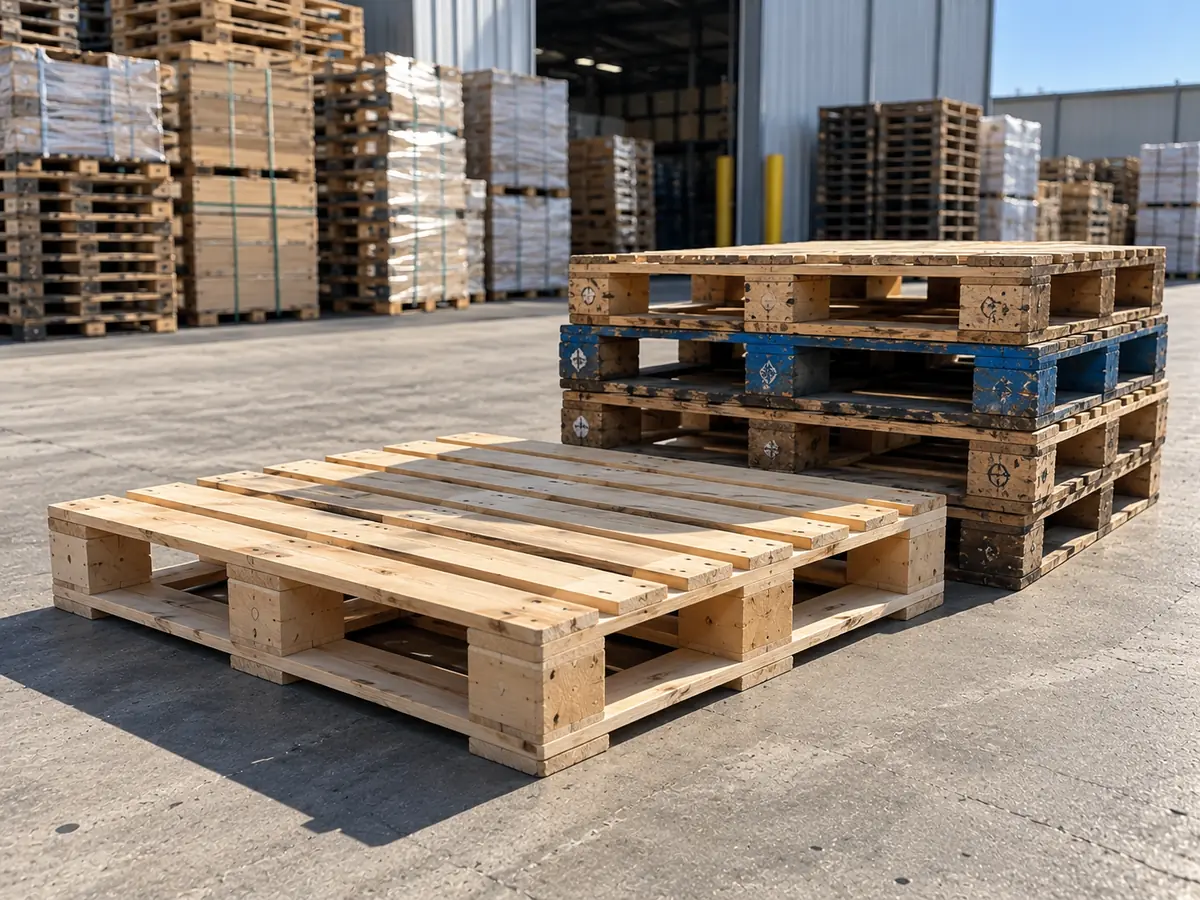
Specification conversations follow a pattern. Deck board thickness gets debated. Stringer dimension gets debated. Species gets debated, sometimes at length and with strong feelings. Then somebody says "standard nails" and everybody moves on.
This is backwards. Pallets rarely fail because a board broke. They fail because a joint let go.
What actually fails
Look at what comes through a teardown line. Most of the pallets are not broken; they are loose. Deck boards that rock. Stringers that have separated from the deck at one end. Nails standing proud, shiny where they have been working back and forth in the hole.
That is fastener withdrawal, and it is the dominant end-of-life mechanism for a pallet that has not been physically damaged.
The three shank types
Smooth shank. A plain wire nail. Cheapest, fastest to drive, and it relies entirely on friction between the shank and the wood fibre. As the wood dries and shrinks (and pallet lumber is frequently built green) that friction reduces. Withdrawal resistance drops substantially over the first year.
Helical (twisted). The shank is twisted so it rotates as it is driven, cutting a spiral path. The wood fibres close around the helix and the nail now has to unscrew itself to come out. Withdrawal resistance is a multiple of smooth shank in softwood and, critically, it degrades far less as the wood dries.
Screw shank (annular / ring). Rings or threads formed on the shank. Fibres lock into each ring. Withdrawal resistance comparable to or slightly above helical, with somewhat different behaviour under cyclic load. Excellent in hardwood.
Published figures vary with species, moisture and nail diameter, but the pattern holds up: a deformed-shank nail holds far more than a plain one, for a cost difference that is a fraction of a cent per nail.
Why the cost difference is irrelevant
A 48x40 pallet has dozens of nails in it. Even a meaningful per-nail premium is small per pallet. Against the cost of replacing a pallet that comes loose early, this is not a close decision.
The only situation where smooth shank is defensible is a genuinely one-way pallet that will be scrapped or recycled at destination and will never be handled again. Even then, it will be handled more than you think.
The other fastener variables
Diameter. Bigger is not automatically better. An oversized nail in a thin deck board splits it, and a split board has no capacity at all. Match diameter to the thinnest member you are going through.
Count and placement. Two nails per deck-board-to-stringer joint is common; three on lead boards is good practice because that is where fork impact lands. Nails too close to a board end split it. There is a reason jigs exist.
Length. The nail should penetrate the stringer by a good portion of its depth and must not come through the other side. Points standing proud of a bottom deck are both a product damage risk and a hand injury risk.
Angle. Some builders drive alternating angles to resist withdrawal mechanically. It works. It also makes teardown harder, which matters at end of life if the pallet is destined for reclaimed lumber.
Where it matters most
On custom pallets, helical or screw-shank fasteners are the sensible default, and smooth shank should need a reason. On repairs, particularly companion stringers, deformed shank matters even more, because a repair that loosens is worse than no repair.
Deformed-shank fasteners do make de-nailing slower when a pallet is torn down for salvage. That is an acceptable trade: a pallet that lasted extra years earned it.
What to put in your specification
Write the fastener into the spec explicitly. "Helical or screw-shank, minimum two per deck-to-stringer joint, three on lead boards" is a handful of words and it will do more for your pallet's service life than any other handful of words on the document.
And if you are comparing quotes from multiple suppliers and one is noticeably cheaper, this is the first place to look. It is the easiest corner to cut and the hardest to see.