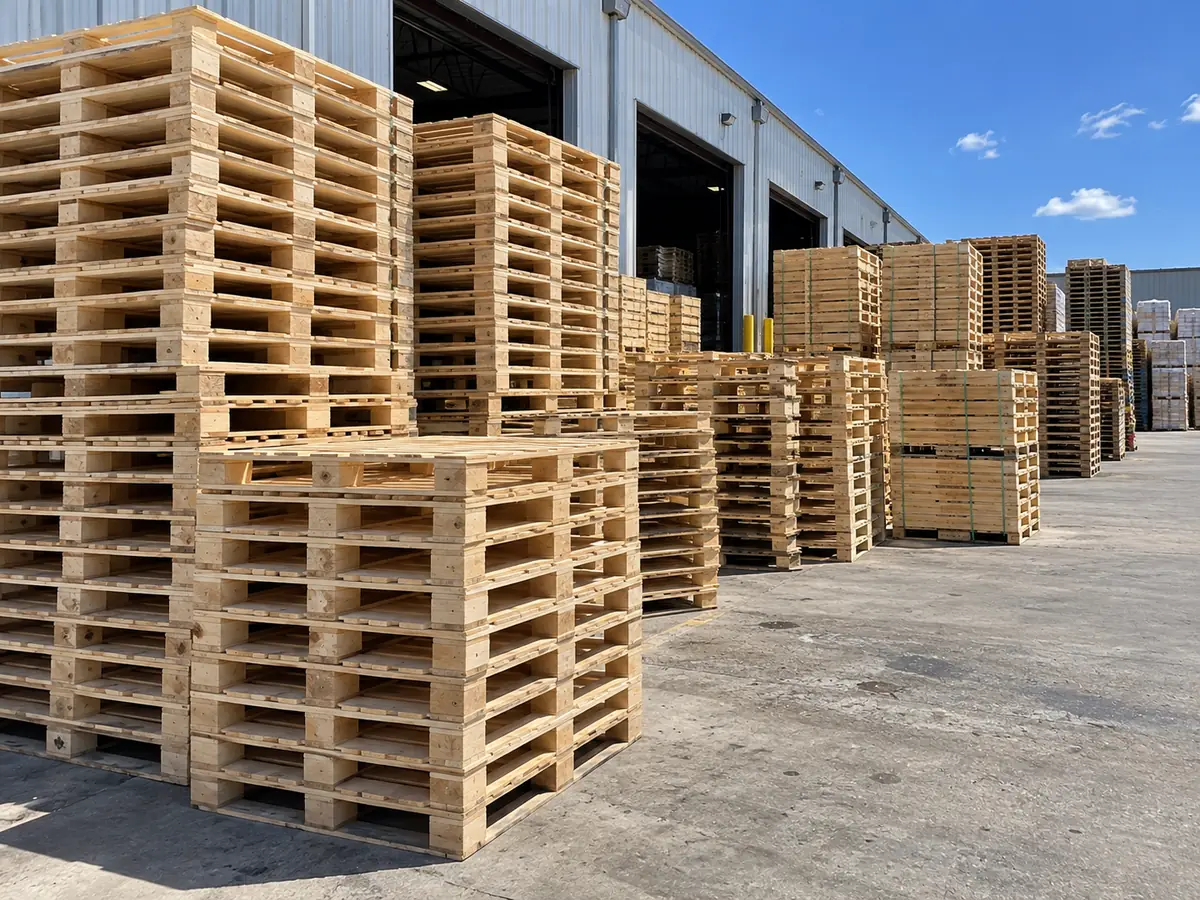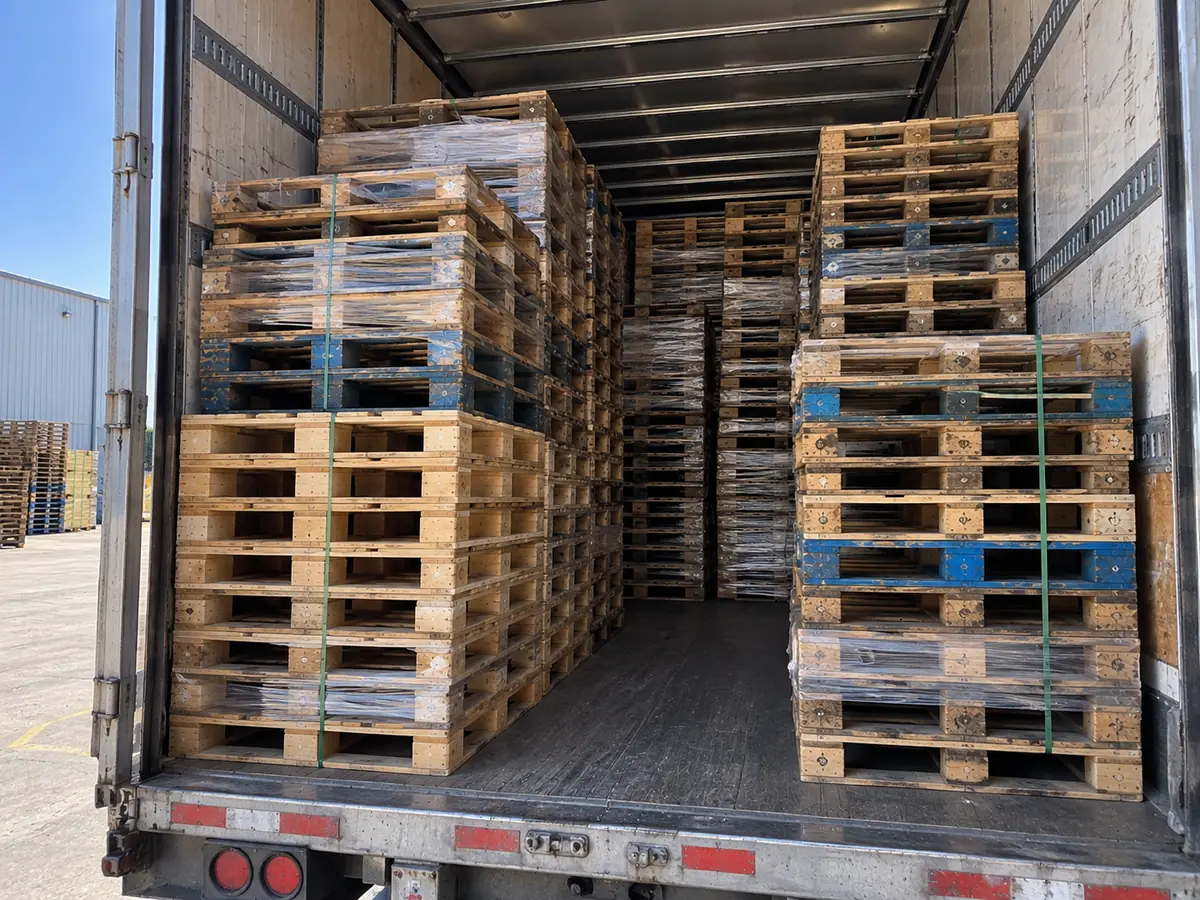
Pallet collections are routinely quoted from photographs. The quotes that go wrong almost always go wrong because of something a photograph would have shown and did not.
Here are the four shots, what each one is actually for, and the mistakes that cause a re-quote at the gate.
Shot 1: the stack from the front
Stand back far enough to get the whole stack in frame. The person quoting is counting: how many stacks, how high, roughly how many pallets.
What goes wrong: photographs taken from four feet away showing two pallets in glorious detail and nothing about the quantity. And photographs taken at an angle that makes it impossible to tell whether there is one row of stacks or three.
Do: stand back, get the whole thing, include something for scale if the stack is unusual.
Shot 2: the stack from the side
Depth. A stack photographed only from the front could be one deep or six deep, and those are very different loads.
This shot also shows whether the stacks are even. Uniform stacks mean a fast load. Stacks of varying heights, leaning, or with pallets laid flat on top mean somebody is going to spend extra time.
What goes wrong: the side shot taken so close that it just repeats the front shot.
Shot 3: one typical pallet, close up
This is the condition sample, and "typical" is the important word. Not the best one. Not the worst one. A representative one.
The quoting party wants to see the deck, the stringer face, whether the stamp is legible, and roughly how much life is left in it. Get the whole pallet in frame and get close enough that a cracked stringer would be visible.
What goes wrong: people photograph their best pallet. Understandable and counterproductive, because the quote gets issued against that pallet and revised at the gate, which is a worse conversation than an accurate quote would have been.
If the load is genuinely mixed, send three condition samples rather than one and say so. A mixed load is usually quoted as a lot, which is typically the right approach anyway.
Shot 4: the dock or gate
The one people leave out, and the one that prevents the most failed collections.
The supplier needs to see: can a 53-foot trailer get in and turn; is there a dock or does this need a truck with a lift gate; is there forklift access to the stacks or are they against a wall in a corner; is there a height restriction, a gate, a barrier, a bollard.
What goes wrong: everything. A stack jammed into a corner with no fork access turns a short job into a long one. A site where a 53-foot trailer cannot turn means the truck comes back empty. A gate needing a permit or a safety induction nobody mentioned means the driver waits and leaves.
None of these are problems. All of them are problems at seven in the morning without warning.
What to write alongside
Four lines is enough.
- Count. Actual, not estimated. Count the stacks, count a representative stack, multiply. A load arriving short of the stated count is the most common cause of a disputed invoice in this industry.
- Footprint mix. Roughly what proportion is 48x40 and what else is in there.
- Where it has been stored. Indoors, outdoors, under cover. Rain changes both the value and the weight. Why.
- Access notes. Dock hours, gate procedure, whether anything needs booking.
What improves the offer
Since you are taking the photographs anyway, it is worth spending some time before you take them.
Sorting by footprint usually improves the per-unit offer, because the sorting cost moves from the buyer's dock to yours. Keeping stacks dry helps in a similar way. Not banding the stacks saves time at the gate. And separating any pooled pallets such as CHEP, PECO or iGPS is not optional; those are not yours to sell.
Full detail in the selling playbook.
Why photographs matter
Because the alternative is a description, and descriptions are honest and useless. Every dock in America has a different idea of what "mostly good" means, calibrated against whatever that dock normally sees.
A photograph is calibrated against nothing. It is just what is there. It takes a couple of minutes and it is the difference between a firm quote and a conversation at the gate. When you are ready, request a quote and a partner supplier in our network can follow up.